9 wonders of ancient Rome to discover

Ancient Rome has fascinated visitors for centuries: colossal monuments, imperial fora, temples still standing, grandiose thermal baths… Visiting Rome means plunging into two millennia of history without leaving the city’s cobblestones. To help you prepare for your trip, we’ve selected the 9 not-to-be-missed wonders of ancient Rome, the ones that turn a simple stroll into a truly timeless journey. From the Colosseum to Trajan’s Forum, via the Pantheon and the Baths of Caracalla, each monument offers a unique encounter with the grandeur of the Roman Empire.
Read also about the Rome guide:
- Top 7 best hotels in Rome
- What to do in Rome Top 8 activities and tips
- The Trevi Fountain in Rome, everything you need to know to discover and see it!
- The best culinary specialities to discover in Rome
- Natale di Roma: the anniversary of the birth of Rome
- 14 must-see museums in Rome
- Free activities and visits in Rome
- Visiting the Vatican in Rome
- Visit Hadrian’s Villa near Rome
1. The Colosseum, eternal symbol of ancient Rome
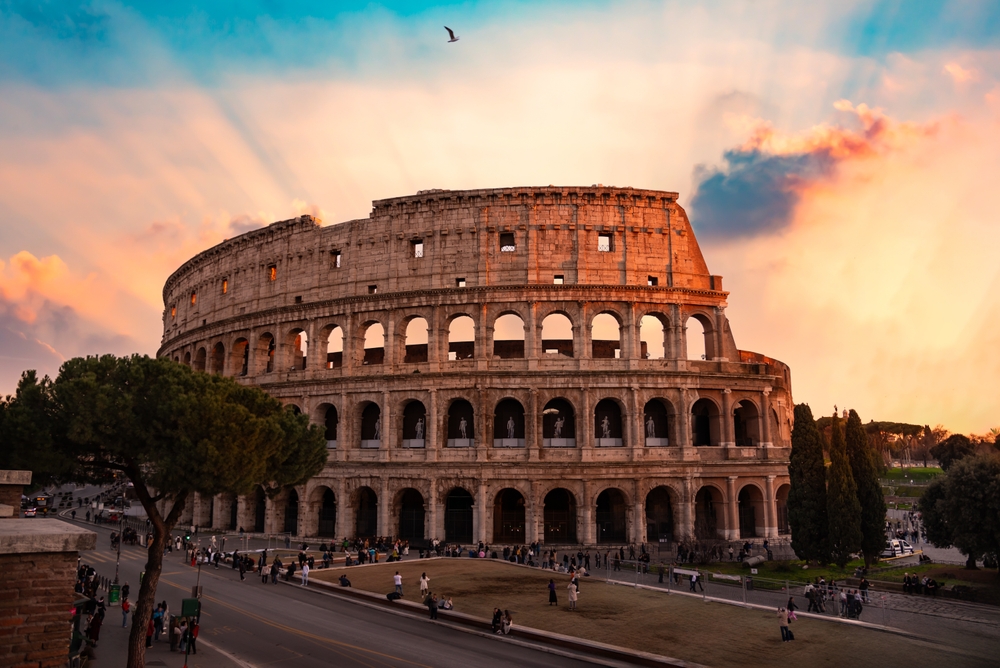
It’s impossible to talk about the wonders of ancient Rome without starting with the Colosseum. This Flavian amphitheatre, the largest ever built by the Romans, stands in the heart of the city with its four storeys and 50,000 spectator seats. Inaugurated in 80 AD under the Emperor Titus, for four centuries it was the scene of gladiatorial combat, wildcat hunts and sometimes even naval battles when the arena was flooded.
Its architecture is a masterpiece of Roman engineering: 80 arcades on each of the first three levels, a system of velarium (protective sails) stretched by sailors from the imperial fleet, and underground galleries (the hypogeum) where men and animals waited before being hoisted into the arena by winch lifts. From the outside, the monumental façade is as impressive as the space inside. The Colosseum is now one of the most visited monuments in the world – remember to book your tickets in advance to avoid the long queues.
Right beside it stands the Arch of Constantine, commissioned by the Senate in 315 to celebrate the emperor’s victory over Maxentius. Together, these two monuments form one of the most impressive panoramas of ancient Rome.
2. The Roman Forum, the political heart of ancient Rome
Just a stone’s throw from the Colosseum lies the Roman Forum, one of the world’s most important archaeological sites. For centuries, this vast public square was the nerve centre of Rome’s political, religious and commercial life. Temples, basilicas, tribunes and triumphal arches follow one another in an apparent disorder that, in reality, tells the story of two thousand years of history.
The Temple of Saturn is one of the oldest in Rome (4th century BC), with eight surviving Doric columns of Egyptian granite. The Basilica of Maxentius, a colossal fourth-century courtroom, impresses with its coffered vaults. The Arch of Septimius Severus, erected in 203, celebrates the emperor’s victory over the Parthians with bas-reliefs of remarkable finesse. To help you understand what you’re seeing, take the Navaway audio tour, which gives a detailed account of the history of this high place of Roman power.
The Forum is included in a combined ticket with the Colosseum and Palatine Hill. Allow at least two hours to get the most out of it, and bring good shoes: the ancient paving stones are magnificent but uneven.
3. The Circus Maximus, the largest circus in the Roman world
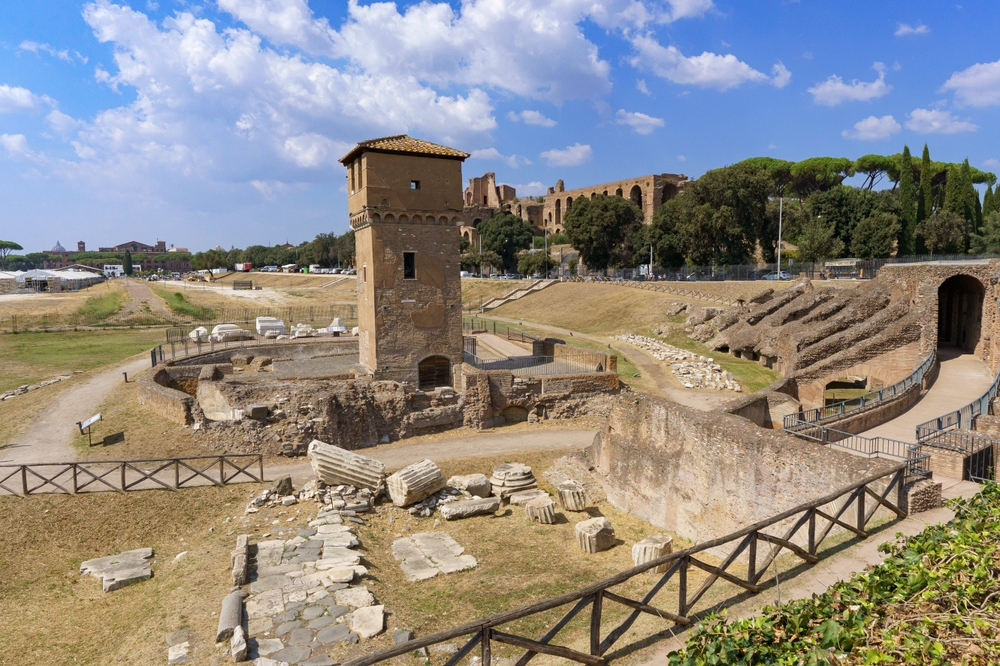
Between Mount Palatine and the Aventine, the Circus Maximus occupies a 620-metre-long valley. It takes a good dose of imagination to recreate its former grandeur: today a simple grassy esplanade, it could accommodate up to 300,000 spectators, the largest human concentration ever assembled in ancient history. It was here that the chariot races(ludi circenses) were held, these frenetic spectacles in which four teams – the Greens, the Blues, the Reds and the Whites – competed in an atmosphere of absolute passion.
According to Roman tradition, construction of the circus dates back to the 7th century BC, and it was enlarged several times until it reached its monumental form under the emperors. At the centre of the ring was the spina, a long platform decorated with Egyptian obelisks and statues of divinities. Two of these obelisks now adorn Piazza del Popolo and the Lateran. Even in its ruins, the Circus Maximus is an essential stop-off on any journey in the footsteps of ancient Rome.
Download the audio tour to discover Rome on foot and on your own
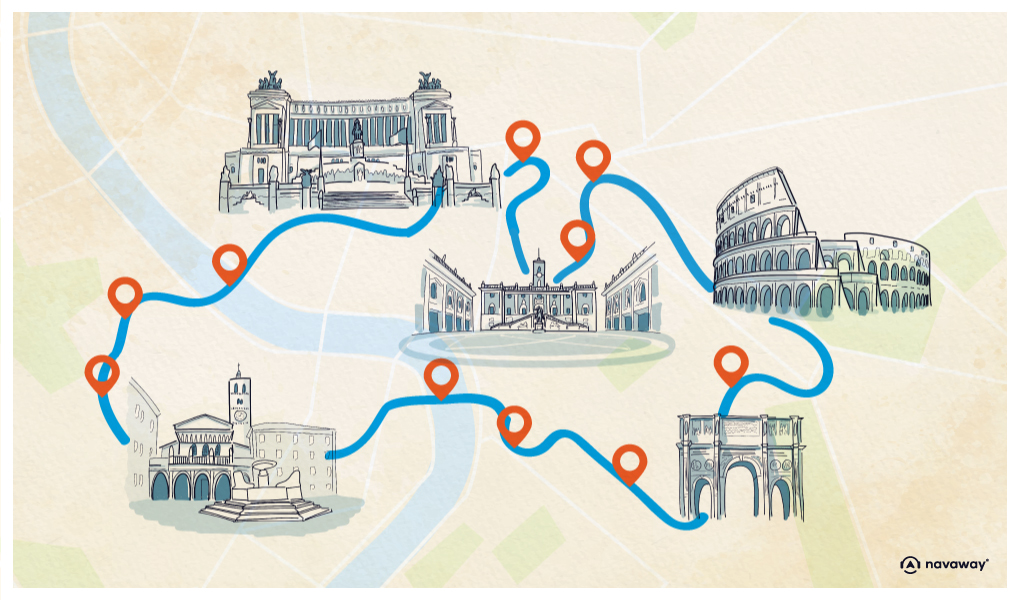
To effortlessly link the Colosseum, the Roman Forum and the Circus Maximus, and make sure you don’t miss any of the secrets of these extraordinary monuments, download the Navaway audio tour of Rome. This 7.3 km walking itinerary guides you through 23 points of interest – from ancient ruins to historic districts – with entertaining and informative audio commentary directly into your headset. There’s no need for a human guide or group tours: you can explore the Eternal City at your own pace, in complete autonomy.
4. The Pantheon, the best-preserved temple in Antiquity
Hidden away in the narrow streets of the historic centre, the Pantheon (Piazza della Rotonda, 00186 Rome) stands out with incomparable force. Built under Hadrian between 118 and 125 AD on the remains of an earlier temple erected by Agrippa, it owes its reputation to a striking paradox: it is both one of Rome’s oldest monuments and one of the best preserved in the world. Its name, from the Greek pan theion (“all the gods”), reflects its original purpose: a temple dedicated to the entire Roman pantheon.
The interior is an architectural vertigo. The Roman concrete dome, 43.3 metres in diameter, was the largest in the world for 1,300 years – before being surpassed by Brunelleschi’s dome in Florence. At the top is a single oculus measuring 8.7 metres in diameter, an opening to the sky that represents the vault of heaven and is the building’s only source of natural light. In fine weather, a ray of sunlight slowly crosses the interior space as the hours go by, creating an unforgettable spectacle. The Pantheon is now a Catholic basilica and houses the tombs of the kings of Italy. Admission is subject to a charge, but remains accessible.
5. The Baths of Caracalla, Rome’s most grandiose public baths
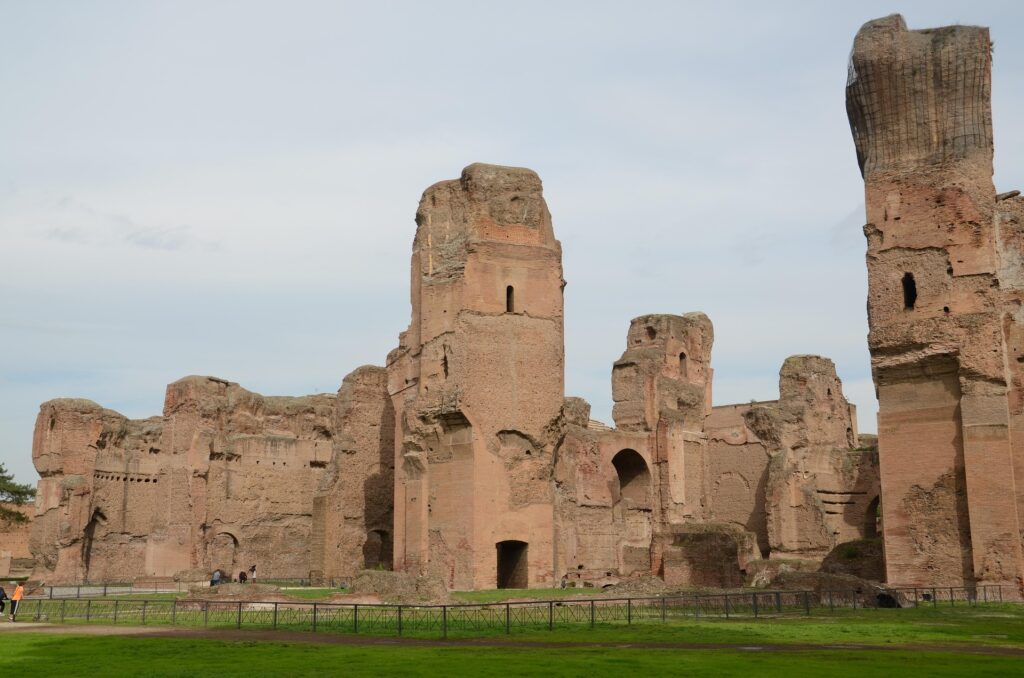
Less well known than the Colosseum or the Pantheon, the Baths of Caracalla (Viale delle Terme di Caracalla 52, 00153 Rome) are nonetheless one of the most impressive wonders of ancient Rome. Built between 212 and 216 under the emperor Caracalla, these monumental public baths could accommodate 1,600 bathers simultaneously in their 130,000 m² rooms. Imagine rooms 30 metres high, covered in mosaics, stucco and coloured marble, complete with libraries, gardens, gymnasiums and shops.
The Romans didn’t just come to the baths to wash: they were a place of social and intellectual life, open to all, free of charge or for a modest sum. A typical Roman bath would take you from the frigidarium (cold water) to the tepidarium (warm water), then to the caldarium (hot water), before moving on to theapodyterium (changing room) or the palestra (exercise room). Today, the ruins of the Baths of Caracalla are sufficiently well preserved for us to appreciate the scale of this complex, and the site hosts open-air opera performances every summer. A spectacular way to pay tribute to this extraordinary monument of ancient Rome.
6. Castel Sant’Angelo, from imperial mausoleum to museum
On the right bank of the Tiber, a stone’s throw from the Vatican, Castel Sant’Angelo (Lungotevere Castello 50, 00193 Rome) is one of the monuments that best illustrates the sedimentation of Roman history. Built between 123 and 139 AD by the Emperor Hadrian as a mausoleum for himself and his family, it was successively transformed into a military fortress, a papal refuge linked to the Vatican by a secret passage – the “Passetto di Borgo” – and a state prison where such illustrious figures as Giordano Bruno were locked up. Today it is a national museum with an exceptional panoramic view of Rome.
The tour takes in several levels: from the medieval rooms to the Renaissance flats decorated with striking frescoes, via the former prisons and the upper terraces. Don’t miss the statue of Archangel Michael at the top, which has given its name to the castle since the 6th century – according to legend, the archangel appeared here during a procession led by Pope Gregory I, announcing the end of a plague epidemic. To reach Castel Sant’Angelo from the Colosseum, take the Navaway audioguide along the Tiber through some of Rome’s most beautiful districts.
7. The Mausoleum of Augustus, the largest circular tomb in Antiquity
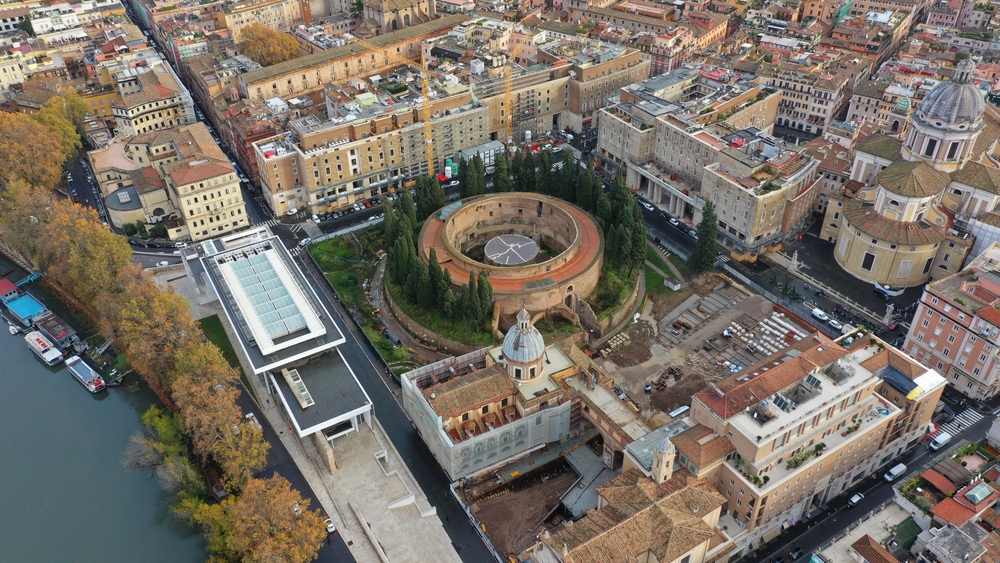
Built in 28 BC on the Campus Martius, shortly after Augustus defeated Mark Antony and Cleopatra, the Mausoleum of Augustus (Piazza Augusto Imperatore, 00186 Rome) is the largest known circular tomb of antiquity. With a diameter of around 87 metres, this monumental funerary monument was intended to house the remains of Rome’s first emperor and his Julio-Claudian successors. Tiberius, Claudius, Livia and many others were buried here, making the mausoleum the dynastic pantheon of the nascent imperial Rome.
The original building was covered by a cypress mound and surmounted by a colossal bronze statue of Augustus. Over the centuries, it was used for a wide variety of purposes: medieval fortress, garden for the Soderini family, bullfighting arena, concert hall, etc. Now restored and open to the public after decades of work, the Mausoleum of Augustus is gradually being restored to its ancient splendour and is one of the most moving discoveries for any fan of ancient Rome. It is ideally visited in combination with the Ara Pacis, just a few metres away.
8. The Ara Pacis, the finest marble poem from Augustan Rome
Just a stone’s throw from the mausoleum, the Ara Pacis Augustae (Lungotevere in Augusta, corner Via Tomacelli, 00186 Rome) is without doubt the most refined sculptural work in all of ancient Roman art. Commissioned by the Senate in 13 BC to celebrate the triumphant return of Augustus after his campaigns in Spain and Gaul, this altar of peace is first and foremost a political message: Augustus, master of the Mediterranean world, had re-established the Pax Romana after decades of civil war.
Its Carrara marble friezes depict a procession of identifiable figures – Augustus himself, his family, priests and senators – with a realism unprecedented in ancient art. The plant reliefs that adorn the lower part of the altar, with their extraordinary botanical luxuriance and precision, have led some art historians to describe the Ara Pacis as a “poem in marble”. The monument is housed in a modern museum designed by the American architect Richard Meier, which allows visitors to admire the altar in natural light, while exploring its historical context through detailed explanatory panels.
To discover the Ara Pacis and the Mausoleum of Augustus in their urban context, the “From Trevi to the Vatican” audio tour guides you through this sector of the Champ de Mars, retracing the history of Augustan Rome with its 24 audio commentaries.
9. The Forum and Markets of Trajan, the last great imperial forum
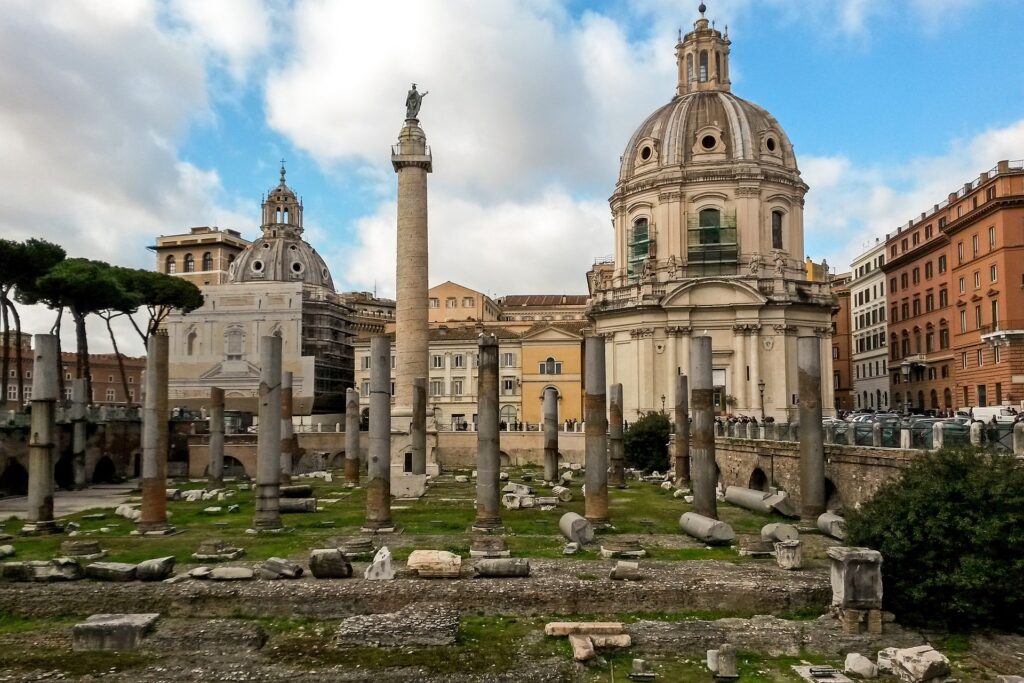
Let’s conclude this tour of the wonders of ancient Rome with the Forum and Markets of Trajan, the most ambitious of the Roman imperial forums. Built between 107 and 113 AD to commemorate the conquest of Dacia (modern-day Romania), this monumental complex was 300 metres long and 185 metres wide. To create it, the architect Apollodorus of Damascus had to move some 61 million cubic metres of rock by razing the natural spur that linked the Quirinal to the Capitoline – an engineering feat hailed by all contemporaries.
At the heart of the forum stands the famous Trajan column, 38 metres high and entirely sculpted with a spiral frieze that unfolds scenes from the two Dacian wars over a distance of 200 metres. This masterpiece of imperial propaganda, still standing after twenty centuries, was the model for all the triumphal columns in history, including the Vendôme column in Paris. Trajan’s markets, which adjoined the forum, were the first “commercial centre” in history: six levels of shops and warehouses organised around a large central hall. Now transformed into a museum of the imperial forums, they offer a total immersion in the economic life of ancient Rome.
From the panoramic footbridge of the Navaway tour, the unobstructed view of the entire Forum of Trajan and the Via dei Fori Imperiali is one of the highlights of the audio tour of Rome. It’s an image that will live long in the memory of every traveller who loves ancient Rome.
In conclusion, ancient Rome offers a rich and dense heritage that is unique in the world. Whether you’re a history buff or just curious, each of these 9 wonders – from the Colosseum and the Trajan column to the mysterious Pantheon and the sumptuous Baths of Caracalla – will give you a special thrill and a direct connection with the grandeur of the Roman Empire. To enjoy this experience to the full, without getting lost in the crowd of tourists and without missing out on any of the Eternal City’s hidden treasures, rely on the Navaway audio tour of Rome: 23 audio commentaries, interactive navigation and total freedom to explore ancient Rome at your own pace, on foot and completely on your own.
FAQ – Wonders of Ancient Rome
Which monuments in Ancient Rome are a must-see?
The must-see monuments of ancient Rome are the Colosseum, the Roman Forum, the Circus Maximus, the Pantheon, the Baths of Caracalla, the Castel Sant’Angelo, the Mausoleum of Augustus, the Ara Pacis and the Forum of Trajan. These nine sites cover most of the history of Ancient Rome, from the Republic to Late Antiquity.
How many days does it take to visit Rome’s ancient sites?
Allow at least two full days to see Rome’s main ancient monuments in good conditions. The first day can be devoted to the Colosseum, the Roman Forum and Mount Palatine (combined ticket available), followed by the Circus Maximus. The second day will take in the Pantheon, Castel Sant’Angelo and the area around the Campus Martius, with the Mausoleum of Augustus and the Ara Pacis. The Forum of Trajan can be easily integrated into either of these two days.
Are Rome’s ancient monuments open to the public?
Some monuments in ancient Rome are free or accessible from the outside without a ticket: the Circus Maximus, the Arch of Constantine, the Forum Boarium and the Trajan column, visible from the street. On the other hand, the Colosseum, the Roman Forum, Mount Palatine, the Baths of Caracalla, Castel Sant’Angelo and the Ara Pacis are subject to an entrance fee. Book your tickets online in advance, especially in high season, to avoid long queues.
How can you visit ancient Rome independently and without a guide?
The best way to visit Ancient Rome on your own is to download the Navaway audio tour. The application guides you step by step between the monuments, with contextualised audio commentary on each site. So you can enjoy a visit that’s just as rich as one with a human guide, but at your own pace, with no time or group constraints.
200 audioguided tours for cities all around the world
Download