Visit the Centre Pompidou
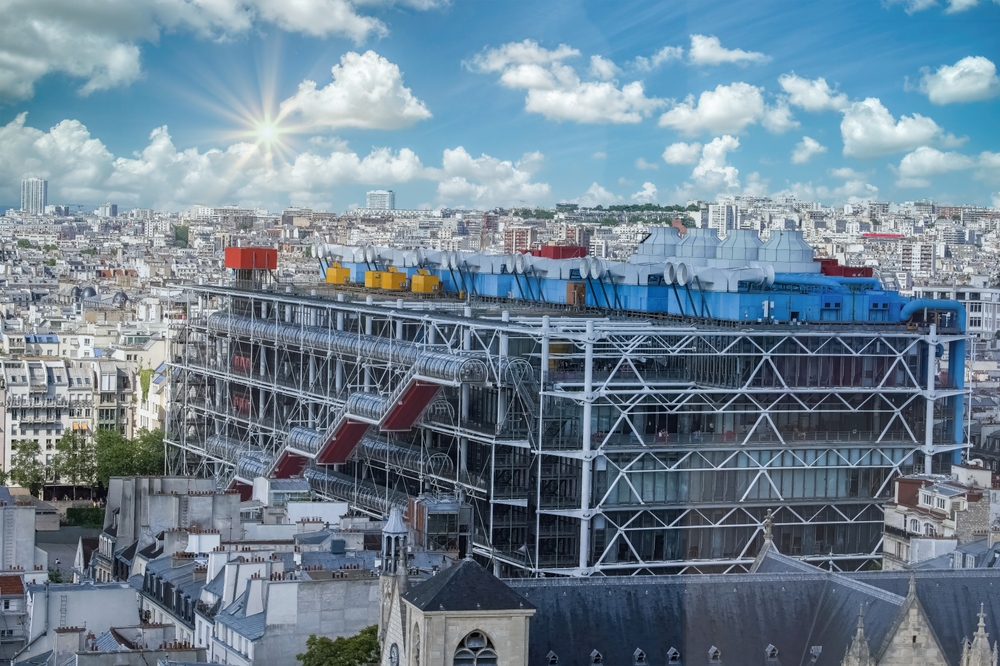

A visit to the Centre Pompidou (Place Georges-Pompidou, 75004 Paris, rated 4.6/5 on Google for over 108,000 reviews) is a unique opportunity to immerse yourself in one of the world’s most ambitious and unique museums. As soon as you spot it from the backstreets of the Beaubourg district, the aesthetic shock is immediate: a façade bristling with coloured pipes, transparent escalators that climb diagonally, architecture that nothing prepares you for in the heart of old Paris. Inaugurated on 31 January 1977, this cultural colossus designed by architects Renzo Piano and Richard Rogers has revolutionised the very idea of what a museum can be.
Over the decades, the Centre Pompidou, also known as Beaubourg, has become much more than an exhibition space: it is a place for life, research, debate and creation, visited by millions of curious visitors from all over the world. Its permanent collection comprises over 140,000 works, making it Europe’s leading museum of modern and contemporary art. From the paintings of Picasso to the installations of Louise Bourgeois, from the sculptures of Brancusi to the photographs of Man Ray, every visit to the Centre Pompidou is an adventure in the century.
Please note: as of 22 September 2025, the Centre Pompidou closed its doors for a major renovation that will last until 2030. But don’t let that stop you from planning your next visit, exploring the Beaubourg district on a trip to Paris, or discovering the outdoor events organised as part of the Constellation programme. In this article, we take you through everything you need to know about Beaubourg and what to expect when it reopens.
See also the Paris guide :
- Must-see museums in Paris
- Visiting the Louvre: works, opening times and practical advice
- Discover the Musée d’Orsay in Paris
- Paris’s culinary specialities – a must-taste!
- The best romantic activities for couples in Paris
- Cruise on the Seine in Paris: guide and advice
- Visit the catacombs of Paris: everything you need to know
- Visit the Père-Lachaise cemetery in Paris
- Paris’s iconic bridges to cross on foot
- Visit the Musée de l’Armée in Paris
1. The history of the Centre Pompidou: from mad idea to global icon
The history of the Centre Pompidou began with a rare political will: to provide Paris with a radically new cultural facility, capable of democratising access to modern art. It was Georges Pompidou, President of the Republic from 1969 to 1974 and a great lover of contemporary art, who took the initiative for this project in 1969. He wanted to create a multi-disciplinary venue, combining museum, library, music research centre and temporary exhibition spaces. It was an ambition that had no equal anywhere in the world.
In 1971, an international architectural competition was launched. It attracted 681 entries from 49 different countries, a record for the time. Of all the entries, the duo of Italy’s Renzo Piano and Britain’s Richard Rogers won with a project that was as provocative as it was innovative. Their idea? To literally turn the building inside out: all the technical structures – escalators, water pipes, electrical ducts, ventilation ducts – would be visible from the outside, freeing up the interior for vast, flexible, open spaces. An architectural revolution that many will immediately describe as provocative.
Construction began in 1972 in the Beaubourg district, which was undergoing major renovation at the time. It took five years to complete. On 31 January 1977, the Centre national d’art et de culture Georges-Pompidou was inaugurated by President Valéry Giscard d’Estaing – Georges Pompidou, who died in 1974, never saw his dream come true. As soon as it opened, visitor numbers exceeded all expectations: the building received twice as many visitors as expected in its first year. In just a few months, Beaubourg became one of the busiest cultural addresses in France, ahead of the Louvre and the Eiffel Tower. Visiting Paris without visiting Beaubourg quickly became unthinkable.
Following a major renovation between 1997 and 2000, which modernised the facilities and improved the way the public were welcomed, the Centre Pompidou continues to reinvent itself. In 2010, a branch opened in Metz (the Centre Pompidou-Metz), followed by another in Malaga in 2015. The Pompidou brand is now being exported all over the world, proof that the crazy idea of 1969 has succeeded beyond all expectations.
2. The architecture of the Centre Pompidou: a building that defies all codes
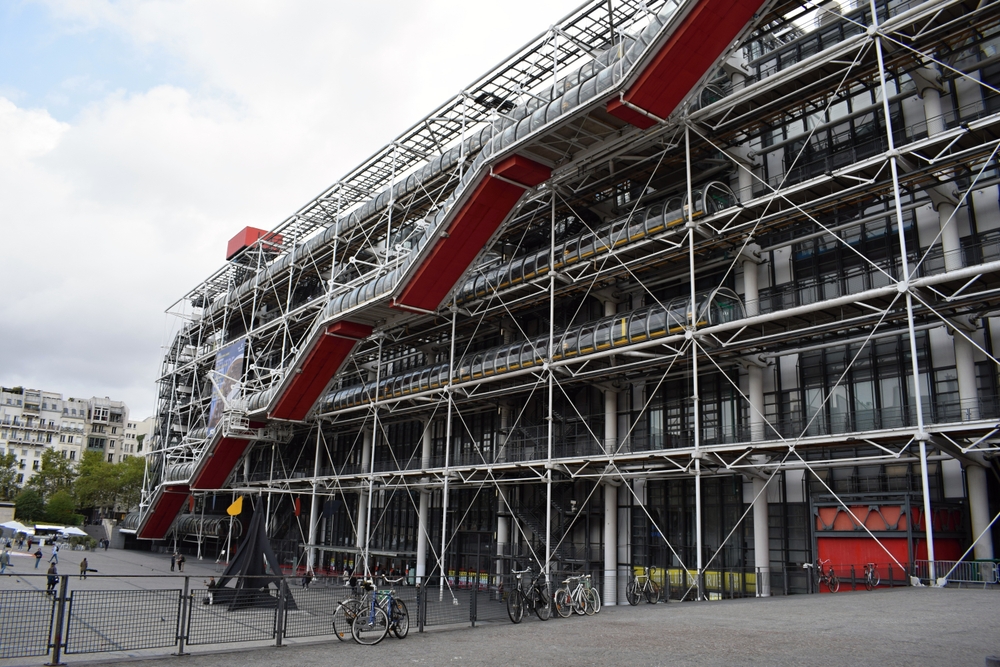
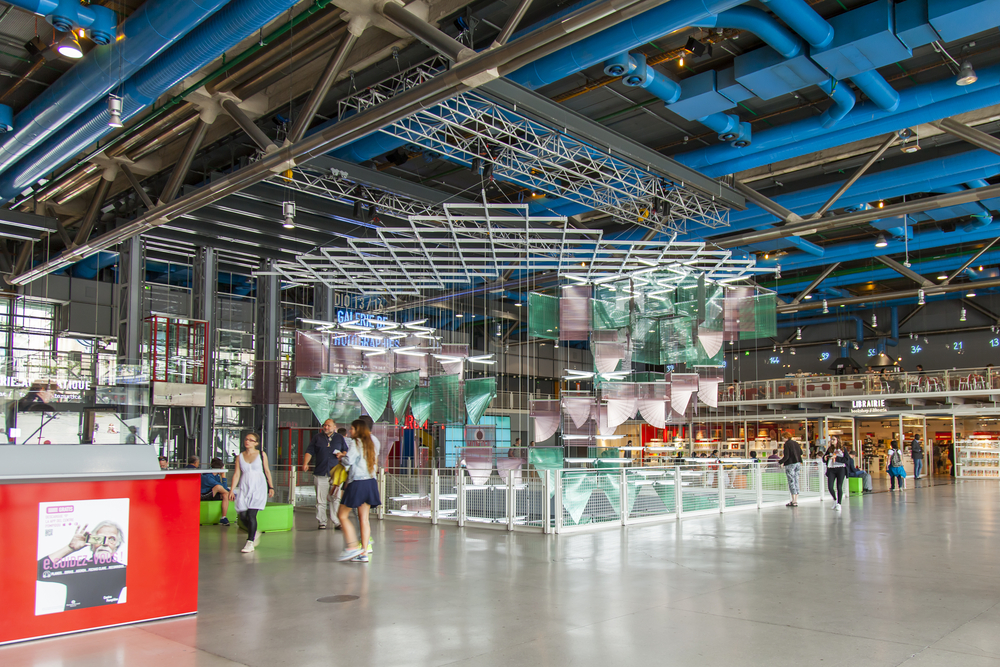
The architecture of the Centre Pompidou is undoubtedly one of the most unusual you will come across on a visit to Paris. Renzo Piano and Richard Rogers designed a “high-tech” or “bowellist” building, in which the entire technical structure is exposed for all to see, on the exterior façade. This radical approach frees the interior floors from any structural constraints, offering fully modular spaces over a surface area of 100,000 m².
The coloured façade follows a precise and carefully thought-out visual language. Blue designates the air-conditioning ducts. Green identifies the water pipes. Yellow identifies the electrical networks. Bright red marks the escalators and passageways. This colour code transforms the building into a giant computer graphics system, legible from afar, where function dictates aesthetics. An architectural manifesto that has greatly influenced the high-tech movement in architecture.
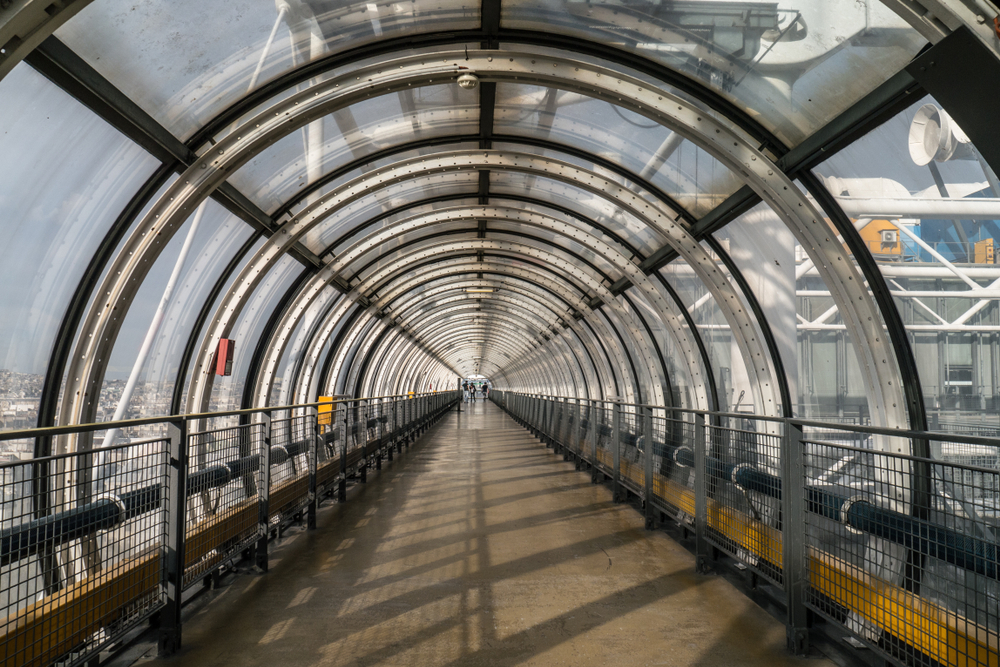
From Place Georges-Pompidou, you can’t miss the west facade of the building, entirely clad in the famous “Chenille” – the panoramic transparent tube escalator that winds its way up the entire height of the building. The escalator offers a gradual ascent, with increasingly spectacular views over the rooftops of Paris. Level by level, the city is revealed: first the roofs of Beaubourg, then the Sacré-Coeur dome, the Eiffel Tower in the distance, Notre-Dame Cathedral… A breathtaking panorama even before you’ve seen the first work of art.
On the piazza side, the building is preceded by a vast, gently sloping esplanade that extends as far as the Stravinsky fountain (Place Igor-Stravinsky, 75004 Paris, rated 4.6/5 on Google for around 16,000 reviews). This lively piazza has always been a popular place to live: buskers, jugglers, calligraphers and portrait artists meet here every day, recreating the fairground atmosphere that the architects had imagined for the place. It is one of the liveliest places in the capital, and is always busy, even outside museum opening hours.
3. What should you see when you visit the Centre Pompidou?
The Centre Pompidou is a world in itself. Its six levels are divided into spaces with very different vocations, each worthy of attention. Here are the must-sees on your visit.
3.1 The Musée national d’art moderne
The Musée national d’art moderne is the beating heart of the Centre Pompidou and one of the world’s leading museums of twentieth- and twenty-first-century art. It occupies levels 4 and 5 of the building and houses a permanent collection of over 140,000 works, around 20,000 of which are regularly presented to the public in a new display. It is the leading collection of modern and contemporary art in Europe, and the second largest in the world, behind the MoMA in New York.
Level 5 is devoted to modern art, covering the period from 1905 to 1960. Here we discover the major movements that shaped the 20th century: Fauvism with Matisse and Derain, Cubism with Picasso and Braque, Dadaism, Surrealism with Dalí and Magritte, lyrical abstraction with Kandinsky and Klee, Informal Art and Constructivism. The works in the exhibition are arranged chronologically and thematically, providing a living history of modern artistic creation, its ruptures, its avant-gardes and its utopias.
Level 4 is devoted to contemporary art, from 1960 to the present day. This is where we meet the leading figures on the international scene: Andy Warhol, Joseph Beuys, Yves Klein, Louise Bourgeois, Christian Boltanski, Sophie Calle… The diversity of media is impressive: paintings, sculptures, video installations, documented performances, photographs, sound works… The display changes regularly to highlight different facets of the collection, so that every visit to the Centre Pompidou can reveal new surprises, even for regular visitors.
3.2 Temporary exhibitions
Since its opening, the Centre Pompidou has hosted some of the most significant exhibitions in the history of contemporary art. Monumental retrospectives, thematic panoramas, discoveries of young talent: Beaubourg’s temporary programme has always been one of the most ambitious and eclectic in Europe. Exhibitions devoted to Picasso, Kandinsky, Magritte, Warhol, Matisse, Basquiat and Cindy Sherman have attracted hundreds of thousands of visitors.
These exhibitions, mainly on level 6 (Galerie 1 and Galerie 2), are the driving force behind the museum’s cultural activities. They are accompanied by late-night events on Thursday evenings, extending the closing time until 11pm so that workers and revellers can spend the evening surrounded by art. When the museum reopens in 2030, this ambitious programme will be revived in a completely renovated space.
3.3 The Atelier Brancusi
At the northern corner of the piazza, at the foot of the Centre Pompidou, is one of the most moving and little-known museums in Paris: the Atelier Brancusi (Place Georges-Pompidou, 75004 Paris, rated 4.5/5 on Google for over 1,400 reviews). This unique space faithfully recreates the Paris studio of Romanian sculptor Constantin Brancusi (1876-1957), which the artist bequeathed to the French state on his death.
Brancusi, a precursor of abstract and modern sculpture, worked all his life in various studios in Impasse Ronsin, in the 15th arrondissement of Paris. When he died in 1957, he bequeathed his entire studio to the French state, on condition that it be restored to its original state. This was achieved in 1997, when the architect Renzo Piano – the same man who designed the Centre Pompidou – designed a 600 m² building specially dedicated to this reconstruction, set up in the piazza. The building houses 137 sculptures, 87 pedestals, 41 drawings, two cameras and all the tools used in the studio. The atmosphere is particularly striking: you have the impression of entering the creative space of a living artist.
Access to the Atelier Brancusi is free and independent of the rest of the Centre Pompidou. It’s one of Beaubourg’s best-kept secrets, and not to be missed on any account during your visit.
3.4 The panoramic terrace and the “La Chenille” escalator
One of the highlights of a visit to the Centre Pompidou is undoubtedly the climb up to the panoramic terrace on the 6th level. To get there, you take the outdoor transparent tube escalator, affectionately nicknamed “La Chenille” for the way it winds along the façade. The climb is a spectacle in itself: at each level, Paris is revealed a little more, the rooftops multiply and the monuments loom larger on the horizon.
Once you reach the top, the reward is as good as the journey: a 360° view over the rooftops of Paris that ranks among the capital’s finest panoramas. On a clear day, you can see the Eiffel Tower, the dome of the Sacré-Coeur, the spires of Notre-Dame de Paris, La Défense in the distance and a host of other monuments, all of which you will recognise with renewed pleasure. For visitors wishing to extend this moment, Restaurant Georges (Place Georges-Pompidou, 6th floor, 75004 Paris) occupies the entire top level of the building, offering a culinary experience with a breathtaking view of the city. Access to the terrace is included in the standard museum admission ticket.
3.5 The Public Information Library (BPI)
The Bibliothèque publique d’information ( 75004 Paris) is one of the largest public reading libraries in Europe, although it is less well known to tourists. Located on levels 2 and 3 of the Centre Pompidou, it offers more than 320,000 freely-accessible documents – books, periodicals, digital resources, documentary films, language methods – over an area of 8,900 m² with 1,500 seats and 220 computer workstations.
The BPI was a pioneer in France in the concept of a completely open-access library, with no registration or membership card required: anyone can come in, sit down and consult the collections, as long as they don’t take anything out of the building. Every year, it welcomes several hundred thousand visitors, students, researchers, tourists and curious people of all kinds. It is also a lively place, with exhibitions, literary events and regular film screenings. The queues to get into the BPI at peak times have themselves become a sign of its popularity.
3.6 IRCAM, the sound laboratory
Few visitors to the Centre Pompidou will be aware that the Beaubourg complex includes IRCAM (1 Place Igor-Stravinsky, 75004 Paris, rated 4.3/5 on Google), the Institut de Recherche et Coordination Acoustique/Musique. Founded in 1969 and inaugurated at the same time as Beaubourg, IRCAM is a unique centre for musical research and creation, working at the intersection of contemporary music, cognitive science and new technologies.
Its laboratories are largely underground, hidden beneath the Place Igor-Stravinsky. Every year, IRCAM organises the ManiFeste festival, a key event on the contemporary music scene. Guided tours of its facilities are regularly offered to the public, giving an insight into its recording studios, its modular hall with exceptional acoustic properties and its research laboratories. For fans of contemporary music and sound innovation, a visit to IRCAM is an experience in itself during a visit to Beaubourg.
3.7 The Stravinsky fountain and the piazza
Before you even enter the building, your visit to the Centre Pompidou actually begins in the piazza and around the Stravinsky fountain (Place Igor-Stravinsky, 75004 Paris, rated 4.6/5 on Google for over 16,000 reviews). This monumental work of public art, inaugurated in 1983, is the joint work of artists Niki de Saint Phalle and Jean Tinguely. Sixteen colourful mechanical sculptures swirl and spurt in an elongated pool, each representing a musical work by Igor Stravinsky: The Firebird, The Rite of Spring, The Nightingale, Petrouchka… The contrast between Niki de Saint Phalle’s round, colourful sculptures and Tinguely’s dark metal constructions creates a surprising, joyful harmony that perfectly illustrates the spirit of the place.
The piazza in front of the building is also a space in its own right. Slightly inclined towards the building, it has been designed to attract the eye and invite curiosity. Street artists, musicians and calligraphers regularly set up their improvised stages here, transforming the space into a permanent theatre of urban creativity. Many Parisians come here simply to sit, chat, read or watch the city go by. It’s a great way to enjoy the Centre Pompidou without untying your purse.
4. The anecdotes and secrets from the Centre Pompidou that no one tells you
Behind the institution and its official history lie some delightful anecdotes that make a visit to the Centre Pompidou that much richer. Here are some of Beaubourg’s best-kept secrets.
The first surprise is the origin of the name. Prior to its inauguration, the building was officially called the “Centre Beaubourg”, in reference to the district in which it is located. It was only after the death of Georges Pompidou in 1974, as a tribute to the president who had initiated the project, that the building took on its definitive name of “Centre national d’art et de culture Georges-Pompidou”. Parisians will forever refer to it simply as “Beaubourg”.
The second anecdote concerns the 1971 architecture competition. Of the 681 entries received, several were for very classical buildings that blended in well with the Parisian fabric. The selection of the Piano-Rogers project, perceived as a real provocation by a large part of the press and the cultural world of the time, was a courageous decision. Some critics compared the future building to an oil refinery in the middle of Paris, a liner stranded among the Haussmann buildings. Decades later, these same critics were often the first to recognise the genius of the project.
Another little-known detail concerns the depth of the building in the Parisian subsoil. To anchor such a structure in a Parisian soil riddled with underground galleries, the foundations had to descend to exceptional depths. The foundations of the Centre Pompidou plunge more than 10 metres below street level, crossing ancient medieval galleries and archaeological remains that required numerous site adjustments.
Finally, there is the colour code on the façade, which many visitors admire without understanding its logic. This code is not a purely aesthetic choice, but a genuine functional signage system, designed to make the nature of each network clear from the outside. Blue for air conditioning, green for water, yellow for electricity, red for traffic: the building is, in a way, an open-air lesson in architecture. This approach had a profound influence on the industrial and technological architecture of the following decades, making the Centre Pompidou a major milestone in the history of architecture worldwide.
If you’re interested in the history and secrets of Paris, the Navaway audioguided tours will reveal the anecdotes and mysteries of the City of Light as you walk along. An ideal way to round off your visit to the Centre Pompidou with a cultural stroll through the neighbouring districts.
5. Renovating the Centre Pompidou between 2025 and 2030: closure and the Constellation programme
On 22 September 2025, after 48 years of uninterrupted service and more than 200 million visitors, the Centre Pompidou closed its doors for a complete renovation that will last around five years. The project, decided in consultation with the Ministry of Culture, is one of the most ambitious ever undertaken on a cultural building in France. The aim is to bring the building up to current technical and environmental standards, modernise all the museographic installations, improve accessibility and rethink the public reception areas.
Closure was a gradual process: the basement performance spaces closed first, in March 2025, followed by the exhibition galleries and the bookshop over the summer, before the building was completely closed to the public at the end of September 2025. The 120,000 works in the collection have been transported to and deposited with partner institutions in France and abroad, ensuring continuity of loans and exhibitions despite the closure of the building.
But the closure of the Centre Pompidou does not mean the end of all cultural activity around Beaubourg. The Constellation programme, set up for the duration of the works, offers a series of events, urban tours, performances and exhibitions in the public space of the district and in partner venues in the Île-de-France region. The Maison Pompidou, housed in the former Atelier Brancusi building (600 m², designed by Renzo Piano), has become the museum’s visible point of contact during the works, hosting temporary exhibitions, meetings, screenings and educational activities.
The Centre Pompidou is due to reopen in 2030, offering visitors a completely renovated building that is more accessible, more energy-efficient and better adapted to the demands of the 21st century. The good news for anyone wishing to visit the Centre Pompidou in the next few years is that the work will ensure that Beaubourg will still be there, more beautiful and more welcoming than ever, for the next 50 years.
While you wait for the museum to reopen, make the most of your stay in Paris to explore the capital’s many other treasures. The Musée d’Orsay, the Louvre and the Père-Lachaise necropolis are just a few metro stops away.
6. Practical information to prepare your visit to the Centre Pompidou
Although the Centre Pompidou is currently closed for renovation, here is all the practical information that will apply to your visit when it reopens in 2030. This information may also be useful for planning your visit now and preparing for that time.
6.1 Prices for visiting the Centre Pompidou
Admission to the Centre Pompidou is not free, but there are a number of formulas for varying the cost depending on the visitor’s profile. Before it closed in 2025, a standard adult ticket giving access to the museum, temporary exhibitions and the panoramic terrace cost €15. A reduced rate of €12 applied to 18-25 year olds from outside the European Union, to jobseekers and in certain other cases. Admission was completely free for under-18s and EU citizens under 26. A family ticket (2 adults + 2 children) was available for €45.
Access to theAtelier Brancusi was entirely free, with no ticket required. Access to the Public Information Library was also free, with no registration or entrance fees required. These two areas will probably remain free after the reopening. Themed guided tours were available at an additional cost of €5. If you’re planning to visit several Paris museums during your stay, don’t forget to ask about the Paris Museum Pass, which includes the Centre Pompidou and offers unlimited access to over 50 museums and monuments in the Paris region.
6.2 Opening hours
Prior to its closure, the Centre Pompidou was open every day of the week except Tuesday and 1 May. Opening hours for the museum and exhibition galleries were 11am to 9pm (last admission at 8pm). On Thursdays, the temporary exhibition galleries were open by night until 11pm, a very popular option for visiting in a more intimate and peaceful atmosphere. The Atelier Brancusi had its own opening hours, generally from 2pm to 6pm on weekdays. It is advisable to check the current opening times directly on the Centre Pompidou’s official website, especially as the reopening in 2030 approaches.
6.3 How to get to the Centre Pompidou
The Centre Pompidou is ideally located in the heart of Paris, at the junction of the Beaubourg, Marais and Les Halles districts, making it easily accessible from all over the capital. By metro, the nearest stations are Rambuteau (line 11) and Hôtel de Ville (lines 1 and 11), both less than 5 minutes’ walk away. Châtelet station (lines 1, 4, 7, 11 and 14) and Châtelet – Les Halles station (RER A, B, D) are also around 10 minutes’ walk away.
Several bus routes serve the district directly: routes 29, 38, 47 and 75 stop at “Rambuteau – Centre Georges Pompidou”. Vélib’ stations are available just a few metres from the building, on the rue Rambuteau and rue Beaubourg sides. Coming from the Louvre area, the walk along the lively streets of Beaubourg takes around 20 minutes, making for a lovely urban stroll. From Notre-Dame de Paris, allow around 20 to 25 minutes’ walk. We strongly advise against using the car: the streets in the area are narrow and the nearby car parks (Rambuteau car park, Beaubourg car park) are often overcrowded and expensive.
6.4 Practical tips for visiting the Centre Pompidou
Here are a few tips to help you make the most of your visit to the Centre Pompidou. We strongly advise you to book your tickets online in advance, especially during the high season (July-August, school holidays) or during exhibitions that attract a lot of media attention: queues can be long, and booking online gives you priority entry. Don’t forget to check out the Thursday evenings: they offer a quieter, more pleasant atmosphere in which to enjoy the collections without the weekend crowds.
Allow extra time for security checks at the entrance, which can extend the wait by 15 to 20 minutes during busy periods. It is best not to bring large items of luggage or suitcases: the left-luggage office is small and cannot accommodate bulky items. Allow at least 2 hours for a proper visit to the permanent collections, and half a full day if you also want to enjoy the temporary exhibitions, the terrace, the Atelier Brancusi and a coffee or lunch on site. A visit to the Centre Pompidou can easily be integrated into a wider programme of discovering the Marais district, which you can then explore at your own pace.
7. What to do around the Centre Pompidou: the Beaubourg and Marais districts

A visit to the Centre Pompidou is not just about the building itself. The surrounding district is one of the capital’s richest and liveliest, combining medieval history, contemporary effervescence, gastronomy and culture. The nearby Marais is one of the most charming districts in Paris, with its Renaissance mansions, art galleries, designer boutiques and lively nightlife. A stroll through the narrow streets of Beaubourg and the Marais is the ideal natural complement to a visit to the Centre Pompidou.
Just a stone’s throw from the piazza Beaubourg, don’t miss the Stravinsky fountain and the aforementioned Place Igor-Stravinsky. Right next door ,IRCAM offers concerts and tours throughout the year.
Heading north, you’ll soon reach the Centre Wallonie-Bruxelles and the Horloge district, with its famous automaton (Rue Bernard de Clairvaux, 75003 Paris), a monumental mechanised work from the 1970s that few visitors are familiar with. Heading down towards the Seine, you’ll reach the historic heart of the Marais, the Place des Vosges – the oldest royal square in Paris, built under Henri IV in the early 17th century – and the many museums dotted around the district: Musée Carnavalet, Musée Picasso Paris, Musée de la Chasse et de la Nature.
The Marais is also the gastronomic district par excellence for lunch or a gourmet break after your visit to the Centre Pompidou. Rue des Rosiers, the historic heart of Paris’s Jewish quarter, offers excellent falafels and pastrami that are a gourmet’s delight. Further afield, the trendy restaurants on rue de Bretagne and in the Saint-Paul district will delight every palate. The [culinary specialities of Paris](https://navaway.fr/specialites-culinaires-paris/) are best tasted in these little neighbourhood addresses that are so much part of the capital’s charm.
If you want to continue your cultural exploration of Paris beyond the Centre Pompidou, the capital is full of equally fascinating museums and monuments. A 20-minute walk to the west, the Musée du Louvre and its 35,000-odd works on display provide one of the world’s most epic museum experiences. Head south, across the Île de la Cité and its medieval remains, to the Musée d’Orsay and its Impressionist paintings. For the more unusual, explore the mysterious catacombs of Paris or stroll among the cenotaphs in the Père-Lachaise cemetery.
To make sure you don’t miss out on all that Paris has to offer during your stay, consider using the Navaway audio tour to visit Paris. As you explore the city at your own pace, you’ll discover not only the iconic monuments, but also the anecdotes and hidden stories that make a visit to the City of Light so special.
Download the audio tour to discover Paris on foot and on your own
Would you like to make the most of your stay in Paris and explore the areas around the Centre Pompidou – Beaubourg, the Marais, Les Halles – without getting lost and missing out on hidden gems? The Navaway audioguide tour of Paris takes you on a themed, commented and interactive journey through the capital’s most beautiful sites and stories. 18 fun audio guides covering the most emblematic monuments and little-known anecdotes, intuitive smartphone navigation, no internet required: just download the application and let yourself be guided. The best way to visit Paris in complete freedom and autonomy.
In conclusion, visiting the Centre Pompidou is much more than spending a few hours in a museum. It’s an encounter with one of the most daring architectural and cultural adventures of the 20th century, a plunge into the artistic currents that have redefined the way we see the world, and an immersion in one of Paris’s most vibrant districts. While the building is currently closed for a necessary and ambitious renovation until 2030, the spirit of Beaubourg continues to radiate throughout the district, through the Maison Pompidou, the Constellation programme, the Stravinsky fountain, IRCAM and the vibrant life of the Marais. And for anyone visiting Paris while they wait for the grand re-opening, the Navaway audioguided itineraries are the best way to explore the City of Light on foot, freely, with curiosity and pleasure.
FAQ – Frequently asked questions about visiting the Centre Pompidou
Will the Centre Pompidou be open in 2025 and 2026?
No. The Centre Pompidou closed its doors to the public on 22 September 2025 for a major renovation that will last around five years. The reopening is scheduled for around 2030. During the works, the Constellation programme will offer cultural activities in the public space of the Beaubourg district and in partner venues in the Île-de-France region. The Maison Pompidou, housed in the Atelier Brancusi building, will remain open with a programme of exhibitions and events.
How much does admission to the Centre Pompidou cost?
Prior to its closure in 2025, a standard adult ticket giving access to the museum, temporary exhibitions and the panoramic terrace cost €15. The reduced rate (18-25 year olds from outside the EU, jobseekers, etc.) was €12. Admission was free for under-18s and EU nationals under 26. A family ticket (2 adults + 2 children) was available for €45. Access to the Atelier Brancusi and the Bibliothèque publique d’information was free of charge and no booking was required. These prices may change when the museum reopens in 2030.
How long does it take to visit the Centre Pompidou?
For a proper visit to the permanent collections, allow at least two hours. If you want to include the temporary exhibitions, the panoramic terrace, the Atelier Brancusi and a lunch or coffee break on site, allow a full half-day, or around 4 to 5 hours. If you’re a contemporary art enthusiast and want to really immerse yourself in all the spaces, a full day is not too much.
Will the Atelier Brancusi be accessible when the Centre Pompidou reopens?
The Atelier Brancusi has a special history during the renovation period: the building that housed it was transformed into the Maison Pompidou to host temporary exhibitions and events during the works. When the Centre Pompidou reopens in 2030, the Atelier Brancusi should return to its original purpose. Access to the Atelier was free of charge before it was closed, and this should continue to be the case when it reopens.
What public transport links are there to the Centre Pompidou?
The Centre Pompidou is very well served by public transport in Paris. The nearest metro stations are Rambuteau (line 11) and Hôtel de Ville (lines 1 and 11), a 5-minute walk away. Châtelet station (lines 1, 4, 7, 11, 14) and Châtelet – Les Halles station (RER lines A, B, D) are about 10 minutes’ walk away. Bus routes 29, 38, 47 and 75 stop directly at “Rambuteau – Centre Georges Pompidou”. Vélib’ stations are available just a few dozen metres from the building.
What can you do around the Centre Pompidou after your visit?
The Beaubourg district and its surroundings offer plenty of opportunities to extend your cultural day. The Marais district is just a few minutes’ walk away, with its town houses, Place des Vosges, museums (Carnavalet, Picasso Paris) and art galleries. The Louvre Museum is a 20-minute walk to the west. The Stravinsky fountain and IRCAM can be reached directly from piazza Beaubourg. Finally, if you want to discover Paris in its entirety on your own and with commentary, the Navaway audio tour is the ideal companion to extend your exploration of the city.
Is the Centre Pompidou suitable for children?
Yes, from the outset the Centre Pompidou has offered a wide range of activities dedicated to young visitors: creative workshops, guided tours adapted for children, themed tours, games and discovery booklets. The Galerie des enfants, a space specially designed for 6-12 year olds, presents contemporary creations in a fun educational context. Admission is free for under-18s. The Stravinsky fountain, with its colourful sculptures and water jets, is a popular spot for families. When it reopens, these features should be further enhanced as part of the renovation.
Can I take photos inside the Centre Pompidou?
Photography is generally permitted in the permanent collection areas of the Centre Pompidou, provided that no flash is used and that no photographs are taken of works for which a specific prohibition is indicated (generally for copyright reasons). For temporary exhibitions, the rules vary according to the rights negotiated with the artists and lenders. The outdoor areas, the piazza and the ‘La Chenille’ escalator are of course free for personal photography.
200 audioguided tours for cities all around the world
Download