Visit the Grotte Chauvet in the Ardèche

Nestling in the heart of the Ardèche, near Vallon-Pont-d’Arc, the Grotte Chauvet is one of mankind’s most extraordinary treasures. Discovered in 1994, this ornate cave reveals cave paintings dating back 36,000 years, a fascinating testimony to the artistic genius of our ancestors. Listed as a UNESCO World Heritage Site since 2014, the original cave remains closed to the public to preserve its fragile treasures. That’s why you can visit Grotte Chauvet 2 – Ardèche, an exceptional replica that recreates the atmosphere and magic of the original site with astonishing accuracy. In this guide, you’ll find everything you need to know about visiting the Grotte Chauvet in the Ardèche and delving into the origins of cave art.
See also the Ardèche guide :
- 14 must-see places to visit in the Ardèche
- Top 10 of the most beautiful villages in the Ardèche to discover
- 11 must-see spots for mountain biking in France
- 20 must-see weekend ideas around Lyon
- France’s most beautiful national and nature parks
What is the Grotte Chauvet?
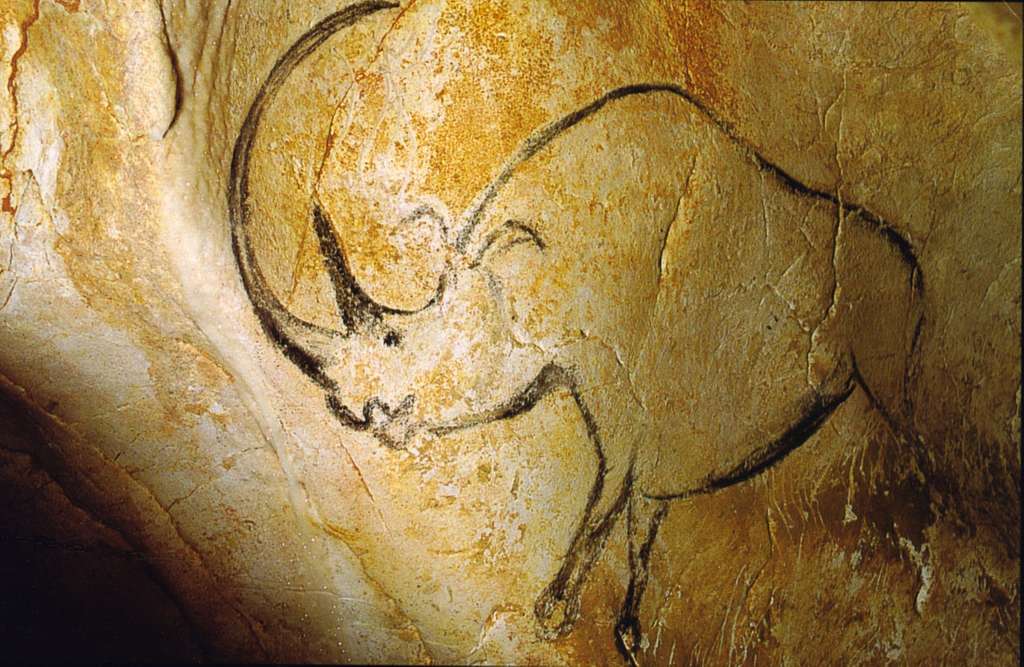
The Grotte Chauvet-Pont d’Arc is one of the oldest decorated caves in the world. Discovered on 18 December 1994 by three enthusiastic cavers – Jean-Marie Chauvet, Éliette Brunel and Christian Hillaire – it has revolutionised our understanding of prehistoric art. Located in the Ardèche gorges, this natural cave contains over 1,000 drawings representing 14 different animal species: cave lions, woolly rhinoceroses, mammoths, horses, bison, bears, etc.
The exceptional artistic quality of the paintings, their perfect state of preservation and their dating back some 36,000 years make them a unique testament to the cognitive and artistic skills of the first Homo sapiens in Europe. Aurignacian artists used sophisticated techniques: perspective, blurring, using the natural relief of the rock to give volume to the representations.
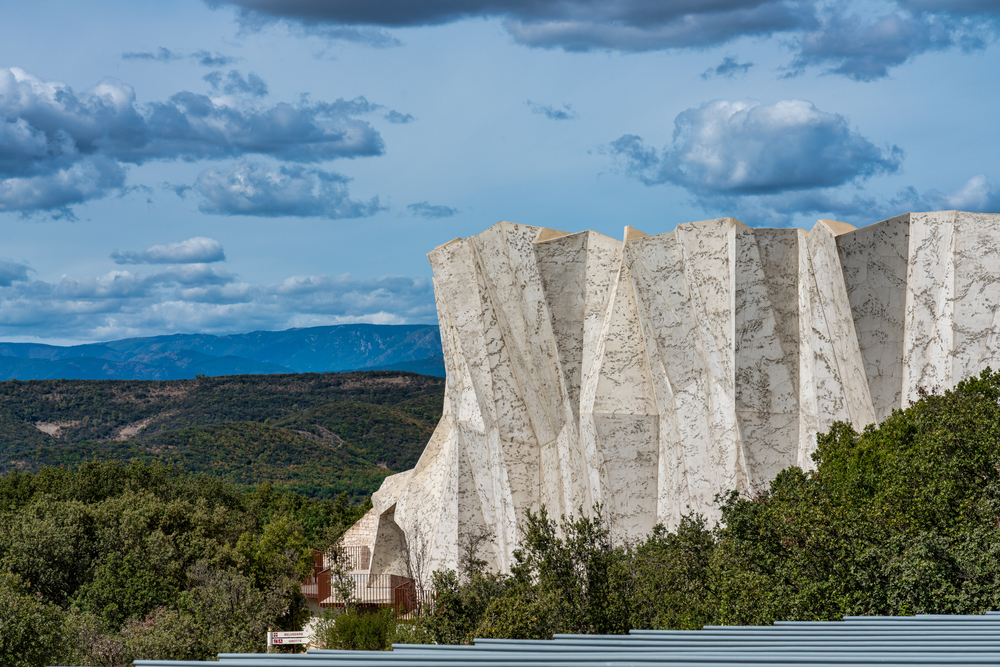
To preserve this priceless heritage, the original cave remains inaccessible to the public. Grotte Chauvet 2 – Ardèche, the largest replica of a cave in the world, allows visitors to discover this masterpiece in optimum conditions. This faithful reconstruction, located a few kilometres from Vallon-Pont-d’Arc, reproduces the 3,000 m² of the decorated cave with millimetre precision.
1. Opening times and prices for visiting the Grotte Chauvet
Opening times
Grotte Chauvet 2 – Ardèche is open all year round, including public holidays. Opening times vary according to the season, but the site generally welcomes visitors from 10am to 7pm in high season. We strongly recommend that you arrive at least 30 minutes before the time of your booked guided tour. Allow around 3? hours to get the most out of the whole site: guided tour of the cave, Aurignacian Gallery, temporary exhibitions and events.
The site is only closed on three days a year: 25 December, 1 January and 1 May. For other dates, check the official website before you come to find out the exact opening times for the period you are visiting.
Admission prices
The prices for visiting the Grotte Chauvet in 2025 are as follows:
- Adults: €18
- Young people aged 10 to 17 and RSA recipients: €9
- Children under 10: Free
This ticket includes access to all areas of the site: the guided tour of the replica cave (duration: 1 hour), the Aurignacian Gallery with its interactive exhibitions, the “Chauvet, the Scientific Adventure” area, educational activities and the reconstructed Palaeolithic camp. An annual pass is also available for €25 per person, giving unlimited access for one year.
2. How do I book a visit to the Grotte Chauvet?
Online booking is highly recommended, and even essential in high season. The site is very busy, especially during school holidays and summer weekends. To book your ticket, visit the official website www.grottechauvet2ardeche.com, where you can choose your time slot.
It is also possible to buy tickets on site, subject to availability. However, this option can lead to long waiting times, particularly at peak times. By booking in advance, you can guarantee access to the cave at the time you want and make the most of your time on site.
Guided tours are given in groups of no more than 25 people. Each visitor receives an individual audio guide available in several languages (French, English, German, Dutch, Italian and Spanish), guaranteeing a personalised immersive experience. People with reduced mobility can also visit the Grotte Chauvet, as the site is fully accessible.
3. The discovery of the original cave in 1994
The story of the discovery of the Grotte Chauvet is almost like a fairytale. On 18 December 1994, three amateur cavers – Jean-Marie Chauvet, Éliette Brunel and Christian Hillaire – were exploring the limestone cliffs above Pont d’Arc. Intrigued by a slight draught escaping from a scree slope, they cleared the blocked entrance and slipped through a narrow opening.
Their progress through the underground galleries leads them to a discovery that will stun the scientific world: hundreds of rock paintings and engravings of exceptional artistic quality cover the walls. Lions, rhinoceroses, mammoths, horses, bison… Animal representations follow one another in a diversity rarely seen in cave art.
The first carbon-14 dates reveal the incredible age of the works: around 36,000 years, almost twice as old as the paintings in the Lascaux cave. This discovery has revolutionised our knowledge of prehistoric art, demonstrating that the first Homo sapiens in Europe already possessed remarkable artistic mastery in the Aurignacian period.
4. What to see and do at Grotte Chauvet 2 – Ardèche?
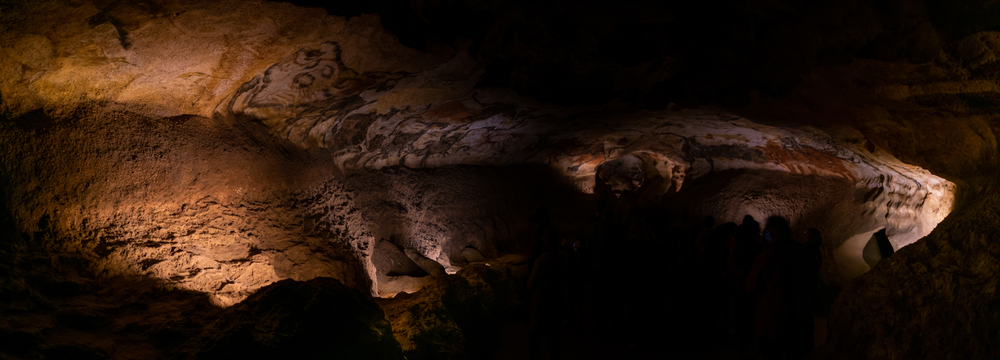
The replica of the cave
The guided tour of the replica is the highlight of your visit to Grotte Chauvet 2. For around an hour, you’ll wander through a space that faithfully recreates 3,000 m² of the original cave. The scientific and artistic teams have used cutting-edge technology to reproduce every detail: the relief of the walls, the limestone concretions and, of course, the extraordinary paintings and engravings.
The tour takes you through several rooms featuring a succession of animal representations. You’ll discover the panel of lions, the room of bear skulls, the area at the back with its rhinoceroses facing each other… Each area reveals the talent of the Aurignacian artists who used the natural relief to give life and movement to their creations. The temperature, kept at 16°C, reinforces the impression of authenticity, so bring warm clothing.
The Aurignacian Gallery
After visiting the cave, the Aurignacian Gallery plunges you into the daily lives of the men and women who lived 36,000 years ago. This permanent interactive exhibition presents the climatic environment of the time, the now-extinct fauna (cave lions, woolly mammoths, woolly rhinoceroses), hunting and survival techniques, and the beginnings of art and spirituality.
Multimedia displays, life-size reconstructions and authentic objects on loan from museums help you to understand the context in which these artists created their works. Find out how they made their pigments, tools and weapons, and how they organised their social lives. There is also a section comparing human evolution on different continents at the same time.
The Palaeolithic camp
Outside, the reconstructed Palaeolithic camp offers a further immersive experience. This installation presents an Aurignacian camp with its habitats, hearths and work areas. Presenters in period costume regularly give demonstrations of prehistoric techniques: flint knapping, friction fire lighting, propulsor shooting, and bone and reindeer antler tool making.
These educational workshops are particularly popular with families with children, offering a fun, hands-on approach to everyday life in the Upper Palaeolithic. Touching materials, trying out gestures, understanding the challenges of survival in a glacial environment: these are all experiences that perfectly complement the artistic dimension of the cave.
The “Chauvet, the Scientific Adventure” exhibition
This permanent exhibition traces the history of the discovery and the research carried out since 1994. You can go behind the scenes of the scientific work: dating methods, pigment studies, analysis of human and animal traces, reconstruction of the climate and environment, etc. Videos and testimonials from the discoverers and researchers help you understand this exceptional site.
The exhibition also explains why the original cave was closed and the process of creating the replica. This will help you understand the conservation issues involved and the importance of preserving this unique heritage for future generations.
5. How do I get to the Grotte Chauvet in the Ardèche?
By car
Grotte Chauvet 2 – Ardèche is located in the commune of Vallon-Pont-d’Arc, at the following address: 4941 Route de Bourg Saint-Andéol, 07150 Vallon-Pont-d’Arc. The site is easily accessible by car from the major towns in the region:
- From Lyon: 2h30 via the A7 (Montélimar-Sud exit)
- From Marseille: 2h30 via the A7 (Montélimar-Sud exit)
- From Montpellier: 2h30 via the A9 then the A7
- From Avignon: 1h30 via the N7
- From Valence: 1h30 via the A7
A large, free car park is available for cars, motorhomes and coaches. Simply follow the “Grotte Chauvet 2” signs as you approach Vallon-Pont-d’Arc.
By public transport
There is limited public transport directly to the site. The most practical solution is to travel to Montélimar by train (SNCF station), then take a bus or taxi to Vallon-Pont-d’Arc (around 40 km away). Regular bus services run between Montélimar and Vallon-Pont-d’Arc during the tourist season.
Once in Vallon-Pont-d’Arc, a seasonal shuttle bus can provide a link to Grotte Chauvet 2 during peak periods. Check with the local tourist office for timetables and availability.
6. What to do around the Grotte Chauvet in the Ardèche?
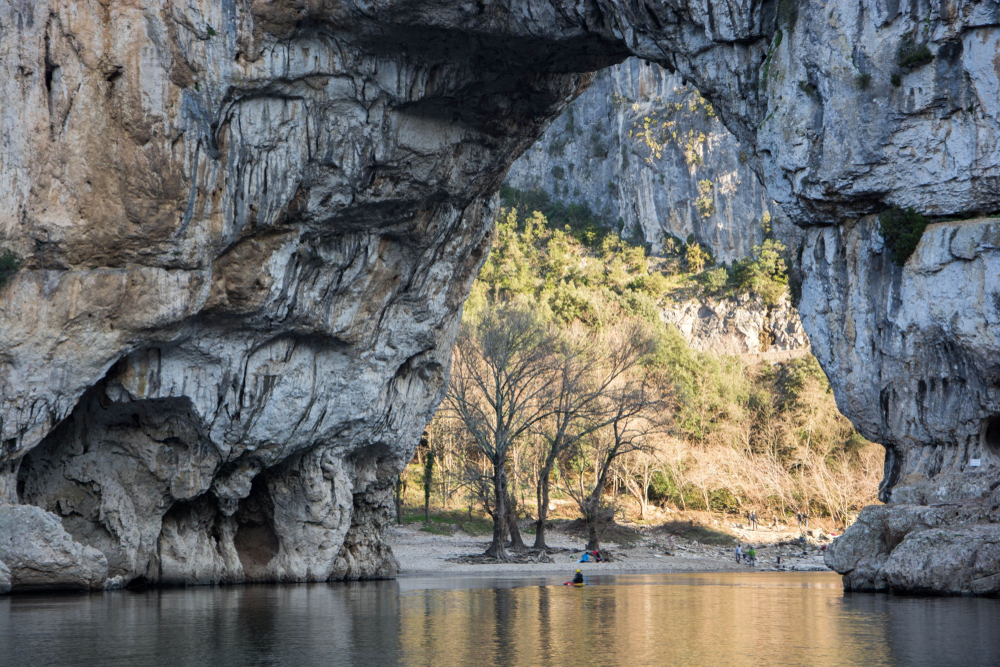
A visit to the Grotte Chauvet is an ideal part of a wider trip to discover the Ardèche and its natural and heritage treasures. The region is full of activities and remarkable sites to explore.
Le Pont d’Arc
Located just a few kilometres from the Grotte Chauvet, the Pont d’Arc is the unmissable landmark of the Ardèche. This natural arch, 54 metres high and 60 metres wide, majestically spans the River Ardèche. Formed by erosion over thousands of years, it marks the entrance to the famous Ardèche gorges. There are several viewpoints from which to admire this geological wonder, and the more adventurous can even pass under the arch in a canoe or kayak.
The Ardèche gorges
Canoeing down the Ardèche gorges is one of the region’s top activities. For 32 kilometres between Vallon-Pont-d’Arc and Saint-Martin-d’Ardèche, the river winds its way through a spectacular canyon with vertiginous limestone cliffs. There are several options to suit all abilities and tastes: a full-day descent (7 to 8 hours), a mini-descent lasting a few hours, or a simple swim near the Pont d’Arc.
The gorges tourist route (D290) also offers an alternative way of discovering the site without getting wet. There are eleven lookouts along the way, offering breathtaking views of the meandering river and rock formations. Don’t miss the particularly spectacular Cathédrale and Madeleine lookouts.
Villages of character
The Ardèche is home to many picturesque villages well worth a visit. Balazuc, listed as one of the Most Beautiful Villages in France, clings to the cliffside above the Ardèche with its cobbled streets and golden stone houses. Vogüé, dominated by its medieval castle, has an enchanting Provencal charm and shady riverside terraces. Labeaume, with its suspension bridge and troglodyte houses, offers a peaceful atmosphere in which to stroll.
Vallon-Pont-d’Arc itself is well worth a stroll through its lively streets, with its many restaurants serving local cuisine, its craft shops and its weekly Provencal market.
Aven d’Orgnac
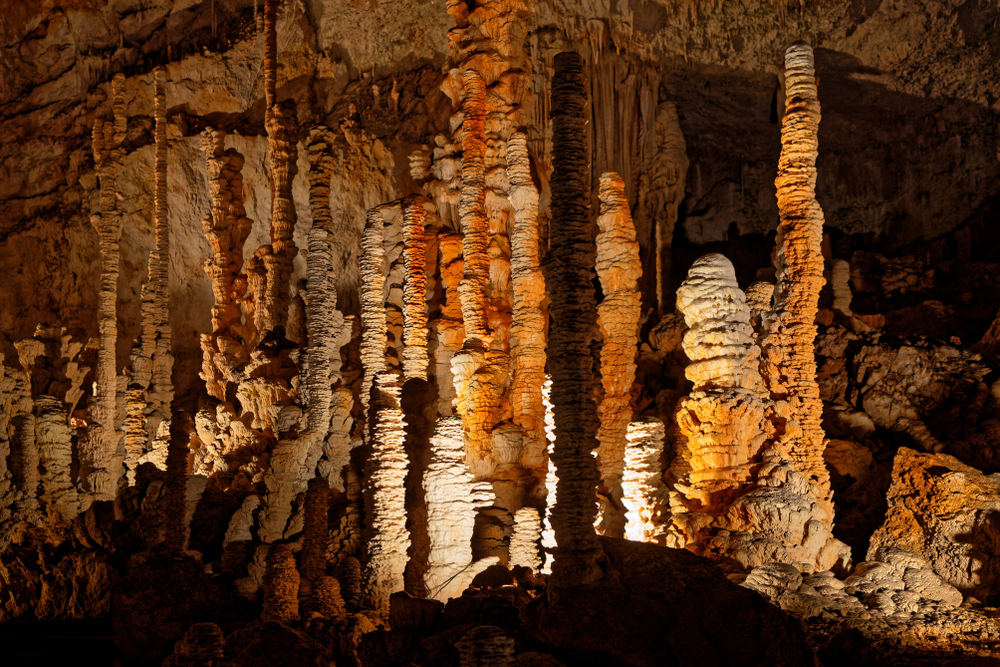
Another of the Ardèche’s underground wonders, the Aven d’Orgnac is around 30 minutes’ drive from the Grotte Chauvet. This immense natural cavern is impressive for its size and the beauty of its concretions: stalactites, stalagmites, draperies and giant columns create an enchanting mineral landscape. The guided tour descends more than 120 metres underground and lasts around 1 hour. A museum devoted to prehistory and geology completes the discovery.
7. Practical tips for your visit
To make the most of your visit to the Grotte Chauvet, here are a few essential recommendations. Bring warm clothing, even in summer: the temperature in the replica is kept at 16°C all year round to reproduce the atmosphere of the original cave. A waistcoat or small jacket is therefore essential.
Photography is forbidden inside the cave to preserve the quality of the collective experience and respect for silence. However, you are free to photograph the other areas of the site: the Aurignacian Gallery, the Palaeolithic camp and the exterior.
The site has a restaurant serving local and seasonal cuisine, as well as a shop offering a wide range of souvenirs, books, regional products and reproductions of prehistoric artefacts.
Pushchairs are permitted throughout the site, which is fully accessible to people with reduced mobility. Reserved parking spaces are available near the entrance. Families with young children should note that the guided tour of the cave lasts around 1 hour, with no possibility of interruptions, so plan accordingly.
8. Where to stay near the Grotte Chauvet?
The Vallon-Pont-d’Arc region offers a wide range of accommodation to suit all budgets and tastes. There are a large number of well-equipped campsites, some of which even offer pitches on the banks of the Ardèche with direct access to the river. Holiday villages, rural gîtes, bed and breakfasts and hotels complete the accommodation on offer.
Vallon-Pont-d’Arc is the ideal base from which to explore the region. The village offers a wide range of shops, restaurants and services, while retaining an authentic atmosphere. For a more unusual experience, some establishments offer atypical accommodation: tree houses, yurts, teepees or lodges with panoramic views over the gorges.
The nearby villages of Ruoms, Labeaume, Balazuc or Vogüé also offer excellent accommodation options in picturesque surroundings, less than 15 minutes’ drive from the Grotte Chauvet. Remember to book well in advance, especially for July-August stays or long weekends.
In conclusion, visiting the Grotte Chauvet in the Ardèche is an unforgettable experience, taking you back 36,000 years to the origins of human art and creativity. This exceptional replica allows you to discover one of the world’s greatest heritage masterpieces in optimum conditions, while preserving the integrity of the original cave. Combined with an exploration of the Ardèche gorges, the Pont d’Arc and the surrounding villages of character, this visit is the perfect complement to a holiday rich in natural and cultural discoveries.
FAQ : Your questions about visiting the Grotte Chauvet
Can we visit the original cave?
No, the original Chauvet cave is definitively closed to the public in order to preserve the exceptional paintings it contains. Only a handful of authorised researchers are allowed access on strictly supervised scientific missions. That’s why Grotte Chauvet 2 – Ardèche was created: this faithful replica allows everyone to discover this unique heritage under optimum conditions.
How long does the full tour last?
It takes around 3? hours to visit the whole site. The guided tour of the replica cave lasts 1 hour. Then add the time to explore the Aurignacian Gallery on your own (around 1 hour), the “Chauvet, l’Aventure Scientifique” exhibition (30 minutes), the Palaeolithic camp and the activities (30 minutes to 1 hour, depending on your interest).
Is the tour suitable for children?
Yes, Grotte Chauvet 2 is suitable for families with children of all ages. Children under 10 are even free. Audioguides are available for children, with commentaries tailored to their understanding. The Palaeolithic camp and demonstration workshops are particularly exciting for younger visitors. Please note, however, that the guided tour of the cave lasts 1 hour, with no interruptions.
Do I have to book in advance?
Online booking is not absolutely compulsory, but is strongly recommended. The site is very busy, especially during the high season, school holidays and weekends. Without a reservation, you risk not being able to access the site or having to wait several hours. Booking guarantees you a time slot and allows you to make the most of your visit.
When is the best time to visit the Grotte Chauvet?
The site is open all year round, and each season has its advantages. Spring (April-May) and autumn (September-October) offer pleasant weather and moderate visitor numbers. Summer allows you to combine your visit with water activities in the Ardèche gorges, but the crowds are at their highest. Winter and winters offer more tranquillity, although some outdoor activities are limited. Whatever the season, the temperature in the cave remains constant at 16°C.
200 audioguided tours for cities all around the world
Download