The 14 most impressive castles in France

France is brimming with architectural marvels that bear witness to its rich medieval past, and among them, fortified castles occupy a special place in our heritage. These majestic fortresses, veritable stone sentinels, tell the tumultuous story of the French Middle Ages through their imposing towers, defensive ramparts and towering keeps. Discover our selection of the 14 most beautiful fortified castles in France, architectural gems that will transport you to the fascinating world of medieval France.
200 audioguided tours for cities all around the world
DownloadSee also the Carcassonne guide:
- The Most Beautiful Villages in France: 15 listed villages to visit
- France’s 10 longest rivers
- Top 7 theme parks in France
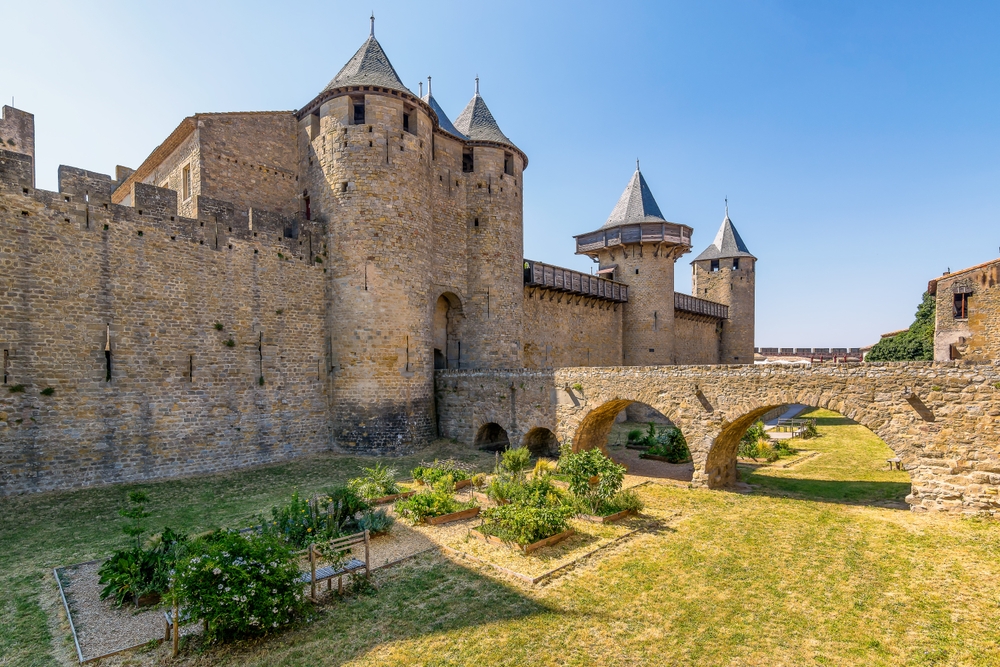
1. The city of Carcassonne, medieval jewel of the Languedoc region
It’s impossible to begin this selection of the most beautiful fortified castles in France without mentioning the majestic city of Carcassonne. Listed as a UNESCO World Heritage Site since 1997, this exceptional fortified city is a remarkable example of medieval architecture, with its 52 towers and 3 kilometres of ramparts. At the heart of these walls stands the château comtal, built in the 12th century by the Trencavel family and modified over the centuries.
The city of Carcassonne alone embodies a thousand years of military architecture. Its fortifications, developed mainly in the 13th century, bear witness to the defensive genius of the Middle Ages. This architectural marvel attracts more than two million visitors every year, who come to admire this setting worthy of the greatest historical films. Don’t hesitate to let theNavaway audio guide take you on a tour of this exceptional citadel.
Download the audio-guided tour to discover Carcassonne on foot and on your own
Immerse yourself in the heart of the citadel of vertigo with our audio tour, which reveals the secrets of this unique fortified city. From the Basilica of Saint-Nazaire to the Chateau Comtal, via the ramparts and defensive towers, our tour of Carcassonne takes you on a 5.7 km journey through 27 major places of interest.
2. Haut-Koenigsbourg castle, sentinel of Alsace
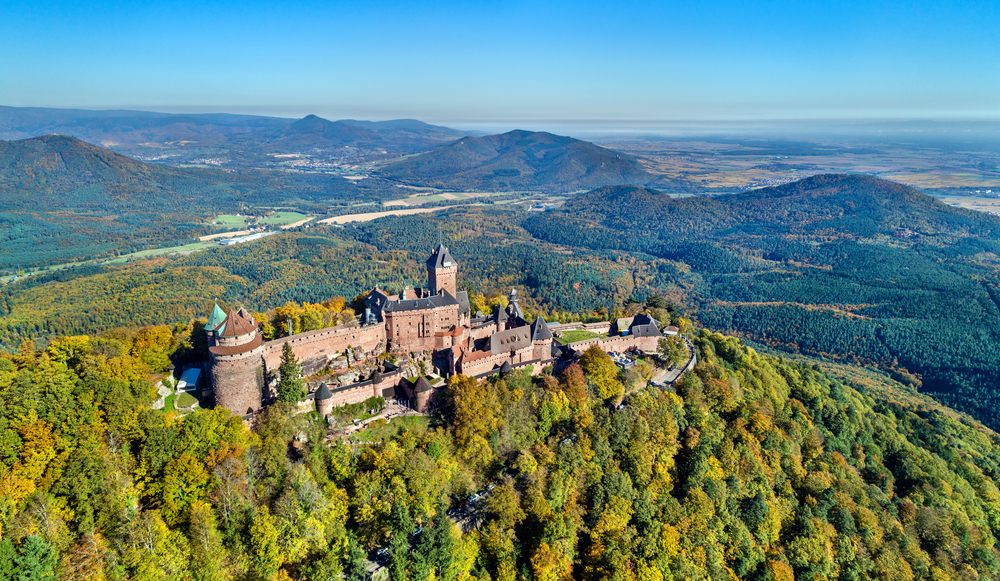
Perched 757 metres high in the Vosges mountains, Haut-Koenigsbourg castle towers majestically over the Alsace plain. This spectacular fortress, built in the 12th century and then modified in the 15th century, was completely restored under Wilhelm II between 1900 and 1908. The German emperor made it a symbol of Germanic grandeur, entrusting the work to the architect Bodo Ebhardt.
Today, Haut-Koenigsbourg castle is one of the most visited monuments in Alsace. Its pink sandstone walls, imposing towers and numerous inner courtyards offer an authentic journey through medieval military architecture. The panoramic view from its ramparts stretches from the Vosges to the Black Forest, embracing the entire Rhine valley. This remarkably well-preserved fortress provides an insight into the development of defensive architecture in the late Middle Ages.
3. The Château de Vincennes, a colossal royal keep
At the gateway to Paris, the Château de Vincennes is the largest French royal castle still standing. This medieval fortress, the first stones of which were laid under Louis VII in the 12th century, became a veritable citadel under Charles V in the 14th century. Its keep, 52 metres high, is the most imposing in Europe and symbolises Capetian royal power.
A privileged witness to the history of France, the Château de Vincennes was home to many sovereigns and played a crucial role in the defence of the capital. Transformed into a barracks and arsenal by Napoleon I, it became a key part of the Parisian defence system. Now fully restored, this exceptional historic monument is easily accessible from the Château de Vincennes metro station, at the terminus of line 1.
4. Pierrefonds Castle, Viollet-le-Duc’s architectural dream
On the edge of the Compiègne forest in the Oise department, stands the spectacular Château de Pierrefonds. This 14th-century fortress, built by Louis d’Orléans, was dismantled in 1617 on the orders of Richelieu before rising from its ashes in the 19th century. Napoleon III entrusted its reconstruction to Eugène Viollet-le-Duc, who turned it into a masterpiece of neo-Gothic style.
The Château de Pierrefonds as we know it today is a perfect illustration of the Romantic vision of the Middle Ages in the 19th century. Viollet-le-Duc displayed all his creative genius here, combining historical restoration with artistic creation. The castle’s round towers, elaborate machicolations and detailed sculptures have made it the setting of choice for numerous film and television productions, including the famous series “Kaamelott”.
5. Fougères Castle, the largest medieval fortress in Europe
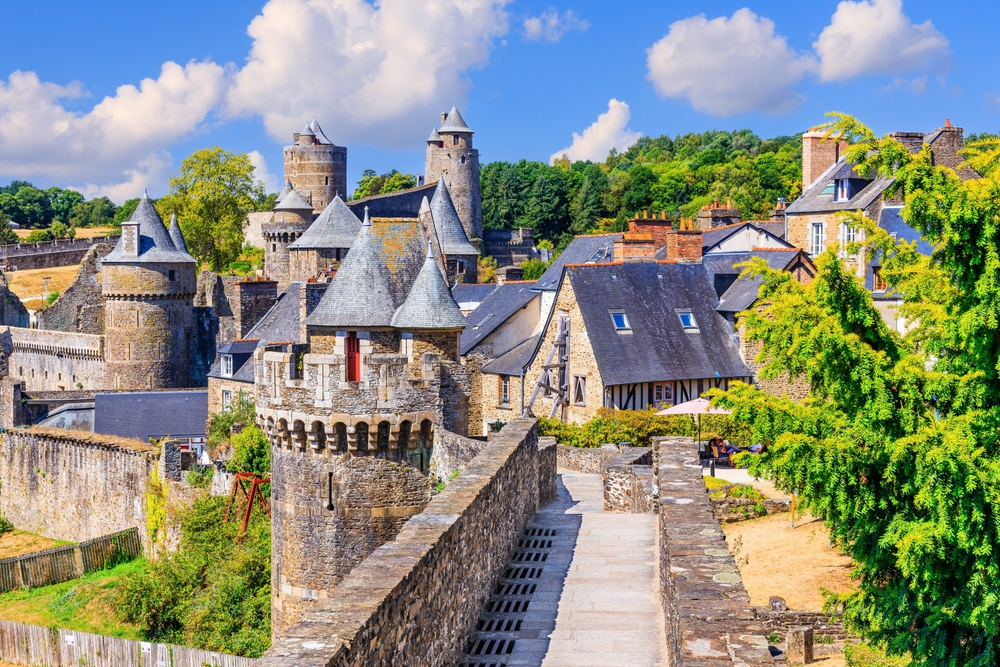
In Brittany, on the banks of the Nançon river, the Château de Fougères lays claim to the title of Europe’s largest medieval fortress in this state of preservation. This imposing two-hectare citadel, flanked by thirteen towers, has watched over the region since the year 1000. Built to defend the eastern border of the Duchy of Brittany, it represents a remarkable synthesis of late medieval fortification techniques.
The Château de Fougères bears witness to the constant battles between English Normandy, the Kingdom of France and the Duchy of Brittany. Its thick walls, round towers and sophisticated defensive systems illustrate the evolution of medieval military architecture. Today, this exceptional historic monument offers a scenographic tour that plunges visitors into the heart of a thousand years of Breton history.
6. The Château d’If, Marseille’s mysterious prison
Off the coast of Marseille, on the rocky islet of If, stands one of France’s most famous fortresses. Built in the early 16th century under François I to protect the entrance to the port of Marseille, the Château d’If quickly became a formidable prison. Alexandre Dumas immortalised it in “The Count of Monte Cristo”, making this maritime citadel a legendary site in French literature.
For more than three centuries, from 1580 to 1890, the Château d’If served as a state prison. Its thick walls imprisoned political opponents, Protestants and common criminals, all isolated on this island in the middle of the Mediterranean. Accessible only by boat from Marseille‘s Old Port, this historic monument now attracts more than 100,000 visitors a year, fascinated by its turbulent history and legends.
7. Château de Beynac, sentinel of the Dordogne
Proudly overlooking the Dordogne valley from the top of a vertiginous cliff, Beynac castle is one of the best-preserved medieval fortresses in France. This 12th-century citadel, once owned by Richard the Lionheart, played a major strategic role during the Hundred Years’ War, serving as a French stronghold against English positions.
The Château de Beynac’s pale stonework preserves the memory of great historical figures: Richard the Lionheart, Simon de Montfort and the fearsome Lords of Beynac. Its armouries, chapel and stately flats bear witness to daily life in a medieval fortress. From the top of the keep, you can see the entire Dordogne valley, offering an exceptional panorama of this UNESCO World Heritage site.
8. Bonaguil Castle, the last fortified castle in France
Straddling the Lot-et-Garonne and Lot departments, Château de Bonaguil holds the prestigious title of being the last fortified castle built in France. Built mainly in the 15th and 16th centuries by Bérenger de Roquefeuil, this anachronistic fortress was built at a time when artillery was already the dominant feature of European battlefields.
Château de Bonaguil is a perfect illustration of the development of military architecture in the late Middle Ages. Its round towers adapted to cannonballs, gunboats and bastions bear witness to the adaptation of fortifications to new warfare techniques. Despite its defensive innovations, the fortress never saw a real siege, remaining intact to this day as an open history book on late medieval military art.
9. The Château de Saumur, elegance from the Loire Valley
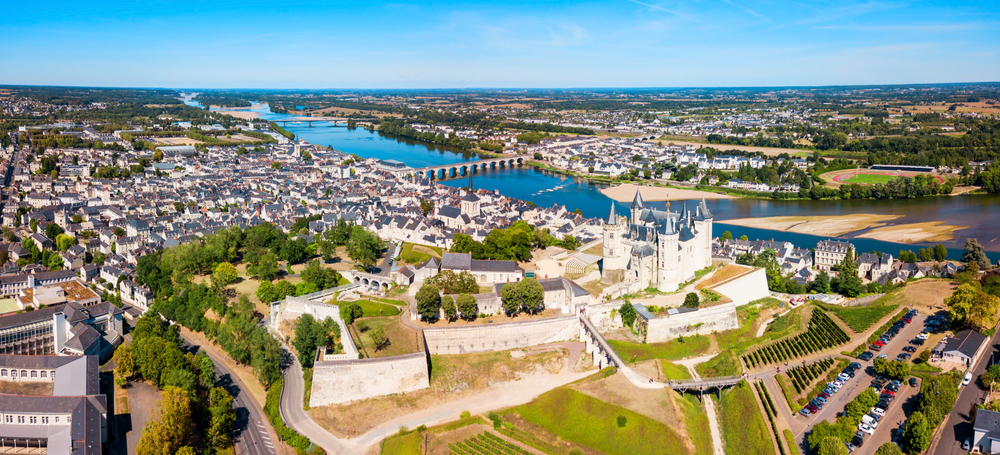
Gracefully overlooking the Loire, the Château de Saumur embodies the elegance of French Gothic architecture. This former fortress of the Counts of Anjou, transformed into a royal residence under Saint Louis, boasts an exceptional panoramic view over the Loire Valley, a UNESCO World Heritage site.
The Château de Saumur stands out for its slender towers and pepper-pot roofs, giving it a silhouette that is instantly recognisable. A historic monument since 1862, it now houses the Museum of Decorative Arts and the Horse, a testament to Saumur’s equestrian tradition. Its privileged location on the route of the Loire châteaux and its proximity to the town centre make it an essential stop-off point for discovering the heritage of the Loire Valley.
10. The fortress of Chinon, setting for the epic of Joan of Arc
In Indre-et-Loire, the Royal Fortress of Chinon occupies a unique place in French history. This exceptional complex, made up of three separate châteaux – Fort du Coudray, Château du Milieu and Fort Saint-Georges – was the scene of decisive historic encounters, notably that between Joan of Arc and Charles VII in 1429.
Former refuge of Henry II Plantagenet, the fortress of Chinon has welcomed some of the greatest names in history: Eleanor of Aquitaine, Richard the Lionheart and Philippe Auguste. Its thousand-year-old walls are a reminder of the time when it was the heart of the Plantagenet Empire. The recently restored throne room is a moving reminder of the Pucelle d’Orléans’ recognition of the Dauphin, a pivotal moment in the Hundred Years’ War.
11. Sedan Castle, the largest fortress in Europe
In the Ardennes, the fortified castle of Sedan lays claim to the title of Europe’s largest fortress, covering an area of 35,000 square metres. Erected on a rocky promontory overlooking the Meuse, this colossal complex bears witness to five centuries of military architecture, from its foundation in 1424 to its 18th-century development.
Sedan Castle was the residence of the Princes of Sedan, a Protestant dynasty who ruled this sovereign principality until 1642. Its thick walls, round towers and bastioned bastions illustrate the development of fortification techniques from the 15th to the 18th century. Listed as a historic monument since 1965, it now offers a unique show recounting the saga of the Princes of Sedan.
12. Château de Fleckenstein, a troglodyte fortress in Alsace
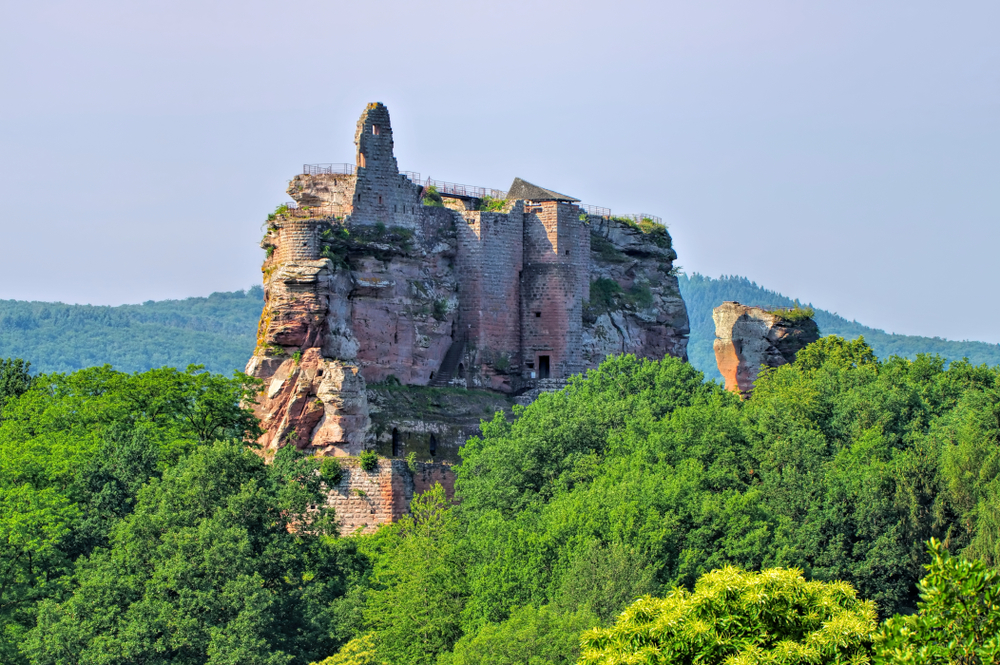
In the northern Vosges mountains, Fleckenstein castle stands out for its unique semi-troglodyte character. Built in the 12th century by the eponymous family, this remarkable fortress was carved directly into the red Vosges sandstone, creating a strikingly original architectural ensemble.
Fleckenstein castle remained in the hands of the same family for over 600 years, a remarkable longevity record. Reputed to be impregnable, the citadel only surrendered to Louis XIV’s troops in 1689, falling without a fight. Now in ruins, it remains the second most visited castle in Alsace after Haut-Koenigsbourg, attracting visitors with its unique architecture and mysterious legends.
13. Château de Coucy, the dismembered colossus of the Aisne region
Although partially destroyed during the First World War, the Château de Coucy deserves its place in this selection, as its history and impressive remains bear witness to the grandeur of medieval military architecture. Built in the 13th century by Enguerrand III de Coucy, this fortress boasted the largest cylindrical keep in Western Europe at 55 metres high.
The Château de Coucy embodied the power of the Sires de Coucy, whose motto “Roi ne suis, ni prince, ni duc, ni comte aussi; je suis le sire de Coucy” sums up their legendary pride. Despite its partial destruction in 1917, its preserved ramparts, round towers and the remains of its gigantic keep continue to impress visitors and bear witness to what was once one of the most powerful fortresses in France.
14. Château-Gaillard, a lock on the Seine
Overlooking the Seine from Les Andelys in Normandy, Château-Gaillard rounds off our selection with panache. This revolutionary fortress, built in just two years (1196-1198) by Richard the Lionheart, embodied the military innovation of its time. Designed to block the Seine and protect Rouen from French ambitions, it represented the ultimate in Anglo-Norman military architecture.
Château-Gaillard is a perfect illustration of the evolution of medieval poliorcetics, with its beaked walls, cylindrical towers and concentric defensive system. Despite its reputation for being impregnable, the fortress fell to Philippe Auguste in 1204 after a memorable siege. Partially dismantled by Henry IV, this historic castle now offers an exceptional panoramic view over the Seine valley and remains a striking testament to the military genius of Richard the Lionheart.
In conclusion, these 14 exceptional fortified castles bear witness to the richness of France’s military heritage and the evolution of defensive architecture in the Middle Ages. From the city of Carcassonne to the imposing ruins of Château-Gaillard, each fortress tells a unique page in our national history. For an in-depth look at these architectural marvels, don’t hesitate to take one of the Navaway audio tours, which reveal all the secrets of these thousand-year-old citadels.
FAQ about fortified castles in France
What is the largest fortified castle in France?
The fortified castle of Sedan, in the Ardennes, holds the record with its 35,000 square metres of surface area, making it the largest fortress in Europe. However, in terms of medieval conservation, the Château de Fougères in Brittany lays claim to the title of Europe’s largest medieval fortress in this state of preservation.
Which castles are UNESCO World Heritage Sites?
The city of Carcassonne has been a UNESCO World Heritage Site since 1997. The Château de Saumur also benefits from this protection as an integral part of the Val de Loire, listed since 2000. These international recognitions testify to their exceptional universal value.
Can all these castles be visited all year round?
Most of these châteaux are open to the public all year round, with sometimes reduced opening times in winter. Some, such as the Château d’If, may have restrictions depending on weather conditions. It is advisable to check the opening times before visiting, particularly for castles located in mountainous areas such as Haut-Koenigsbourg.
Which is the best-preserved fortified castle in France?
The Château de Beynac in the Dordogne is often considered to be the most authentic fortified castle in France, retaining all of its original medieval architecture. The city of Carcassonne, although partially restored in the 19th century by Viollet-le-Duc, remains the most complete and best-preserved fortified complex in France.
200 audioguided tours for cities all around the world
Download