11 must-see places in Piedmont

Located in north-west Italy, at the gateway to the Alps, the Piedmont region is a treasure trove for travellers in search of authenticity. Between snow-capped peaks, majestic lakes, vine-covered hills and art cities steeped in history, Piedmont offers a diversity of landscapes and extraordinary experiences. Former land of the Kingdom of Savoy and cradle of the Italian Risorgimento, this region has preserved an exceptional heritage that bears witness to its glorious past. From the royal palaces of Turin to the hilltop villages of the Langhe and the romantic shores of Lake Maggiore, each place tells its own unique story. Get ready to discover the 11 must-do things to do in Piedmont for a memorable stay in the heart of Northern Italy.
200 audioguided tours for cities all around the world
Download1. Turin, the royal capital of Piedmont
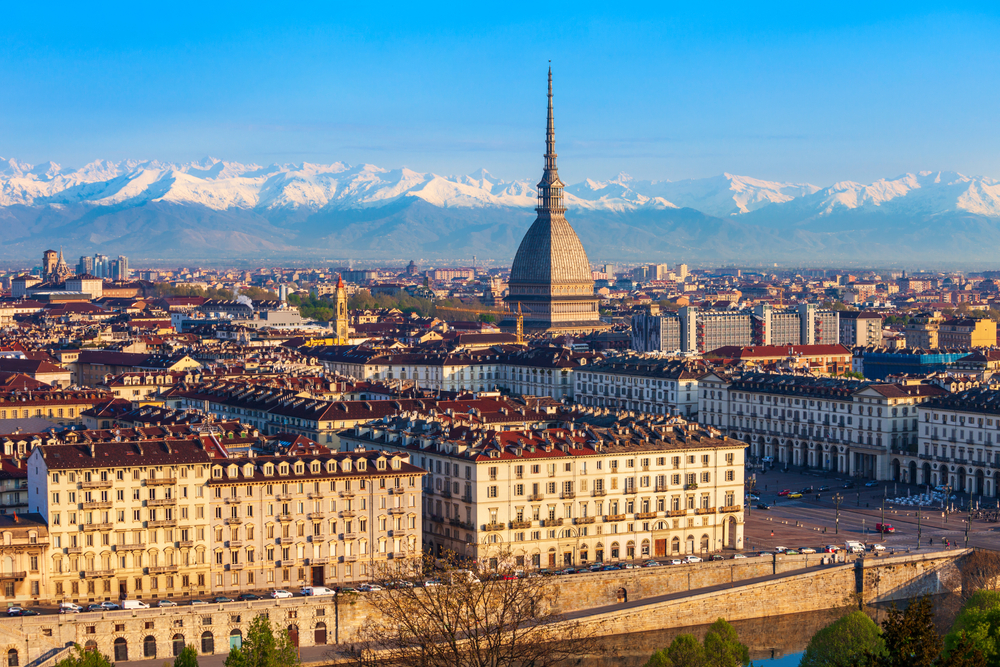
It’s impossible to begin this guide to must-do things to do in Piedmont without mentioning its magnificent capital. To visit Turin is to immerse yourself in the history of a city that was the first capital of the Kingdom of Italy in 1861. Far from the image of a simple industrial city that it is sometimes given, Turin is an elegant city with wide avenues lined with arcades, majestic squares and historic cafés.
At the heart of the city, Piazza Castello (Piazza Castello, 10122 Torino TO, Italy, rated 4.6/5 on Google for over 11,000 reviews) is the ideal starting point for discovering Turin’s heritage. Here you can admire the Palazzo Reale, the former residence of the kings of Savoy, with its sumptuous royal flats and formal gardens. Nearby, the Palazzo Madama (Piazza Castello, 10122 Torino TO, Italy, rated 4.5/5 on Google out of 9,800 reviews) now houses the city’s museum of ancient art.
Download the audio-guided tour to discover Turin on foot and on your own
To explore Turin in a fun and rewarding way, let yourself be guided by the Navaway audio tour. This 6.5 km route takes you to 30 of the city’s major points of interest, from Piazza Castello to the majestic Mole Antonelliana, via historic cafés and elegant Baroque squares. Each audio guide tells you the fascinating story of this Piedmontese capital and reveals its best-kept secrets.
Don’t miss the 167-metre-high Mole Antonelliana (Via Montebello, 20, 10124 Torino TO, Italy, rated 4.5/5 on Google out of 25,000 reviews), the emblematic symbol of Turin. This monument houses the National Cinema Museum and offers breathtaking panoramic views of the city and the Alps from its summit. The Egyptian Museum of Turin (Via Accademia delle Scienze, 6, 10123 Torino TO, Italy, rated 4.6/5 on Google out of 25,000 reviews) is also well worth a visit: it is the second most important Egyptian museum in the world after the one in Cairo.
For a typically Turinese gourmet break, take a seat in one of the city’s historic cafés, such as Caffè San Carlo, or enjoy a gianduiotto, the famous hazelnut chocolate created in Turin. The Piedmontese city also offers an exceptional culinary scene where you can enjoy agnolotti, vitello tonnato or brasato al Barolo.
2. Lake Maggiore and the Borromean Islands
Lake Maggiore is undoubtedly one of the most beautiful things to do in Piedmont. Covering an area of 212 km², this majestic Alpine lake stretches between Italy and Switzerland and offers breathtakingly beautiful scenery. Its Piedmontese shores, dominated by Alpine peaks, are home to charming towns and villages that have inspired many artists and writers over the centuries.
The pearl of Lake Maggiore is undoubtedly Stresa (Stresa, VB, Italy, rated 4.6/5 on Google out of 8,200 reviews), an elegant seaside resort with Belle Époque charm. Its lakeside promenade lined with grand historic hotels and luxurious villas is a testament to its glorious past. From Stresa, you can embark to visit the famous Borromean Islands, the jewels of Lake Maggiore.
Isola Bella (Isola Bella, Stresa, VB, Italy, rated 4.5/5 on Google out of 12,000 reviews) is the most spectacular, with its 17th-century baroque palace and exceptionally beautiful terraced gardens adorned with statues, fountains and white peacocks. Isola Madre (Isola Madre, Stresa, VB, Italy, rated 4.6/5 on Google out of 5,300 reviews), the largest of the islands, is home to an exceptional botanical garden where rare exotic species thrive. Isola dei Pescatori, the only permanently inhabited island, has an authentic feel with its picturesque little streets and lake fish restaurants.
Other towns on the lake are also worth a visit: Verbania (Verbania, VB, Italy, rated 4.5/5 on Google with 4,100 reviews) with its Villa Taranto gardens containing more than 20,000 species of plants, or Cannobio (Cannobio, VB, Italy, rated 4.6/5 on Google with 2,800 reviews), a charming village with medieval streets just a few kilometres from the Swiss border.
3. The Langhe and Barolo vineyards
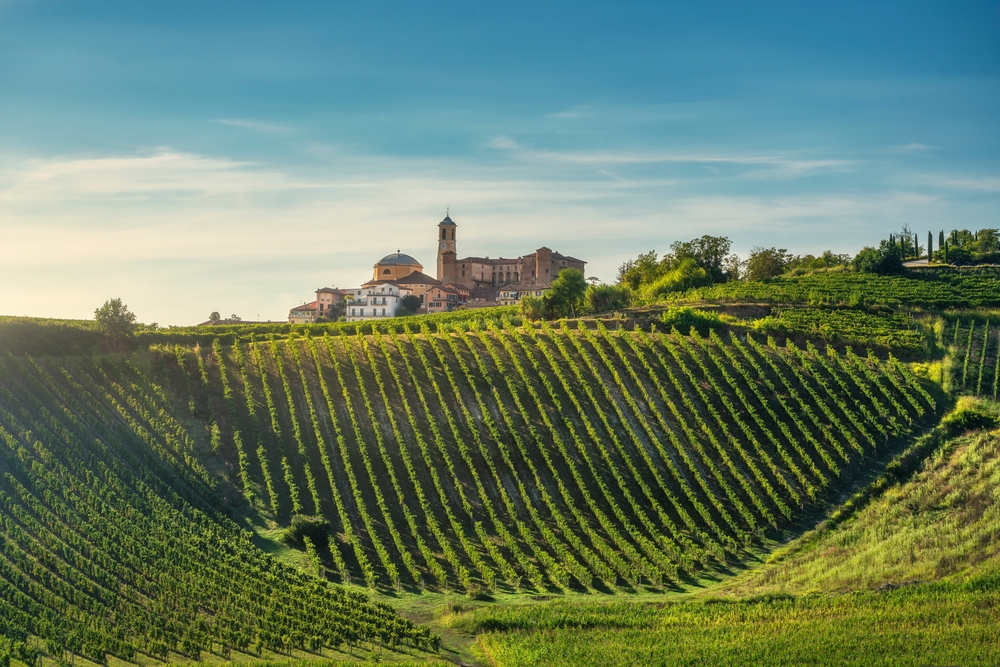
For lovers of fine wines and bucolic landscapes, the Langhe region is an absolute must when exploring Piedmont. This hilly region between Alba and Asti is the birthplace of some of Italy’s most prestigious wines. Listed as a UNESCO World Heritage Site since 2014, the Langhe hills offer an enchanting visual spectacle, with rows of perfectly aligned vines undulating as far as the eye can see.
Barolo (12060 Barolo, Province of Cuneo, Italy, rated 4.7/5 on Google out of 3,200 reviews) is the emblematic village that gave its name to the famous “king of wines”. Perched on a hill, this medieval village is home to Falletti Castle, which houses the Wine Museum. A visit to one of the many canteens in the village will allow you to taste this powerful and complex nectar, made exclusively from the Nebbiolo grape variety. Wine lovers can also visit the prestigious Enoteca Regionale del Barolo (Castello Comunale Falletti, 12060 Barolo CN, Italy, rated 4.5/5 on Google out of 1,800 reviews) to discover the full diversity of the region’s wines.
Not far away, La Morra (La Morra, CN, Italy, rated 4.6/5 on Google out of 1,500 reviews) offers one of the finest views of the Langhe vineyards from its belvedere terrace. The village of Barbaresco (Barbaresco, CN, Italy, rated 4.6/5 on Google out of 1,100 reviews) produces an exceptional wine that rivals Barolo, but is more elegant and accessible in its youth. Be sure to visit the Enoteca Regionale and climb to the top of the medieval tower to admire the winegrowing landscape.
Alba, capital of the Langhe region, is also well worth a visit. This medieval town is world-famous for its white truffles, one of the most precious products of Italian gastronomy. Every autumn, the Fiera del Tartufo (Piazza Medford, 12051 Alba CN, Italy) attracts gourmets from all over the world who come to sample this culinary diamond. Take the opportunity to stroll through Alba’s historic centre, with its medieval towers and lively squares.
4. The Royal Palace of Venaria Reale
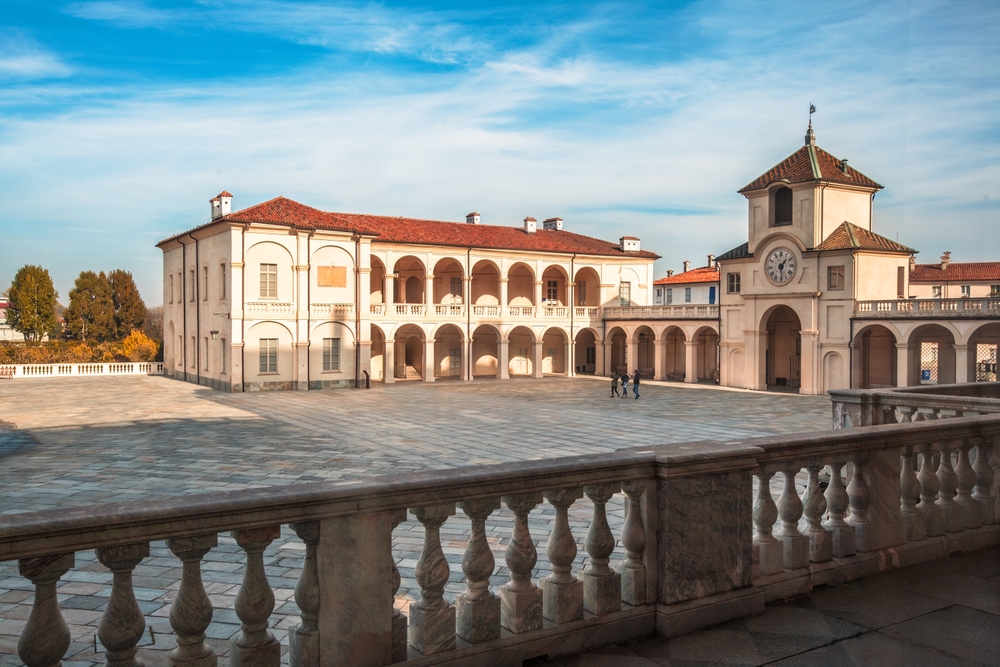
Just 15 kilometres north of Turin lies one of Piedmont’s heritage gems: the Reggia di Venaria Reale (Piazza della Repubblica, 4, 10078 Venaria Reale TO, Italy, rated 4.6/5 on Google out of 38,000 reviews). This former hunting residence of the House of Savoy is one of the largest architectural complexes in Europe and is a UNESCO World Heritage Site. Commissioned in the 17th century by Duke Charles-Emmanuel II of Savoy, this royal residence rivals Versailles in splendour.
A visit to the palace takes you back to the sumptuous world of the Savoy court. The magnificently restored royal flats reveal sumptuous state rooms, including the spectacular Galerie de Diane, 44 metres long and adorned with dazzling Baroque frescoes. The Salle des Écuries basses, a contemporary exhibition space, creates a striking contrast with the palace’s baroque decor.
The palace gardens alone are well worth a visit. Covering 80 hectares, they have recently been redeveloped in keeping with the original 17th-century plans. With its formal flowerbeds, monumental fountains and contemporary sculptures, a stroll through these royal gardens offers a moment of absolute serenity. Don’t miss the Chapelle Saint-Hubert, a masterpiece of Piedmontese Baroque, whose richly decorated façade impresses all visitors.
The site regularly hosts temporary exhibitions of international renown, making Venaria Reale a lively and dynamic cultural venue. Allow at least half a day to fully appreciate a visit to this exceptional royal complex, a testament to the power and refinement of the Savoyard dynasty.
5. Lake Orta and the village of Orta San Giulio
Less well known than its neighbour Lake Maggiore but just as enchanting, Lake Orta (Lago d’Orta, Italy, rated 4.7/5 on Google for 6,200 reviews) is one of Piedmont’s best-kept secrets. This small 18km² lake nestling at the foot of the Alps has a romantic and peaceful atmosphere that has inspired many writers, including Balzac and Nietzsche.
The jewel of the lake is undoubtedly Orta San Giulio (Orta San Giulio, NO, Italy, rated 4.7/5 on Google out of 5,800 reviews), one of Italy’s most beautiful villages. Its narrow cobbled streets winding between colourful houses with flower-filled balconies lead to the charming Piazza Motta, the beating heart of the village. This lakeside square, lined with cafés and restaurants with terraces, offers a breathtaking view of Isola San Giulio, a mysterious little island that seems to float on the calm waters of the lake.
A short boat trip takes you to Isola San Giulio (Isola San Giulio, Italy, rated 4.6/5 on Google out of 4,100 reviews), where time seems to stand still. This tiny island is home to a fourth-century Romanesque basilica dedicated to Saint Julius, the island’s legendary founder, and a Benedictine monastery that is still in operation. The twenty-minute meditation trail around the island offers a unique spiritual experience, punctuated by thought-provoking signs.
From Orta San Giulio, be sure to climb the Sacro Monte d’Orta (Sacro Monte, 28016 Orta San Giulio NO, Italy, rated 4.7/5 on Google out of 2,900 reviews), a UNESCO World Heritage site. This sacred path dotted with 20 Baroque chapels containing frescoes and terracotta statues depicting scenes from the life of Saint Francis of Assisi winds through a forest of beech and chestnut trees over a hundred years old, offering sublime views over the lake.
6. Asti and the Monferrato vineyards
Located halfway between Turin and Alexandria, Asti (Asti, AT, Italy, rated 4.5/5 on Google out of 3,700 reviews) is a must for lovers of wine and medieval heritage. This Piedmontese town is world-famous for its Asti Spumante, the sweet sparkling wine for which the region is famous, and its Moscato d’Asti, both of which have DOCG status.
Asti’s historic centre is well worth exploring in depth. Piazza Alfieri (Piazza Vittorio Alfieri, 14100 Asti AT, Italy, rated 4.4/5 on Google out of 1,200 reviews), with its lively cafés, is the heart of the town’s social life. Not far away, the Cattedrale di Santa Maria Assunta (Piazza Cattedrale, 14100 Asti AT, Italy, rated 4.6/5 on Google for 1,800 reviews), the largest Gothic church in Piedmont, impresses with its size and the richness of its frescoes.
Asti has preserved a remarkable medieval heritage, with its towers punctuating the town’s skyline. In the Middle Ages, Asti had more than 120 towers, symbols of the power of the noble families. Today, around fifteen of them remain, including the Torre Troyana, the tallest at 44 metres, which offers an exceptional panoramic view of the town and surrounding hills.
Every September, Asti comes alive during the famous Palio d’Asti, a historic horse race that has been held since the 13th century. This spectacular event, which rivals the Palio in Siena, transforms the town into a colourful and passionate medieval theatre for several days.
The Monferrato hills surrounding Asti, also a UNESCO World Heritage Site, offer magnificent wine-growing landscapes. This region produces excellent red wines such as Barbera d’Asti and Grignolino. A wine route takes you through the vineyards and allows you to taste these nectars in an exceptional bucolic setting.
7. Gran Paradiso National Park
Gran Paradiso National Park (Parco Nazionale Gran Paradiso, Italy, rated 4.8/5 on Google out of 12,000 reviews) is Italy’s oldest national park, created in 1922 to protect the Alpine ibex from extinction. Covering more than 70,000 hectares between Piedmont and Valle d’Aosta, this spectacular mountainous territory culminates at the summit of Gran Paradiso at 4,061 metres.
The park offers an extraordinary playground for nature lovers and hikers. Dozens of signposted trails of varying levels wind their way through breathtaking Alpine scenery, larch forests, flower-filled mountain pastures, high-altitude lakes and eternal glaciers. The luckiest visitors will be able to observe the alpine fauna in its natural environment: majestic ibex, agile chamois, playful marmots and golden eagles soaring in the sky.
The valleys that make up the Piedmont part of the park are all well worth exploring. The Val Soana and its preserved traditional villages offer an authentic immersion in Piedmontese mountain life. The hamlet of Ceresole Reale (Ceresole Reale, TO, Italy, rated 4.6/5 on Google out of 800 reviews), on the edge of its turquoise artificial lake surrounded by snow-capped peaks, is an excellent starting point for many hikes.
In summer, the park is adorned with thousands of alpine flowers that carpet the high meadows. In autumn, the larch forests take on spectacular golden hues. Winter transforms the mountains into a paradise for ski touring and snowshoeing. Whatever the season, the Gran Paradiso National Park offers an unforgettable nature experience in one of the most beautiful massifs in the Italian Alps.
8. Novara and the Basilica of San Gaudenzio
Novara (Novara, NO, Italy, rated 4.4/5 on Google out of 2,900 reviews), Piedmont’s second most populous town, is well worth a visit for its exceptional architectural heritage, dominated by the iconic silhouette of its basilica. Situated between Milan and Turin, this historic city harmoniously combines Piedmontese traditions with Lombardy influences.
Novara’s main attraction is undoubtedly the Basilica of San Gaudenzio (Via S. Gaudenzio, 22, 28100 Novara NO, Italy, rated 4.7/5 on Google out of 4,500 reviews), an architectural masterpiece that dominates the town with its imposing 121-metre-high dome. Designed by the architect Alessandro Antonelli, the same man who built the Mole Antonelliana in Turin, this breathtaking dome is one of the symbols of Piedmont. The interior of the basilica, richly decorated with Baroque frescoes and stucco, houses the relics of Saint Gaudentius, the city’s patron saint.
Novara’s historic centre is home to a number of remarkable monuments. The Piazza della Repubblica (Piazza della Repubblica, 28100 Novara NO, Italy, rated 4.5/5 on Google for 900 reviews), with its elegant arcades, invites you to stroll among the shops and cafés. The Broletto (Piazza della Repubblica, 1, 28100 Novara NO, Italy, rated 4.4/5 on Google out of 600 reviews), a former medieval communal palace, forms a harmonious architectural whole with its four buildings arranged around a central courtyard.
Art lovers won’t want to miss the Museo di Arte Moderna e Contemporanea, with its rich collection of nineteenth- and twentieth-century works. The Cattedrale di Santa Maria Assunta, altered several times over the centuries, is also worth a visit for its imposing neoclassical architecture and precious works of art.
9. The Sacro Monte di Varallo
The Sacro Monte di Varallo (Via al Sacro Monte, 13019 Varallo VC, Italy, rated 4.7/5 on Google out of 5,100 reviews) is one of the most extraordinary and moving sites in Piedmont. Perched on a rocky hill above the small town of Varallo in the Valsesia region, this unique UNESCO World Heritage-listed religious complex offers an extraordinary spiritual and artistic experience.
Created in 1491 by the Franciscan friar Bernardino Caimi, the Sacro Monte was intended to recreate the Holy Places of Jerusalem for pilgrims who were unable to get there. The site is made up of 45 chapels dotted around the hillside, each representing an episode in the life of Christ, from the Annunciation to the Resurrection.
What makes this place so exceptional is the artistic quality of the representations. Each chapel contains spectacular frescoes and sculpted groups of life-size figures in painted terracotta, creating scenes of striking realism. More than 800 statues and 4,000 painted figures make up this extraordinary three-dimensional sacred theatre. The greatest Piedmontese and Lombard artists of the Renaissance contributed to the decoration of these chapels, including the famous Gaudenzio Ferrari.
The walk up the Sacro Monte, which winds through a magnificent natural setting of woods and gardens, takes around two to three hours. At the summit stands the Basilica dell’Assunta, the culmination of this journey of faith and art. Even for non-believers, the experience of the Sacro Monte di Varallo is a deeply moving testimony to popular devotion and the artistic genius of the Italian Renaissance.
10. Alessandria and its citadel
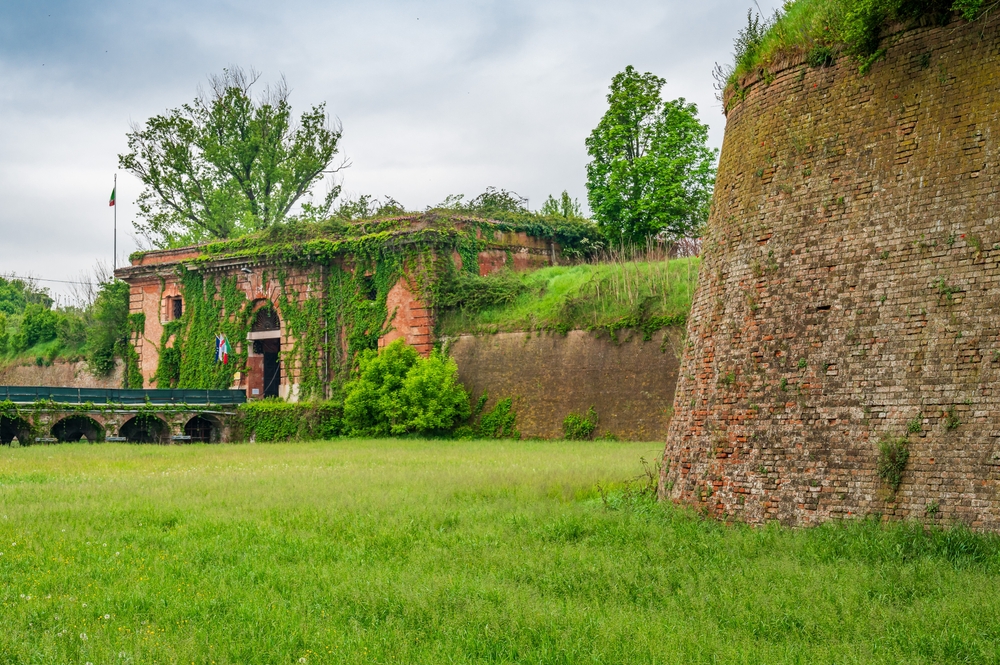
Alessandria (Alessandria, AL, Italy, rated 4.3/5 on Google for 2,400 reviews), located in south-east Piedmont, offers a different face to the region, marked by its military past and strategic role. Founded in the 12th century as a fortress town, Alessandria enjoyed its golden age during the Renaissance and the Napoleonic era.
The city’s most emblematic monument is undoubtedly the Cittadella di Alessandria (Piazza Gobetti, 15057 Alessandria AL, Italy, rated 4.6/5 on Google out of 3,200 reviews), one of the best-preserved military fortresses in Europe. This imposing six-pointed star-shaped citadel, built in the 18th century on the orders of Napoleon Bonaparte, is a testament to the military genius of the time. Recently restored and opened to the public, it offers a fascinating journey through European military history. Guided tours explore the ramparts, bastions and underground galleries.
Alessandria’s historic centre is also well worth exploring. The Piazza della Libertà (Piazza della Libertà, 15121 Alessandria AL, Italy, rated 4.5/5 on Google for 1,100 reviews), a vast rectangular square surrounded by arcades, is the heart of the town’s social life. The Duomo (Piazza Duomo, 15121 Alessandria AL, Italy, rated 4.5/5 on Google for 800 reviews), a 19th-century neoclassical cathedral built by order of Napoleon, dominates the square with its slender bell tower and impresses with its imposing dimensions.
Alessandria is also famous for being the birthplace of Umberto Eco, the famous Italian writer and semiologist, and of the milliner Borsalino, whose hats have conquered the world. The Museo del Cappello Borsalino traces the history of this legendary company and the art of Italian hat-making.
11. The salt route from Cuneo to maritime Piedmont
To round off this tour of must-sees in Piedmont, we head south to Cuneo (Cuneo, CN, Italy, rated 4.4/5 on Google out of 3,100 reviews), gateway to the Maritime Alps. This elegant town, built on a triangular plateau at the confluence of two rivers, boasts a remarkable historic centre laid out in a characteristic chequered pattern.
The long Via Roma, lined with arcades for over a kilometre, is the backbone of the city and one of the longest porticoed streets in Europe. On Tuesdays, it hosts one of the largest markets in Piedmont, vibrant with colour and scent. Piazza Galimberti, a vast area surrounded by beautiful palaces, is the beating heart of Cuneo with its lively cafés and cultural events.
Cuneo is the ideal starting point for exploring the surrounding Alpine valleys, which are full of treasures. The village of Ostana (Ostana, CN, Italy, rated 4.7/5 on Google out of 400 reviews), perched at an altitude of 1,300 metres in the Valle Po, is one of Italy’s most beautiful villages. This Occitan hamlet, long abandoned but now remarkably restored, offers a moving example of traditional Alpine architecture, with its stone houses covered in roofing stones. The cobbled streets wind between the old houses, which have been lovingly restored, offering spectacular views of Mount Viso and the surrounding peaks.
The Cuneo region is also the starting point for the ancient salt route, which once linked the Mediterranean Sea to Piedmont via the Alpine passes. Today, this route offers magnificent hiking itineraries through the Maritime Alps. The Parco delle Alpi Marittime (Parco Naturale Alpi Marittime, CN, Italy, rated 4.7/5 on Google out of 1,900 reviews), which borders on France, preserves an exceptional alpine nature where wolves, ibexes and golden eagles live.
In conclusion, Piedmont is a multifaceted region, where the urban elegance of Turin meets the majesty of the Alpine lakes and the authenticity of the medieval villages. From the renowned vineyards of the Langhe region, which produce some of Italy’s finest wines, to the snow-capped peaks of the Gran Paradiso National Park and the artistic treasures of Savoyard palaces, each place tells its own unique story. A land of refined gastronomy, age-old traditions and breathtaking landscapes, Piedmont is well worth several visits to discover all its riches. Whether you’re an art and history lover, a wine enthusiast, an experienced hiker or simply an epicurean in search of beauty, this region of northern Italy will win you over with its unspoilt authenticity and gentle way of life. Don’t hesitate to let yourself be guided in your exploration of Turin thanks to the Navaway audio-guided itinerary, which will enable you to discover the Piedmontese capital in a fun and enriching way.
Frequently asked questions about Piedmont
When is the best time to visit Piedmont?
Piedmont can be visited all year round, but the ideal periods are spring (April-June) and autumn (September-October). Spring offers lush green landscapes and pleasant temperatures for exploring the lakes and towns. Autumn is harvest time in the Langhe and white truffle season in Alba, with magnificent colours in the vineyards. Summer can be hot in the cities but pleasant in the Alps. Winter is perfect for skiing in the Alpine resorts of Piedmont.
How many days does it take to visit Piedmont?
To discover the main must-see sites in Piedmont, allow at least 5 to 7 days. Allow 2 days for Turin, 1 or 2 days for Lake Maggiore and the Borromean Islands, 2 days for the Langhe and the vineyards, and a further 1 or 2 days to explore other sites such as Venaria Reale, Lake Orta or the Alpine valleys. If you want to explore the region in depth, two weeks won’t be enough.
Getting around Piedmont
A car is the most practical way to explore Piedmont, particularly for visiting the Langhe villages and lakes. The road network is excellent and the scenery magnificent. However, Turin and the main towns are well served by train from Italy’s major cities. Regional trains also connect Turin with towns in the region such as Asti, Alessandria and Novara. As for the lakes, there are boat services to take you from one shore to the other and to visit the islands.
What gastronomic specialities from Piedmont are not to be missed?
Piedmont is a gastronomic paradise. The must-try dishes include Alba white truffles (in autumn), agnolotti del plin (traditional ravioli), vitello tonnato (veal in tuna sauce), brasato al Barolo (wine-braised beef), bagna cauda (anchovy and garlic fondue), grissini from Turin, gianduiotto (chocolate with hazelnuts), and of course cheeses such as Castelmagno and Toma Piemontese. As for wines, try Barolo, Barbaresco, Barbera d’Asti and Moscato d’Asti.
Is Piedmont suitable for family holidays?
Absolutely! Piedmont has plenty to offer the whole family. In Turin, the Cinema Museum in the Mole Antonelliana captivates children, as does the Egyptian Museum. The lakes offer water sports and beaches. The national parks offer easy hikes suitable for families. The medieval village of Valentino Park in Turin is also very popular with children. In autumn, truffle hunting with dogs can be an unforgettable experience for the whole family.
200 audioguided tours for cities all around the world
Download