Visiting Kos: the 8 must-dos

Nestling in the Dodecanese, off the coast of Turkey, the island of Kos is one of the most attractive Greek destinations in the Aegean. Barely 40 kilometres long and 8 kilometres wide, this island offers an exceptional wealth of treasures: ancient remains testifying to thousands of years of history, beaches with crystal-clear waters, picturesque mountain villages and a lively nightlife. A visit to Kos means strolling between Roman ruins and shady tavernas, cycling along a spectacular coastline, or conquering Mount Dikaios. Whether you’re a history buff, a beach lover or just looking for a change of scenery, Visiter Kos won’t disappoint. Here are the 8 things you absolutely must do during your stay.
Also read on the Kos guide :
- The 20 most beautiful Greek islands to visit
- Visit Santorini: the 10 must-sees in Greece
- Discovering the Saronic Islands in Greece
- When to go to Santorini Climate, crowds and advice for each season
- What to do in Athens Top 10 activities + Good tips
- How do I get around the Cyclades by ferry?
- 10 must-see hidden treasures in Greece
1. Get lost in Kos and its ancient remains
As the island’s capital, Kos is a veritable open-air museum. As you wander through its narrow streets, you’ll discover layers of history: Greek, Roman, Byzantine, Venetian and Ottoman civilisations can be seen around every corner. This is where your adventure to visit Kos really begins.
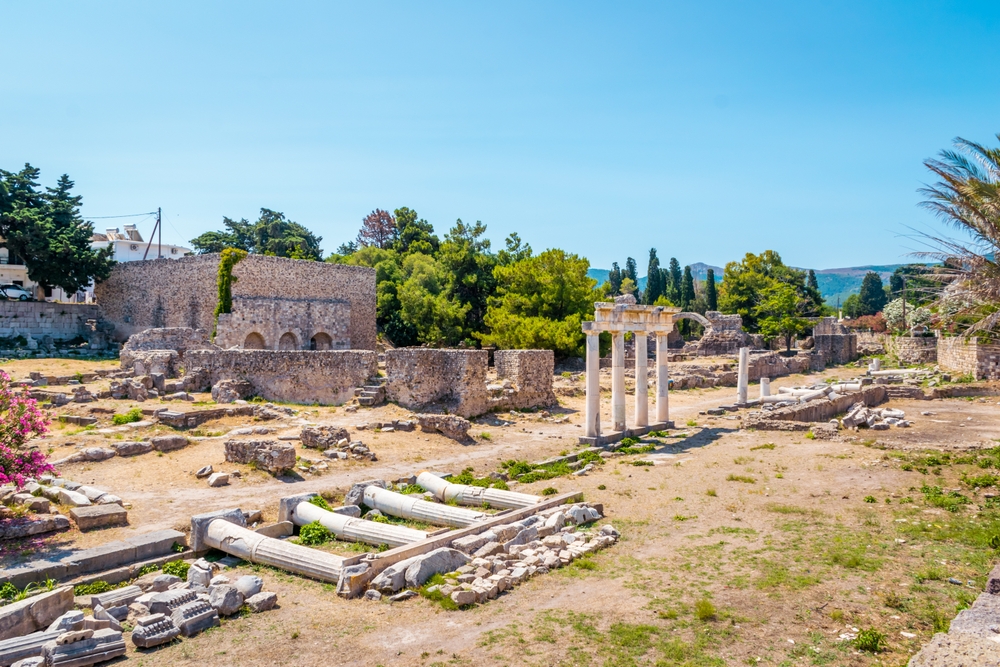
Among the must-see sites in the town, the Ancient Agora of Kos (Kos 853 00, Greece, rated 4.3/5 on Google out of 468 reviews) is one of the town’s largest archaeological excavations. This vast open-air area reveals the foundations of a public market that brought the city to life in ancient times, with its upright columns, cobbled streets and ruined temples. A short walk away, the Kos Archaeological Museum houses a fine collection of sculptures and mosaics found on the island.
Don’t miss the Roman Odeon, a small semi-circular theatre that is still remarkably well preserved, or the Casa Romana, a 3rd-century Roman patrician residence with surprisingly fresh mosaics and frescoes. In short, the city has relics at every turn – a rare feature that makes a stroll through its streets fascinating even for those less keen on history.
2. Discover Nératzia Castle, the medieval fortress of the Knights of Burgundy
Standing proudly opposite the harbour, Neratzia Castle (Akti Miaouli 4, Kos 853 00, Greece, rated 4.2/5 on Google out of 835 reviews) is one of Kos’s strongest symbols. Built in the 14th and 15th centuries by the Knights Hospitallers of St John – the same people who built the famous fortress of Rhodes – this medieval castle offers a fascinating insight into the island’s history.
Its imposing ochre stone ramparts, built in part from materials salvaged from the town’s ancient ruins, tell the story of the island’s resistance to the onslaught of the Ottoman Empire. Once inside, the site presents itself as a collection of ruins strewn with sculptures, capitals and architectural fragments, with a panoramic backdrop of the port of Kos and the Turkish coast of Bodrum. Admission is free, making it an even more enjoyable stop-off on your visit to Kos.
The château is open Wednesday to Monday from 8.30am to 3pm (closed on Tuesdays). Allow an hour for a leisurely tour and enjoy the views over the harbour.
3. Visit Asklepion, the cradle of Western medicine
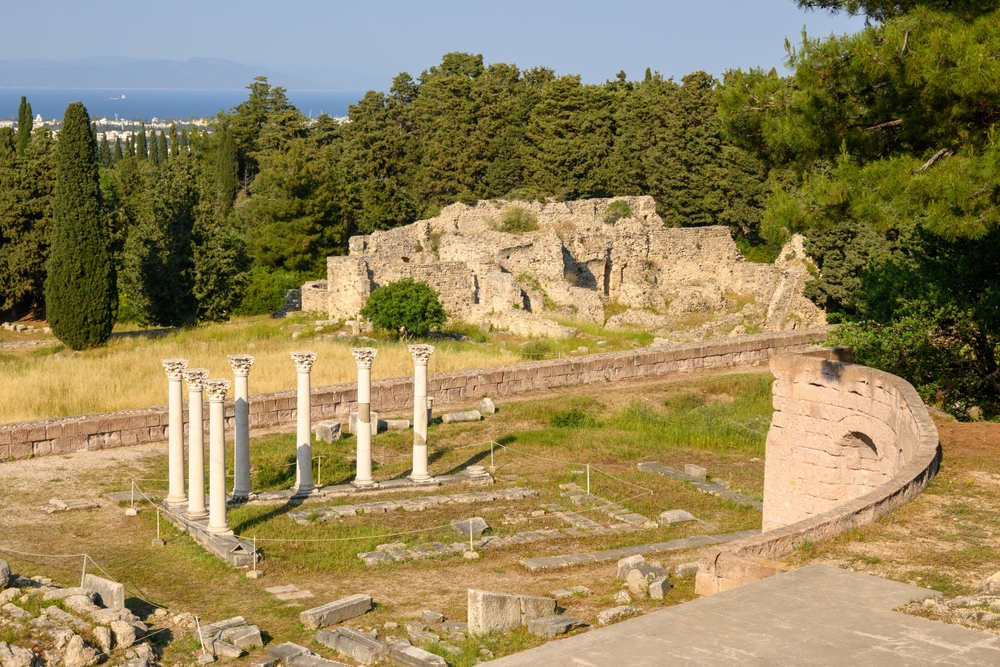
Around 4 kilometres west of the town, perched on a wooded hill with splendid views of the Aegean Sea and the Turkish coast, theAsklepion of Kos (Kos 853 00, Greece, rated 4.4/5 on Google out of 9,552 reviews) is one of the most important archaeological sites in ancient Greece. It was here that Hippocrates, the father of medicine, is said to have studied, practised and taught the art of healing.
This sanctuary dedicated to Asclepius, the god of medicine, was a place of worship, a health centre and a medical school that attracted patients and students from all over Greece. The site is spread over three terraces linked by monumental staircases. There are Doric and Ionic colonnades, the foundations of a temple to Apollo, purification pools and a theatre. The museum adjoining the site is a perfect complement to the visit, with explanations of ancient medical practices.
The Asklépiéion is open every day from 8am to 8pm. To get there from Kos town, you can hire a bike (about 10 minutes’ ride), take the tourist train that runs around the island, or walk along a shady road for about an hour.
4. Reflecting under the Hippocratic plane tree
In the heart of the town, in Place du Platane, stands one of the most famous trees in the world: the Hippocratic plane (Place du Platane, Kos 853 00, Greece, rated 4.3/5 on Google out of 11,489 reviews). Greek legend has it that Hippocrates himself taught his disciples medicine in the shade of this tree, which is several hundred years old.
Scientifically, the tree we see today – an Oriental plane tree with a crown 12 metres in diameter – is not the same tree that grew in the 4th century BC: scientists estimate it to be around 500 years old, and therefore a descendant of the original tree. It doesn’t matter, though, because this place is so full of meaning that it’s well worth the diversions. Backed by the Gazi Hassan Pacha Mosque (now an art gallery), framed by an Ottoman fountain and the ramparts of Nératzia Castle, the whole ensemble forms a unique historical tableau.
The Hippocrates plane tree is accessible free of charge at any time of the day or night. A few steps away, you’ll find cafés and tavernas where you can stop for a well-earned break after your tour of Kos old town.
5. Explore the picturesque villages in the centre of the island
From Kos town, a serpentine road climbs inland in just a few minutes, revealing a completely different face of the island. Perched on the mountainside, the villages of the Asfendiou massif are one of Kos’s most beautiful surprises: here, there is no mass tourism, just narrow flower-filled streets, whitewashed houses and friendly locals.
The village of Zia (Lagoudi Zia 853 00, Greece, rated 4.6/5 on Google for 10,019 reviews) is undoubtedly the most visited and most attractive of these mountain villages. An eagle’s nest overlooking the plain and the sea, it is particularly renowned for its breathtaking sunsets. The tavernas in the central square serve authentic Greek cuisine, while the shops sell local products such as thyme honey, olive oil, aromatic herbs and handcrafted jewellery.
Further east, the abandoned medieval village of Paleo Pyli is worth a short hike (around 4km from the road) to discover its ruined houses, fresh-water fountains and the Byzantine church of Christos. The summit of Mount Dikaios, the island’s highest point at 847 metres, can be reached from Zia via a hiking trail that takes around an hour, and is rewarded with a panoramic view of the entire Dodecanese archipelago. Another village worth visiting is Antimachia, with its traditional house converted into a museum and its restored windmill.
These mountain villages represent the authentic soul of Kos and are well worth a half-day’s exploration.
6. Enjoy the heavenly beaches of Kos
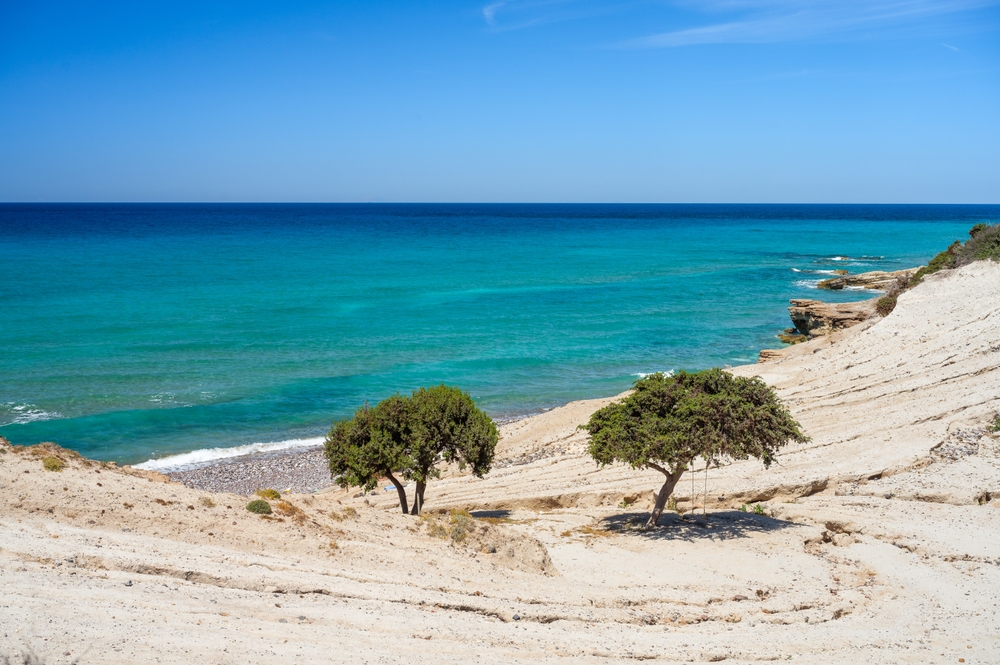
Kos is universally recognised for the quality of its beaches and the purity of its waters. Whether you’re looking for excitement, tranquillity or the most crystal-clear waters in the Aegean, you’ll find what you’re looking for on one of the many beaches that line most of the island.
In the north-east of the island, the beaches of Lambi, Psalidi and Agios Fokas are within easy reach of Kos town, ideal for a quick swim. At Agios Fokas, natural hot springs mingle with the sea, offering a unique thermal experience – locals regularly come here for the supposed virtues of these waters.
On the north coast, Tigaki and Marmari offer long sandy beaches with shallow waters, ideal for families with children. Further east, the beaches of Mastichari and Kardamena combine lively tavernas with translucent waters. For the wildest and most unspoilt beaches, look no further than the Kefalos peninsula in the far south-west, whereAgios Stefanos beach – with the ruins of a Paleochristian basilica in the background – is one of the most beautiful and photogenic in the whole of Greece.
Paradise Beach, near Kefalos, lives up to its name: turquoise waters, immaculate white sand and unspoilt natural surroundings. Getting there can be tricky at times, but the result is well worth the effort.
7. Cycle around the island
Kos is one of Greece’s most cycling-friendly islands, and it’s no coincidence that the two-wheeler has become a tourist icon. The north of the island is almost entirely flat, making it possible to cycle along the coastal roads without any particular effort, enjoying the sea breeze and panoramic views over the Aegean Sea.
Numerous cycle paths link Kos town to neighbouring villages and beaches. You can cycle to Asklépiéion in around ten minutes, or cycle along the coast to the beaches of Tigaki (around 15 km) and Marmari (around 20 km). There are plenty of bike hire companies in Kos, and prices are very affordable (from €5-8 a day for a classic bike, or €15-20 for an electric bike).
For a more sporty experience, mountain bikers can tackle the trails that climb the hills in the centre, particularly towards Zia and Mount Dikaios. This is also the most environmentally-friendly and enjoyable way to get from beach to beach: simply set your bike down, plunge into the incomparably blue waters, then get back on the road to the next cove.
8. Take a boat trip to the neighbouring islands
The geographical position of Kos, in the heart of the Dodecanese, makes it a great starting point for boat trips to neighbouring islands. These maritime escapades are often one of the best memories for travellers visiting Kos.
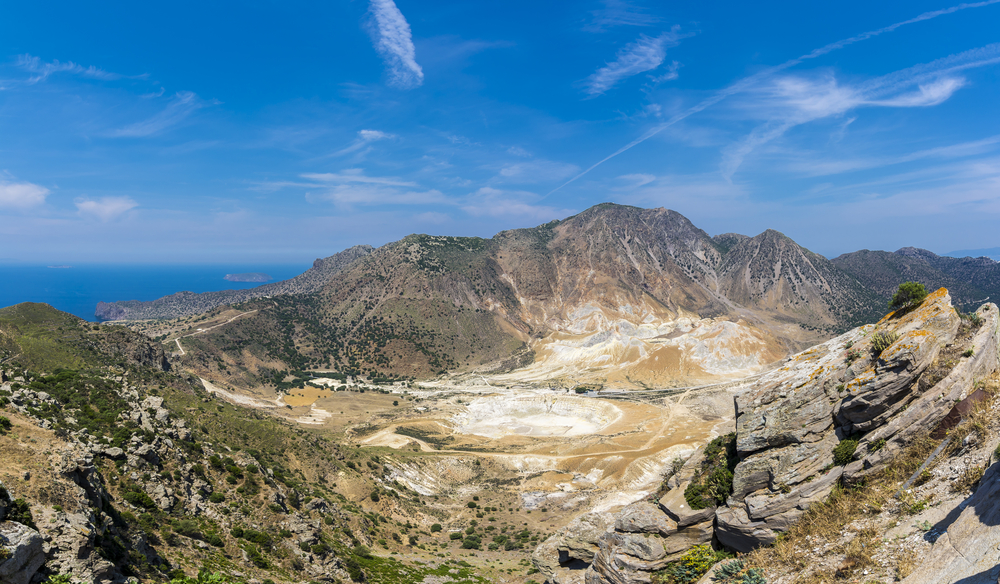
Nisyros, the volcanic island, is the most spectacular: just 30 minutes by boat from Kardamena, it is home to one of the most accessible active volcanoes in Europe. You can descend into the Stefanos crater to be confronted by a breathtaking sulphurous lunar landscape – an experience unique in the whole of Greece. Day trips depart regularly from the ports of Kos in high season.
Kalymnos, nicknamed the island of sponges and climbers, can be reached in around 1? hours. Its colourful harbour, white limestone cliffs and friendly locals make it an ideal day trip destination. Pserimos, a tiny, unspoilt island between Kos and Kalymnos, offers a wild beach and absolute tranquillity, ideal for a lazy day away from the crowds.
From the port of Kos, it is also possible to reach Bodrum in Turkey by ferry in half an hour – an original way to discover another continent and visit St Peter’s Castle, a fascinating underwater museum. Cruise ships also offer tours combining several Dodecanese islands: Rhodes, Symi, Leros or Patmos can all be added to your programme.
As well as these 8 must-sees, Kos has plenty of other activities in store: scuba-diving sessions around the island (the Dodecanese seabed is remarkably rich), days out at the Aquatica Water Park (Kardamaina 853 02, Greece, rated 4.2/5 on Google for 1,180 reviews) for families, or lively evenings in the bars and clubs on Kos town’s disco street.
In conclusion, to visit Kos is to embrace several millennia of history while revelling in the simple pleasures of Mediterranean life – swimming in turquoise waters, sampling Greek cuisine in a shady taverna, or contemplating the sunset from the village of Zia. This Dodecanese island, often underestimated in favour of Santorini or Mykonos, richly deserves its place among the top destinations of insular Greece.
FAQ – Frequently asked questions about visiting Kos
When is the best time to visit Kos?
The best time to visit Kos is from May to October. June, September and October are ideal: the weather is fine, the sea is warm and there are fewer tourists than in July and August. The high season (July-August) corresponds to the highest temperatures (up to 35°C) and the greatest crowds on the beaches and at the tourist sites. Spring (April-May) is excellent for hiking and visiting archaeological sites, with lush green vegetation and mild temperatures.
How do I get around Kos?
There are several options for getting around Kos. Cycling is ideal for the northern part of the island (flat terrain) and getting around town. Hire a car or scooter to explore the whole island, particularly the southern beaches and mountain villages (from €30/day for a car). The KTEL bus links Kos town with the main villages and beaches. A tourist train also runs through Kos town and up to Asklépiéion. For excursions to neighbouring islands, ferries depart daily from the ports of Kos and Kardamena in season.
How many days does it take to visit Kos?
A minimum stay of 5 to 7 days is recommended to get the most out of Kos. This will allow you to devote one day to visiting the town of Kos and its ancient sites, half a day to the Asklepion, one day to the mountain villages, two days to the beaches and cycling, and at least one day for a boat trip to Nisyros or Kalymnos. For a quick trip, 3 days is enough to cover the essential points with the Navaway audio tour.
Is Kos an island suitable for families with children?
Yes, Kos is a very family-friendly destination. The many sandy beaches with shallow waters (Tigaki, Marmari, Mastichari) are ideal for children. The Aquatica Water Park at Kardamena will appeal to children of all ages. The flat terrain of the northern part of the island is ideal for family cycling. The archaeological sites, most of which are accessible free of charge to under-18s, can also arouse the curiosity of younger visitors with the right explanatory tools – such as those offered by the Navaway audio tour.
Can you visit Turkey from Kos?
Absolutely! Kos is just 4 kilometres from the Turkish coast. A fast ferry runs daily between Kos and Bodrum (Turkey) in around 30 to 45 minutes. Various ferry companies run services several times a day in high season. Remember to have a valid passport (an identity card alone is not enough to enter Turkey for nationals of many countries). This trip to Bodrum, with its St Peter’s Castle and bustling market, is a very popular experience for visitors to Kos.
200 audioguided tours for cities all around the world
Download