Historic monuments in Montréal: 7 sites to discover

Montréal, a Quebec metropolis with a rich colonial past, is home to historic monuments that bear witness to its fascinating evolution. From majestic religious buildings to the emblematic squares of Old Montreal, each stone tells a unique story. Discover these 7 historic monuments that embody the soul of the city and let yourself be transported through the centuries on your visit to Montreal.
Download the audio-guided tour to discover Montreal on foot and on your own
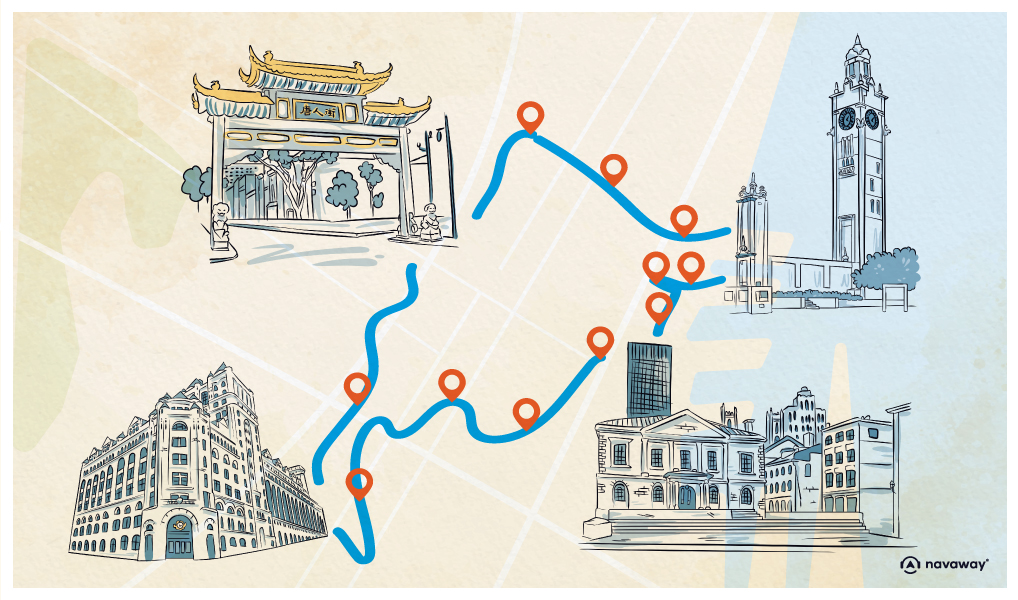
Discover Montreal with the Navaway audio tour, which takes you through the iconic streets of Quebec’s metropolis. In 6.5 km and around 2 hours 40 minutes of walking, explore 24 major places of interest with captivating historical commentaries and unusual anecdotes. This route allows you to visit Montreal on your own, at your own pace, while learning more about each historic monument you come across.
You can also read in the Montreal guide :
- Visit Montreal in 1 day: 24 things to do and see on foot
- What to do in Montreal Top 8 activities + Tips
- Top 8 best hotels in Montreal
- Top 10 culinary specialities in Montreal
- Visiting Canada
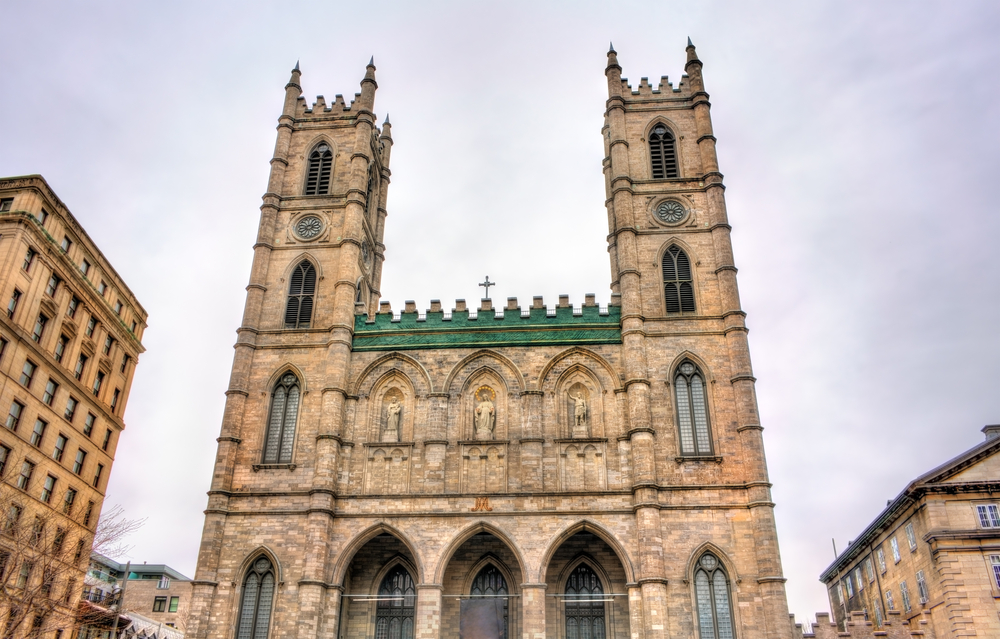
1. Notre-Dame de Montréal Basilica
A true jewel of neo-Gothic architecture, Notre-Dame de Montréal Basilica majestically dominates Place d’Armes in Old Montréal. Built between 1824 and 1829 by Irish-American architect James O’Donnell, it stands on the site of the former Notre-Dame parish church, which had become too small to accommodate the city’s growing population.
As soon as you walk through its doors, you are struck by the splendour of its interior: a deep azure nave adorned with dazzling gilding, remarkably fine carved woodwork and stained glass windows recounting the religious history of Montreal. The star-vaulted ceiling creates a celestial atmosphere, while the choir altarpiece, a true masterpiece, is a real eye-catcher.
The basilica is also home to a monumental 7,000-pipe Casavant organ and a chapel of the Sacred Heart at the back, known for its avant-garde architecture following its reconstruction after the fire of 1978. This historic Montreal landmark bears witness to the importance of Catholicism in the city’s development, and remains one of the most photographed buildings in Quebec (110 Rue Notre-Dame Ouest, Montreal, QC H2Y 1T1, rated 4.7/5 on Google for over 20,000 reviews).
The Navaway route takes you straight to this architectural masterpiece and reveals all the secrets of this iconic basilica.
2. Saint Joseph’s Oratory of Mount Royal
Perched on the northern slope of Mount Royal, Saint Joseph’s Oratory is the largest shrine dedicated to Saint Joseph in the world. Founded in 1904 by Brother André Bessette, a humble porter at Collège Notre-Dame renowned for his healing powers, this religious monument attracts millions of pilgrims and visitors every year.
The history of the Oratory began modestly with a small chapel measuring 4.5 metres by 5.5 metres, built thanks to the determination of Brother André. In response to the growing number of worshippers, construction of the current basilica began in 1924, based on plans by architects Dalbé Viau and Alphonse Venne. The work was spread over several decades, and it was not until 1967 that the building was completed, thirty years after the death of Brother André.
The Oratory’s architecture is a harmonious blend of Italian Renaissance style on the outside and modern design on the inside. Its imposing dome, one of the largest in the world, rises to a height of 97 metres and dominates the Montreal landscape. Inside, you’ll discover colourful stained glass windows, a century-old crypt housing the relics of Brother André, and a museum tracing the history of the sanctuary.
The Garden of the Way of the Cross, set on the slopes of Mount Royal, offers a meditation path punctuated by sculptures and a spectacular panoramic view of the city. A staircase with 283 steps allows the most fervent pilgrims to climb the site on their knees, perpetuating an age-old devotional tradition (3800 Queen Mary Road, Montreal, QC H3V 1H6, rated 4.6/5 on Google for over 50,000 reviews).
3. Château Ramezay – Museum and historic site
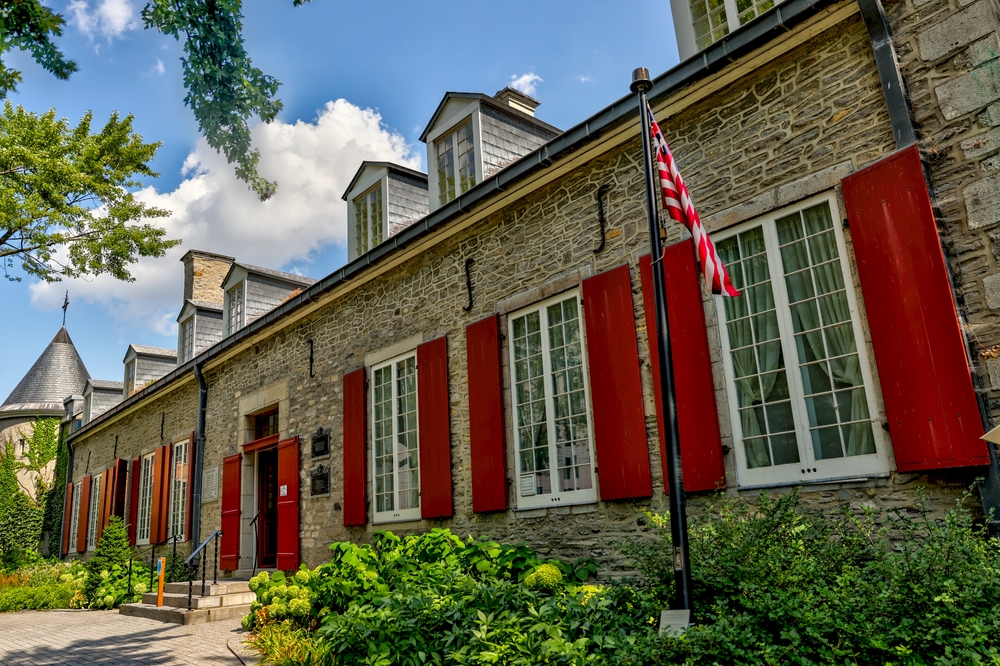
Opposite Montreal’s City Hall stands the Château Ramezay, the first building in Quebec to be classified as a historic monument. Built in 1705 as the residence of the Governor of Montreal, Claude de Ramezay, this stone building with its French colonial architecture has endured more than three centuries of turbulent history.
Over the years, the Château Ramezay has served many purposes: governor’s residence, headquarters of the West India Company, headquarters of American troops during the occupation of 1775-1776, then courthouse. This succession of functions makes it a privileged witness to the great upheavals that have shaped Montreal and Quebec.
Converted into a museum in 1895 by the Société d’archéologie et de numismatique de Montréal, it is the oldest private history museum in Quebec. The permanent collections retrace 500 years of history, from the pre-colonial period to the present day, via New France and the British regime. The typical 18th-century vaults in the basement, the meticulously reconstructed period salons and the thematic exhibitions immerse visitors in the atmosphere of the Montreal of yesteryear.
The formal garden surrounding the château, with its geometric flowerbeds and medicinal plants, evokes the art of living in New France. A must-see place to understand the evolution of Montreal through its historic monuments (280 Rue Notre-Dame Est, Montreal, QC H2Y 1C5, rated 4.5/5 on Google out of around 2,500 reviews).
4. Place Jacques-Cartier
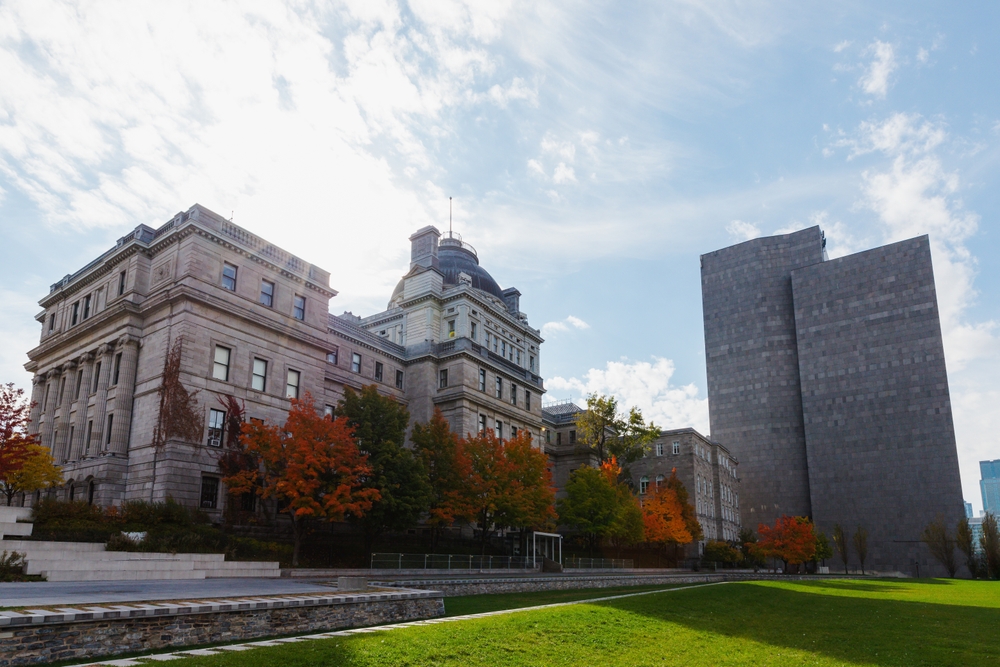
At the heart of Old Montreal, Place Jacques-Cartier is one of the city’s liveliest and most historic public spaces. Created in 1808 on the site of the former château of Governor Philippe de Rigaud de Vaudreuil, destroyed by fire in 1803, this gently sloping square slopes down to the St. Lawrence River and the old port.
Named in honour of Jacques Cartier, the French explorer who discovered the site of Montreal in 1535, the square is crowned by the Nelson Column, erected in 1809. This 15-metre-high monument pays tribute to British admiral Horatio Nelson, victor of the Battle of Trafalgar, long before London built its own Nelson column in Trafalgar Square in 1843.
Throughout its history, Place Jacques-Cartier has served as a public market, a popular gathering place and a stage for numerous events. Today, it is teeming with street artists, portrait painters, musicians and restaurant terraces. The heritage buildings that line it, including the Del Vecchio house dating from 1807, create a picturesque atmosphere reminiscent of the colonial era.
In summer and winter alike, the square remains an essential meeting place, where residents and tourists mingle in a friendly atmosphere. The Navaway audio guide takes you on a tour of this place steeped in history and invites you to stroll along its century-old cobblestones (Place Jacques-Cartier, Montreal, QC, rated 4.4/5 on Google out of around 11,000 reviews).
5. Maison Saint-Gabriel
In the Pointe-Saint-Charles district, Maison Saint-Gabriel stands as one of the oldest architectural reminders of New France in Montreal. Built around 1660 by François Le Ber, a wealthy fur trader, this stone house became the property of Marguerite Bourgeoys, founder of the Congrégation de Notre-Dame de Montréal and the first teacher in New France, in 1668.
Sainte Marguerite Bourgeoys used this farmhouse to house and train the Filles du Roy, the young women sent by Louis XIV to populate the colony. Within these walls, they learned the rudiments of colonial life: cooking, sewing, farming and running a household, before marrying settlers and starting a family. Maison Saint-Gabriel thus played a crucial role in the establishment and development of French-Canadian society.
Listed as a historic monument, the house now houses a museum that faithfully recreates the daily life of Montréal’s first inhabitants in the 17th and 18th centuries. The period-furnished rooms, antique utensils, farming tools and traditional clothing give a concrete idea of what life was like for these pioneers.
The vegetable gardens and orchards surrounding the property, cultivated according to the methods of New France, complete this plunge into the past. Guided tours and educational activities are offered on a regular basis to help visitors relive this fascinating page in Montreal’s history (2146 Place Dublin, Montreal, QC H3K 2A2, rated 4.7/5 on Google out of around 400 reviews).
6. Bonsecours Market
Along rue Saint-Paul, facing the Old Port, the Marché Bonsecours unveils its magnificent neoclassical façade topped by a silver dome that sparkles in the sunlight. Inaugurated in 1847, this monumental grey stone building designed by architect William Footner is one of the finest examples of 19th-century public architecture in Canada.
For over a century, the Bonsecours Market was the economic heart of Montreal, welcoming farmers and merchants who came to sell their wares. But its history is not limited to commerce: the building also served as the seat of the city council from 1852 to 1878, and even housed the Parliament of the United Province of Canada for a few years. Lavish balls and social events were held in its great hall, making the market a centre of Montreal’s social life.
Its Doric-columned portico, six spacious halls and strategic riverside location made it a symbol of prosperity and prestige. After a period of decline in the 20th century, the Marché Bonsecours underwent a meticulous restoration in the 1990s.
Now a National Historic Site of Canada, the building houses Quebec craft shops, art galleries and exhibition spaces. Its reception hall hosts concerts, conferences and cultural events. During your guided tour with the Navaway audioguide, take the time to admire its majestic façade from de la Commune Street and imagine the bustle that animated this place in the 19th century (325 Rue de la Commune Est, Montréal, QC H2Y 1J1, rated 4.4/5 on Google for more than 8,000 reviews).
7. Notre-Dame-de-Bon-Secours chapel
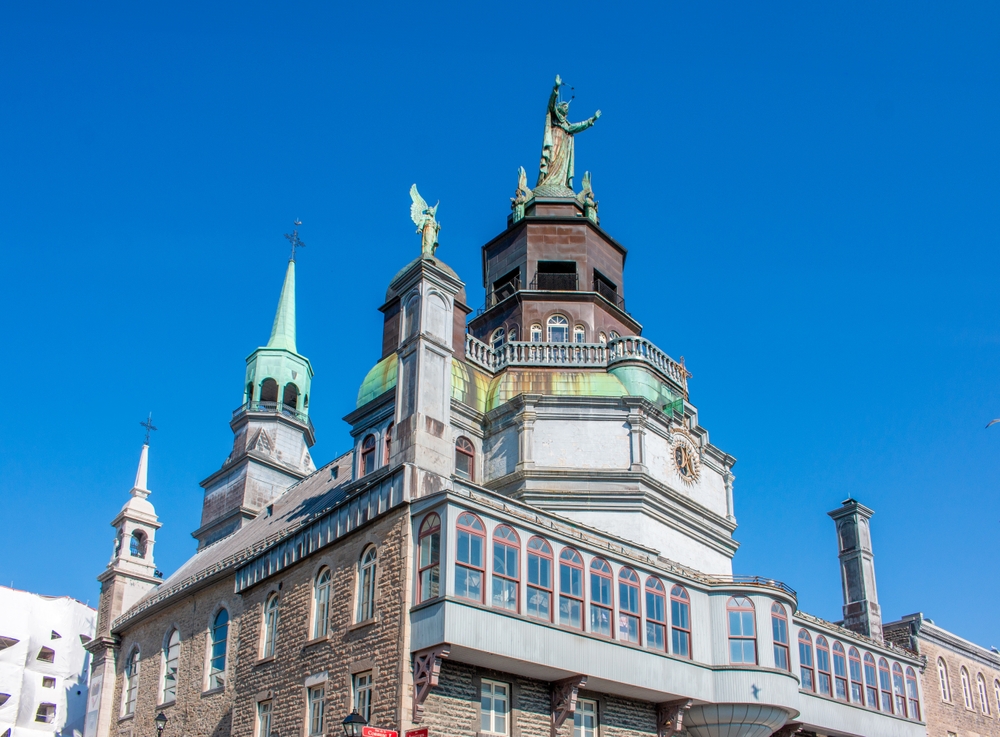
Just a stone’s throw from Bonsecours Market, Notre-Dame-de-Bon-Secours chapel has watched over the Old Port since 1771. Nicknamed the “sailors’ church” because of its proximity to the port and the sailors’ devotion to Notre-Dame-de-Bon-Secours, protector of travellers, this chapel holds a special place in the hearts of Montrealers.
It was Marguerite Bourgeoys herself who had the first wooden chapel erected on this site in 1675, well before the construction of the current stone building. The saint wanted to offer a place of prayer accessible to the inhabitants of the port and to passing sailors. Destroyed by fire, then rebuilt several times, the chapel we admire today dates from the 18th century and was enlarged in the 19th century.
Its elegant neoclassical façade, enhanced by columns and a triangular pediment, contrasts with the richly decorated interior in the Baroque style. The many votive offerings hanging in the nave bear witness to the gratitude of the sailors saved from the shipwreck. A statue of the Virgin Mary, her arms outstretched towards the river, dominates the roof and symbolically blesses the ships entering the port.
The Marguerite Bourgeoys Museum, located in the crypt of the chapel, traces the life of the saint and the religious history of Montreal. Don’t miss the chance to climb up to the observation tower for a 360-degree panoramic view of Old Montreal, the St. Lawrence River and the city centre. This unique vantage point allows you to grasp the full extent of the architectural heritage surrounding this historic monument (400 Rue Saint-Paul Est, Montréal, QC H2Y 1H4, rated 4.6/5 on Google out of around 3,000 reviews).
In conclusion, these 7 historic monuments of Montreal are essential milestones in understanding the evolution of this fascinating metropolis. From the religious fervour exemplified by Notre-Dame Basilica and Saint Joseph’s Oratory, to the vestiges of New France such as Maison Saint-Gabriel, to social centres such as Place Jacques-Cartier and Bonsecours Market, each site tells the story of a chapter in Quebec’s history. To discover these heritage treasures in a rewarding way and at your own pace, let yourself be guided by the Navaway audio tour, which will reveal all the secrets of the city during your stay.
FAQ
What is Montréal’s oldest historic monument?
Maison Saint-Gabriel, built around 1660, is one of the oldest buildings in Montreal that can still be seen today. It bears witness to the architecture of New France and the life of the first settlers.
How long does it take to visit Montreal’s historic monuments?
To discover these 7 historic monuments at a comfortable pace, allow at least 2 full days. The Navaway itinerary allows you to explore the historic centre in around 2 hours and 40 minutes, plus the time needed to visit each site.
Can I visit Notre-Dame Basilica for free?
Notre-Dame Basilica is an active place of worship, but admission is charged to visitors outside religious services. The ticket gives access to the entire basilica and often includes an explanatory audio guide.
When is the best time to visit Montreal’s historic monuments?
Spring (May-June) and autumn (September-October) offer pleasant temperatures and fewer tourists. Summer is still the high season, with plenty of entertainment, while winter offers the chance to discover snow-covered Montreal, with fewer visitors but very cold temperatures.
Does the Navaway audioguide work offline?
Yes, once downloaded, the Navaway audioguide works completely offline. So you can explore Montreal without using mobile data, while enjoying audio commentaries on each historic monument.
200 audioguided tours for cities all around the world
Download