Côte Vermeille cruise: 6 sites to discover

The Côte Vermeille, nestling between the foothills of the Pyrenees and the Mediterranean, is one of the most enchanting cruising destinations on the French coast. From its purple schist cliffs to its ochre-faced villages, every turn reveals a vivid picture combining Catalan history, unspoilt nature and unique Mediterranean light. Embarking on a cruise along the Côte Vermeille means sailing between sites that have inspired Matisse, defied the armies of Charles V and fascinated lovers of the sea for centuries. Whether you set off from Argelès-sur-Mer or another marina in the region, here are the 6 must-see sites to discover on your cruise along the Côte Vermeille.
200 audioguided tours for cities all around the world
DownloadAlso in the Collioure guide :
- Top 5 things to do in and around Collioure
- The most beautiful villages in the Pyrénées-Orientales
- The most beautiful villages to visit around Perpignan
- What to do in and around Perpignan
- Visiting the Pyrenees: 20 must-dos
- The 8 best straw huts around Perpignan
- The 16 most beautiful lakes in the Pyrenees
1. The port of Collioure, the Catalan jewel on the Côte Vermeille
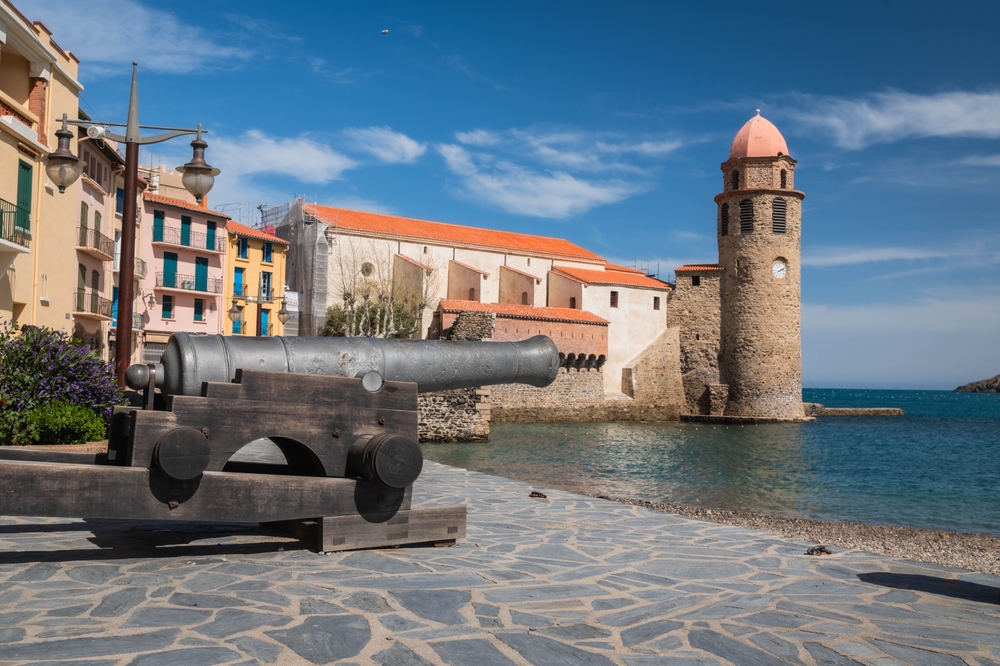
It’s impossible to think of a cruise along the Côte Vermeille without starting with Collioure, nicknamed the “Catalan Pearl”. From the sea, the view of the village is breathtaking: the houses with their pink and ochre facades spread out in an amphitheatre at the foot of the hills, framed by two monuments that have been seen around the world.
The Château Royal de Collioure has dominated the bay since the 7th century. Enlarged and fortified over the centuries, notably by the Kings of Aragon and Majorca, it remains one of the last remaining medieval seaside castles in France. From your yacht or boat, its massive silhouette set against the rock offers one of the most photographed panoramas of the French Mediterranean.
Just a stone’s throw away, the church of Notre-Dame-des-Anges and its pink bell tower topped with a glazed tile dome are the ultimate symbol of Collioure. The church tower was once used as a lighthouse to guide boats entering the bay. From the sea, it’s easy to see why Matisse and Derain set down their easels here in 1905 to invent Fauvism.
If you drop anchor in the bay, be sure to explore the boulevard du Boramar on foot, the emblematic promenade between the château and the church, or the chapel of Saint-Vincent, perched on the rocks at the end of the jetty. The port of Collioure itself, with its brightly-coloured Catalan boats, is an authentic haven where you can linger over a glass of Collioure wine and a plate of anchovies.
Download the audio tour to discover Collioure on foot and on your own
To make the most of your stopover in Collioure, theNavaway audioguide itinerary allows you to explore the “city of painters” in complete freedom. In a 3km, 1? hour stroll, 21 audio guides will immerse you in the history, legends and anecdotes of its narrow streets, from the Maison du Fauvisme to the heights of the Moulin de la Cortina. An ideal companion for sailors who want to visit Collioure at their own pace, with no time constraints.
2. Fort Saint-Elme, the impregnable sentinel of the Vermeille coast
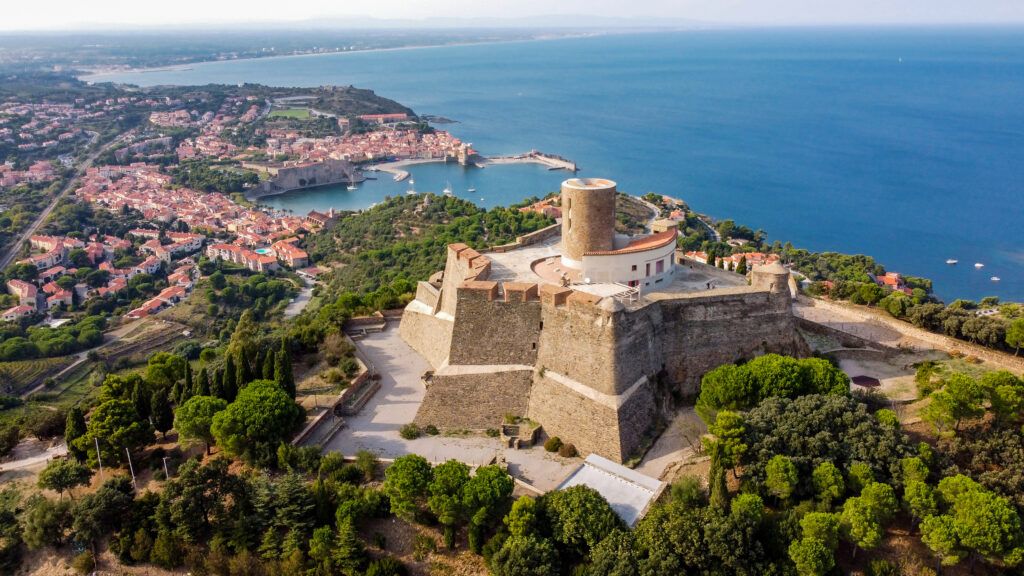
When you look up to the heights between Collioure and Port-Vendres on your cruise, you can’t miss Fort Saint-Elme. Perched 170 metres above sea level on a ridge overlooking the entire coast, this massive stone star is one of the most recognisable silhouettes on the Vermeille coast.
Its history dates back to the 9th century, when the Moors erected the first watchtower to keep watch over the coastline. It was under the orders of Charles V, between 1538 and 1552, that the fortress took on its characteristic star shape, an ingenious military design that allowed it to cover all angles of attack and resist the new firearms. Vauban later improved on it in the 17th century, making Fort Saint-Elme one of the key elements of the Catalan defensive system.
From the sea, its austere architecture and grey ramparts stand out against the green backdrop of the garrigues. The panoramic view from its ramparts is quite simply exceptional: on a clear day, you can see the Spanish coast to the south, the peaks of the Albères and, of course, the bay of Collioure in all its splendour. It’s a sight that sailors can see from their cockpit, but one that can only be fully experienced on land.
Fort Saint-Elme is currently closed to internal visits (private property since 2023), but its external tour, accessible on foot from Collioure via a signposted path starting from the Musée d’Art Moderne, remains an extraordinary walk with unforgettable views of the entire coastline. If you stop off in Collioure, take the Navaway audioguide tour to the fort, which includes this must-see monument.
3. Port-Vendres, an authentic fishing port with Catalan flair
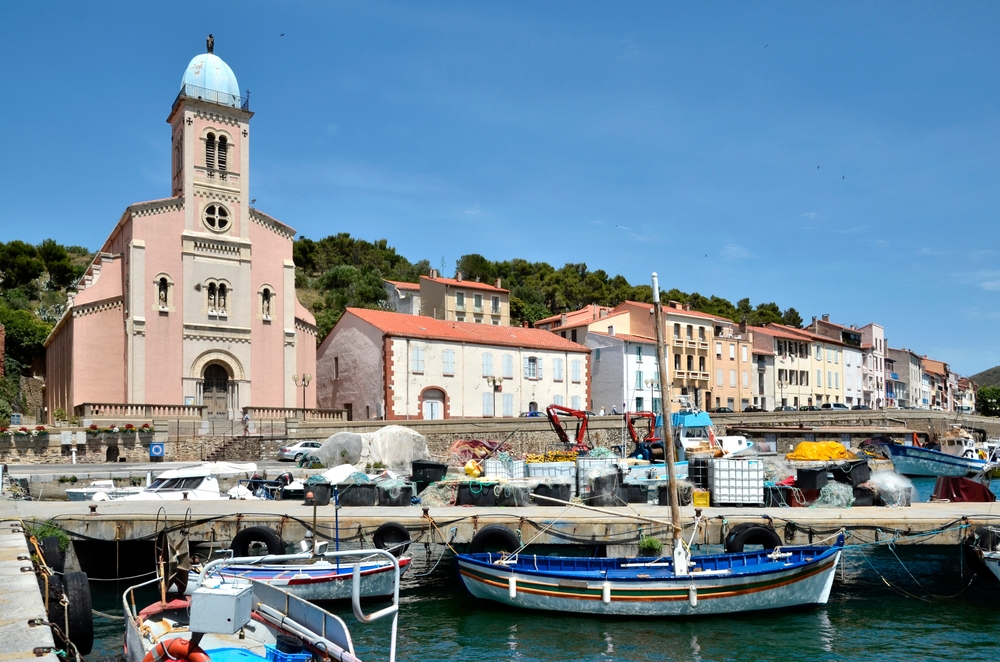
Just 2km from Collioure, Port-Vendres(Portus Veneris, Latin for “Port of Venus”) offers a radically different face on a cruise along the Côte Vermeille. This natural deep-water port, one of the few on the entire coast, is still an active fishing, commercial and yachting port. Its sheltered harbour makes it an ideal stopover for sailors surprised by the wind.
From the sea, the town reveals all its typical Catalan features: warmly-coloured facades set against the surrounding hills, a lively quay from which trawlers depart and arrive daily, and on the heights, the ruins of the Mauresque fort and the Fanal redoubt, built by Vauban to watch over the entrance to the port. Further up towards the headland, you can see the Cap Béar semaphore, a watchtower that is still in operation.
On the quays(66660 Port-Vendres, rated 4.6/5 on Google out of 695 reviews), the atmosphere is authentic: fishermen unload their morning catch in a lively, colourful atmosphere. ThePort-Vendres obelisk, dedicated to Louis XVI, sits enthroned on the Quai Fanal – one of the few royal monuments to have survived the French Revolution standing upright. The weekly market, on Friday and Saturday mornings, is an opportunity to sample the local flavours: anchovies, red mullet, langoustines and Catalan specialities such as bullinada.
Port-Vendres is also the ideal starting point for excursions to the surrounding wild coves, particularly those stretching towards Cap Béar, accessible only by sea or on foot via the coastal path. Anchoring opposite the quay lets you enjoy an evening in a true Catalan port, far from the tourist hustle and bustle of Collioure.
4. Cap Béar and its emblematic lighthouse, watchtowers of the Vermeille coast
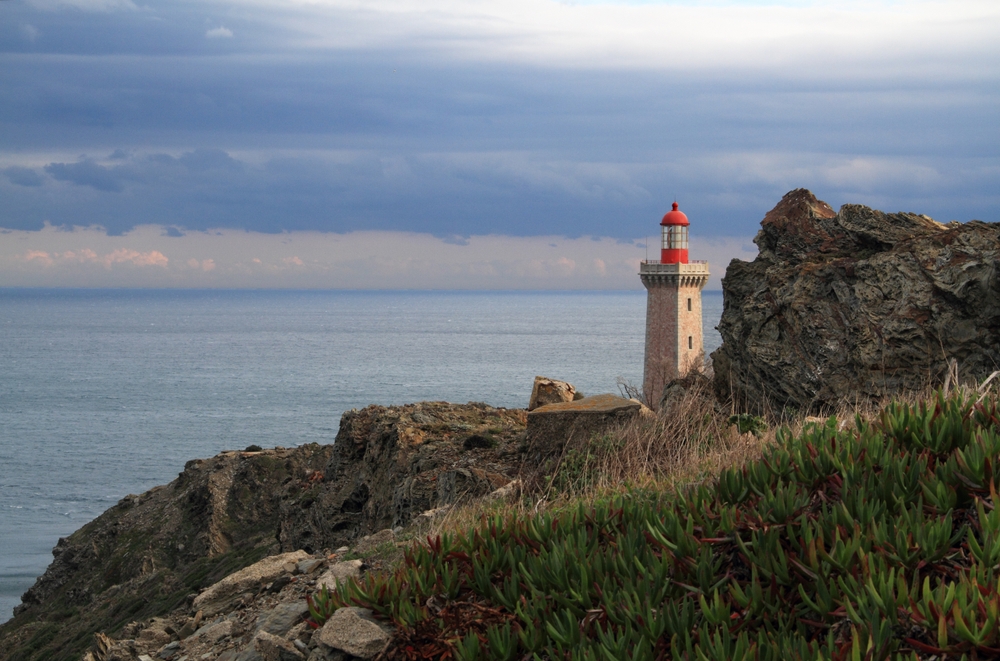
To the south of Port-Vendres, the Cap Béar lighthouse(Chem. du Cap Béar, 66660 Port-Vendres, rated 4.6/5 on Google out of 1,377 reviews) is one of the highlights of a cruise along the Vermeille coast as seen from the sea. This spectacular rocky outcrop, a land of wild garrigues and cliffs plunging into deep blue water, marks a break between the bay of Port-Vendres and the cove of Paulilles.
The Cap Béar lighthouse, which was lit in 1905 and classified as a historic monument in 2012, stands atop a 27-metre pyramidal tower built from blocks of pink Villefranche marble. With a range of 30 nautical miles, it is an essential landmark for sailors along the Vermeille coast. Remarkably, it is one of the few lighthouses in France to have its interior walls covered in opaline tiles, giving it a unique architectural character.
From the open sea, Cap Béar offers a breathtaking 360° panorama: the Pyrenees in the background, the Spanish coast to the south, wild coves and red shale cliffs below. On the nearby heights, the Cap Béar semaphore – still in operation – watches over the waters and guides ships. Remains of Second World War bunkers dot the summit, silent witnesses to a strategic past.
Beware: Cap Béar is exposed to strong winds, particularly during episodes of tramontana, which can make the approach tricky. In fine weather, however, the coves at the foot of the cliffs are ideal for swimming and snorkelling – the crystal-clear waters reveal exceptional marine life, right on the edge of the Cerbère-Banyuls marine reserve.
5. The Paulilles cove, a natural setting and an industrial memory
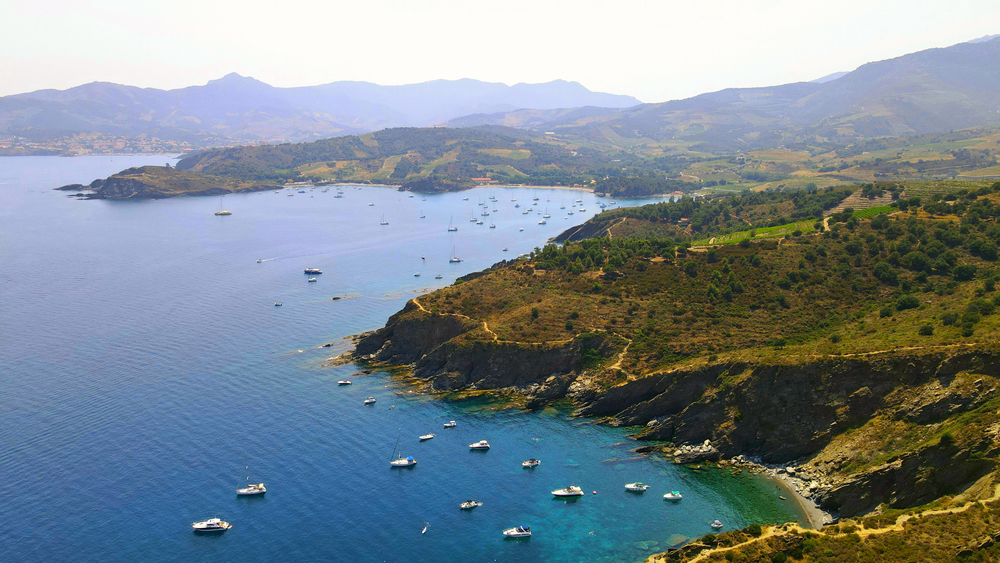
Nestling between Cap Béar and Port-Vendres, the Paulilles cove(Route Départementale 914, 66660 Port-Vendres) is one of the most beautiful surprises on a cruise along the Vermeille coast. This 17-hectare listed site, at the foot of the Albères mountain range, hides a fascinating history behind its peaceful beaches and turquoise waters.
The cove may seem like a paradise of unspoilt nature today, but for over a century it was the scene of intense industrial activity. In 1870, Alfred Nobel set up France’s first dynamite factory, which produced up to 20 tonnes of explosives a day to supply the world’s major construction sites (tunnelling, mining, etc.). The factory closed for good in 1984. After years of neglect, the site was converted into a natural and cultural area, managed by the Conservatoire du Littoral.
Today, the rehabilitated former industrial buildings house an eco-museum with exhibitions on the history of the dynamite factory and a workshop for restoring traditional Catalan boats. Walking trails follow the coast through pine forests, cork oak forests and Mediterranean scrubland. The pebble beaches are ideal for swimming in the remarkably clear waters, and the underwater posidonia meadows are a delight for snorkellers.
For sailors, the Paulilles cove offers a particularly pleasant anchorage in a northerly wind. Its location between Cap Béar and Banyuls makes it a natural stopover for resting and exploring the surrounding area. Activities around Collioure and the Côte Vermeille include hiking from Paulilles to the Cap Béar lighthouse, one of the most beautiful coastal walks. On site, the Clos de Paulilles wine estate by the sea offers tastings of Collioure and Banyuls wines in breathtaking surroundings.
6. The port of Banyuls-sur-Mer, between terraced vineyards and the wild Mediterranean
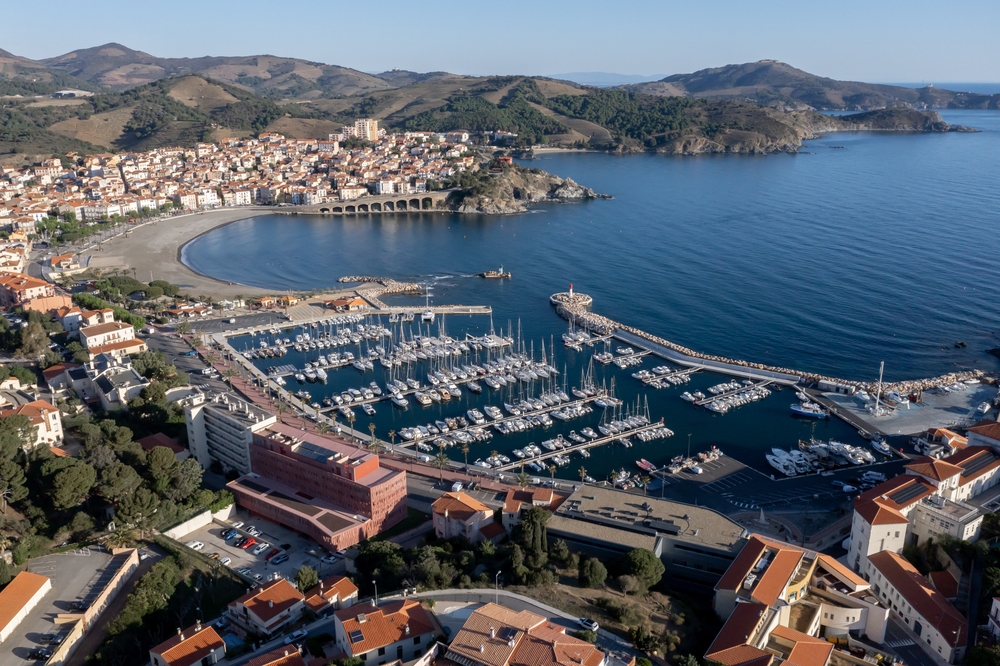
Banyuls-sur-Mer is the last port of call on a cruise along the Côte Vermeille, a coastal village of discreet, authentic charm nestling on the edge of Mediterranean France, just a few kilometres from Spain. Its marina is well protected from the prevailing winds, making it a safe and pleasant stopover for sailors.
From the sea, the scenery is unique: terraced vineyards tumble down the slopes of the Albères to the beach, offering a picturesque picture that can’t be found anywhere else on the French coast. These vines clinging to the purple shale produce the famous Banyuls wines (natural sweet wines made from black Grenache, with notes of candied fruit and coffee) and Collioure wines. Several estates, such as Terres des Templiers, welcome visitors for memorable tastings just a stone’s throw from the water.
Banyuls-sur-Mer is also the birthplace of the sculptor Aristide Maillol (1861-1944). His home and studio, Mas Maillol, is nestled in the heights in the middle of a Mediterranean garden, and is open to visitors. In town, the Biodiversarium(avenue du Fontaulé, 66650 Banyuls-sur-Mer) is a unique scientific centre combining a Mediterranean aquarium, botanical garden and exhibitions on marine and terrestrial biodiversity – fascinating for young and old alike.
Just a stone’s throw away, the Cerbère-Banyuls marine reserve is one of the oldest marine nature reserves in France. Its crystal-clear waters are home to exceptional biodiversity: groupers, sars, girelles, octopuses and forests of red gorgonians. A paradise for scuba divers, accessible directly from the anchorage. The coastal path, which links Banyuls to Cerbère and then to the Spanish border, offers breathtaking views of this wild, unspoilt coastline.
After anchoring in the port, let yourself be guided through the narrow streets of Banyuls before setting sail again. And if your itinerary takes you back to Collioure, take the opportunity to visit Collioure on foot thanks to the Navaway audioguide tour: 21 sound stages so you don’t miss a thing of the Catalan pearl of the Vermeille coast.
Some practical advice for your cruise on the Côte Vermeille
The Vermeille coast is best explored in spring (April-June) or in September-October, outside the high season. The prevailing winds are the tramontana (a strong, refreshing north-westerly) and the marin (a warm, humid south-easterly). In summer, the winds are lighter but the sea can be rough in the afternoon. The most popular anchorages are the bay of Collioure, the cove of Paulilles and the port of Banyuls. For a full cruise, allow 2 to 3 days to explore each of the 6 sites at your own pace.
All in all, the Vermeille coast boasts a remarkable diversity of sites in just a few kilometres, ranging from historic heritage to unspoilt nature and the Catalan art of living. From the port of Collioure and its colourful boats to the terraced vineyards of Banyuls, via the fortress of Fort Saint-Elme, the authenticity of Port-Vendres, the breathtaking panorama of Cap Béar and the unique history of the cove at Paulilles, each stopover offers its own share of discoveries and emotions. To extend your adventure ashore and explore every nook and cranny of Collioure, download the Navaway audio tour and let yourself be guided through the narrow streets of the “city of painters” – the perfect way to round off an unforgettable cruise on the Côte Vermeille.
FAQ – Cruise on the Vermeille coast
What’s the best time of year to cruise the Côte Vermeille?
Spring (April-June) and autumn (September-October) are the ideal times to sail the Côte Vermeille. The winds are steadier, the anchorages less crowded and the temperatures mild. In summer, the tramontana can blow hard and the ports are very busy, but the light and warm waters are still magnificent.
Can you visit Collioure on a day cruise?
Yes, Collioure is accessible from the sea and has a bay where you can anchor. Several cruise companies offer excursions from Argelès-sur-Mer or Port-Vendres. One day is enough to visit the main sites of the village on foot. For a complete and rewarding visit, consider using the Navaway audio tour, which covers 21 places of interest in a 1? hour stroll.
Where are the best anchorages on the Côte Vermeille?
The bay of Collioure offers a well-protected anchorage from the north, with a breathtaking view of the castle and church. The cove at Paulilles is very popular in calm weather for its exceptional natural setting. The port of Banyuls-sur-Mer offers effective protection against the tramontana wind. Port-Vendres has a full range of facilities for sailboats and motorboats.
Is the Côte Vermeille suitable for scuba diving?
Absolutely. The Côte Vermeille, and particularly the Cerbère-Banyuls marine reserve (one of the first marine nature reserves created in France in 1974), is renowned for its rich underwater biodiversity. The waters are crystal clear, the seabed varied (posidonia meadows, rocks, caves) and the fauna abundant: groupers, sea urchins, gorgonians, cuttlefish… A paradise for divers and snorkellers of all levels.
What specialities can you try on a cruise along the Côte Vermeille?
The Côte Vermeille is as much about food as it is about drink. Don’t miss: the famous Collioure anchovies (marinated, preserved or grilled), Collioure wines and banyuls (a sweet natural wine perfect with dessert or foie gras), bullinada (Catalan fish soup), fresh grilled fish and tapas in the port bars. In Port-Vendres, the morning fish auction is an experience in itself for discovering local fishing.
200 audioguided tours for cities all around the world
Download