Etna, Stromboli, Vulcano: climbing Sicily’s volcanoes
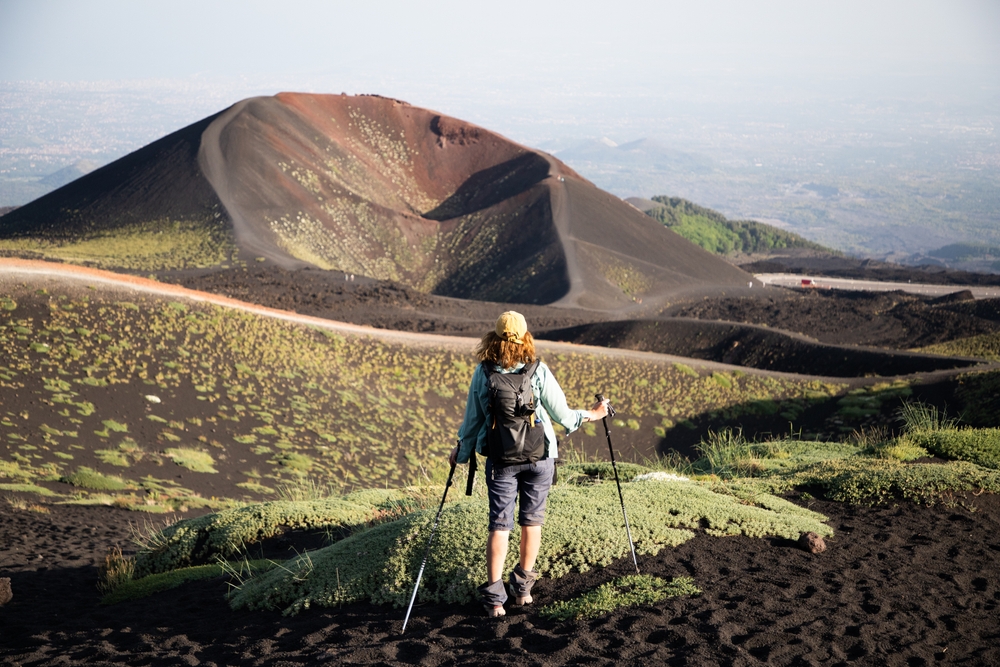

Sicily and its surroundings are home to three of Europe’s most fascinating volcanoes.Etna, Stromboli and Vulcano – these three names are the stuff of dreams for lovers of volcanic hikes and fiery landscapes. Symbols of a living and unpredictable land, they attract hundreds of thousands of visitors every year from all over the world to try their hand at climbing Sicily’s volcanoes. Listed as a UNESCO World Heritage Site since 2013, Etna is the highest active volcano in Europe. Just a few hours by boat from the Aeolian Islands, Stromboli has been spewing lava for thousands of years, while Vulcano offers one of the most accessible volcanic climbs in the Mediterranean. Whether you’re a seasoned hiker or just curious and looking for adventure, this article gives you all the practical advice you need to make a success of your visit to these three giants of stone and fire.
Before embarking on these extraordinary excursions, Palermo is an excellent base from which to explore the whole of Sicily. From the Sicilian capital, it’s easy to reach Mount Etna, the port of Milazzo (departure point for the Aeolian Islands) or the great baroque towns of the Val di Noto. Before or after your volcanic adventure, a visit to Palermo is a must if you want to discover the island’s rich history and culture.
Also read the Sicily guide :
- Visiting Sicily: 10 must-sees and must-dos
- The most beautiful villages in Sicily
- Visit the Palazzo dei Normanni in Palermo
- The most beautiful beaches near Palermo
- Selinunte: archaeological site in Sicily
- Taking the ferry to Sicily from Toulon
- Visiting the Aeolian Islands: a journey in several stages
- Top 6 things to do in Palermo
1. Mount Etna: climbing Europe’s highest active volcano
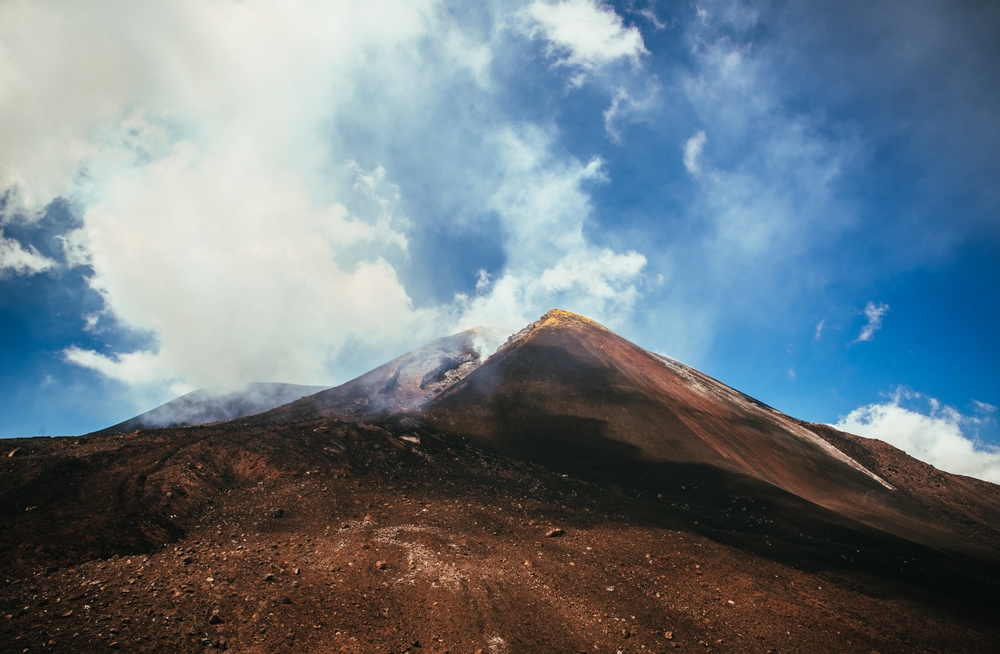
It’s hard to talk about climbing Sicily’s volcanoes without starting with the most imposing. Mount Etna (95012 Castiglione di Sicilia, Province of Catania, rated 4.7/5 on Google) rises to an altitude of around 3,350 metres – a figure that varies with each eruption – and is an extraordinary force of nature. Its frequent eruptions, cooled lava flows and steaming craters create landscapes that are both lunar and breathtaking. It is also one of the most studied volcanoes in the world, and its classification as a Unesco World Heritage Site in 2013 crowns the scientific and natural importance of the site. From the east coast, the town of Catania is a natural starting point for excursions to Mount Etna.
1.1. Climbing the south face: the classic route from the Sapienza refuge
The southern slope is by far the most popular for climbing Mount Etna. It all starts at the Rifugio Sapienza (Piazzale Rifugio Sapienza, 95030 Nicolosi CT, rated 4.4/5 on Google), situated at an altitude of 1,910 metres. The refuge can be reached by car from Catania or by bus. This is where the vast majority of excursions start, with several levels of commitment possible depending on your level of fitness and your ambitions.
The first option is to take the cable car (Funivia dell’Etna) from the refuge up to 2,500 metres, which costs around €33 return. This is the quickest way to gain altitude and start the ascent in good conditions. Once you’ve reached 2,500 metres, you can continue on foot, either on your own or accompanied by a certified volcano guide – strongly recommended for ascents above 2,750 metres. A second, more comfortable and spectacular option is to add a 4×4 bus after the gondola to climb to around 2,920 metres. From here, the final ascent on foot to the edge of the summit craters is short but breathtaking, with breathtaking views of the Ionian Sea on a clear day. Allow a full day for this version – between 5 and 8 hours depending on the pace you choose – and budget between €50 and €80 per person all-inclusive (cable car + 4×4 + guide).
At the summit, several craters are accessible: the small side craters already offer breathtaking views, while the main crater at the very top is an unforgettable volcanic experience. Helmets are compulsory above a certain altitude, and are generally provided by the tour operators. The smell of sulphur, the slippery terrain and the steep gradient mean that you need to be in good physical condition and not suffer from heart or respiratory problems.
1.2. Climbing the north face: the wild Piano Provenzana route
Less well known but just as spectacular, the north face of Mount Etna is well worth a visit. It can be approached from Piano Provenzana (via Provenzana, 95015 Linguaglossa CT, rated 4.6/5 on Google), at an altitude of around 1,800 metres, accessible from the village of Linguaglossa. There are no gondolas here: you can climb by small all-terrain buses that criss-cross the slopes of the volcano up to altitudes of around 3,000 metres.
The contrast with the southern slopes is striking. The north side of Etna is much greener and wilder, with more mountain vegetation, notably the Ragabo forest, before giving way to the expanses of frozen lava and desert landscapes characteristic of the volcano. This is the ideal option for hikers looking to avoid the crowds and enjoy a more immersive experience of volcanic nature. There are far fewer visitors than on the southern slopes, especially in the high summer season. Expect to pay roughly the same budget as for the southern slopes, with slight variations depending on the local service providers.
1.3 Exploring Mount Etna by 4×4: an off-road adventure around the giant
For those who prefer a less athletic but just as thrilling approach, the 4×4 excursion around Mount Etna is an excellent alternative. From around €54 per person, this half-day tour takes you through the volcano’s most striking landscapes, which are generally accessible all year round when the volcano is sufficiently calm.
The programme includes crossing the Valle del Bove, an immense depression carved out by successive volcanic collapses, visiting a real lava cave (an underground tunnel formed by the cooling of an ancient flow), and stopping off at Piano Provenzana to admire the still-recent lava flows. The walk often ends with a sunset on the slopes of the volcano, offering an unforgettable panorama of Sicily and, on a clear day, the Strait of Messina. Local guides also take advantage of these excursions to offer tastings of typical Sicilian products: Etna wines, Bronte pistachios and other local delicacies.
1.4. Essential equipment and practical advice for climbing Mount Etna
Whichever option you choose for climbing Mount Etna, there are a few basic rules. The temperature at the top can be 10 to 15°C lower than at the bottom, even in midsummer. So it’s essential to pack layers of clothing: a technical base layer, a fleece and a waterproof windbreaker. Waterproof hiking boots are compulsory – simple sports trainers are absolutely unsuitable on crumbly and sometimes unstable lava terrain. You should also bring plenty of water (at least 1.5 litres per person), energy snacks, sunglasses and sun protection. Hiking poles are a real plus for balance on steep terrain.
Remember that it is forbidden to climb above 2,750 metres without an approved volcano guide. Don’t try to get round this rule: it’s there for your own safety, as Etna remains an active volcano capable of sudden eruptions. The best time to visit Etna is from May to October, although excursions are possible all year round depending on volcanic activity. In winter, snow-covered slopes may require crampons.
2. Stromboli: climbing the Mediterranean lighthouse
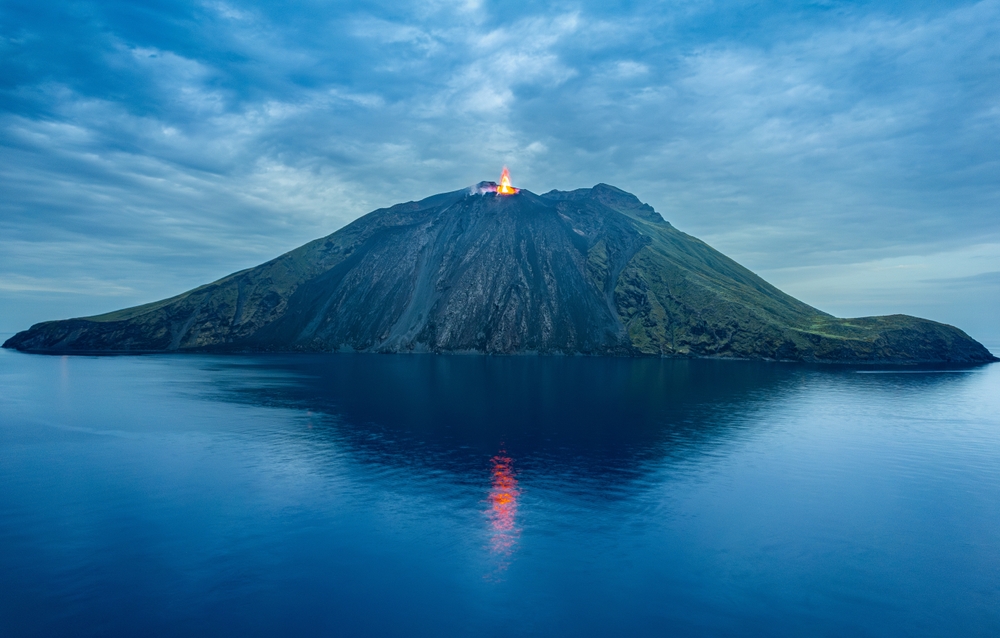
After Etna, the ascent of Stromboli (98050 Lipari, Province of Messina, rated 4.7/5 on Google) is undoubtedly the most mythical in the whole of the Mediterranean. This spectacular volcano, located in the heart of the Aeolian Islands, has been erupting almost continuously for over 5,000 years. Its regular explosions, visible from the sea, have earned it the poetic nickname of “lighthouse of the Mediterranean”, whose glow once served as a landmark for navigators. The island itself is almost entirely formed by the volcano, whose lava-black flanks slope straight down to the sea.
2.1. Climbing to 400 metres: the sunset excursion
Unlike Etna or Vulcano, the regulations around Stromboli are particularly strict. It is currently forbidden to exceed an altitude of 400 metres without special authorisation (reserved for scientists and volcanologists), due to the constant risk of eruption and rapid lava flows on the Sciara del Fuoco. The presence of a certified guide is compulsory for any hike on the flanks of the volcano, even up to 400 metres. Do not attempt to climb alone: the penalties are considerable and, above all, the danger is real.
The most popular excursion, and by far the most magical, is thesunset climb. It starts in mid-afternoon from the island’s main village, Stromboli Scari, for a gradual climb up the sides of the volcano. As you gain altitude, the landscape opens up to the Aeolian archipelago, the Tyrrhenian Sea and the silhouettes of the other islands in the distance. The highlight of the guided tour is the Sciara del Fuoco area, at 400 metres above sea level, which is the best place to watch both the sunset and the lava ejections from the summit. Stromboli’s explosions occur every 15 to 30 minutes on average, hurling incandescent lava bombs into the starry sky – an absolutely unforgettable spectacle. This tour lasts between 4 and 5 hours and costs from around €25 per person.
2.2 Seeing Stromboli from the sea: the alternative by boat
If you’re not fit enough to hike, or if you’d like to complement the land tour with a different view, theboat trip around Stromboli is a great alternative. After dark, the volcano’s eruptions take on an even more spectacular dimension, with the glowing lava bombs silhouetted against the black sky and reflected in the sea. Many local operators offer these boat trips from the port of Stromboli or from Lipari. Some tours combine the ascent on foot and the return by boat, to enjoy both perspectives.
2.3 How do I get to Stromboli from Sicily?
Stromboli can be reached by ferry or hydrofoil from the port of Milazzo (Via Ammiraglio Luigi Rizzo, 1, 98057 Milazzo ME, rated 4.1/5 on Google), which is on Sicily’s north-east coast. The trip by fast hydrofoil takes around 1 hour 10 minutes, while the classic ferry takes up to 3 hours. Stromboli can also be reached from Lipari, the main Aeolian island (journey time of around 55 minutes to 1? hours, depending on the type of boat). Liberty Lines and Siremar provide most of the services. Make sure you book in advance during the high season (July-August), as places are often fully booked. If you’re planning a trip to the Aeolian Islands, read our full article on visiting the Aeolian Islands to plan your stopovers.
2.4. Practical tips for visiting Stromboli
For your excursion to Stromboli, take closed hiking boots (flip-flops and trainers are strictly inadvisable on volcanic ash), a headlamp (essential for the return journey at night), long trousers and a jacket. Don’t forget to wear dark clothes that you don’t mind ruining, as ash splashes stain. Take water (at least 1 litre), snacks and protect your camera. The ideal season is from March to October, as winters can be rough on the seaside and in logistics. To book your guided tour, go directly to one of the local agencies on the island, such as Magmatrek or Vulcano a Piedi, located just a stone’s throw from the hydrofoil dock.
3. Vulcano: the most accessible ascent of the Aeolian Islands
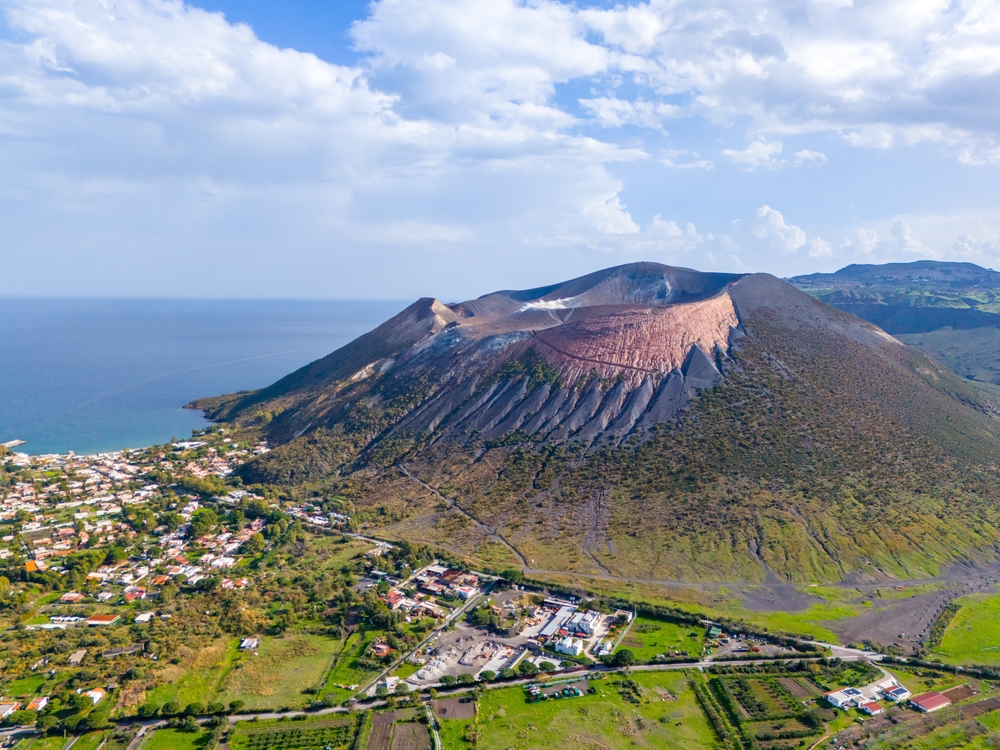
The third peak in our Sicilian volcanic trilogy, Vulcano (98055 Lipari, Province of Messina, rated 4.6/5 on Google) is geologically an island made up of four volcanoes, three of which are extinct. Only the Gran Crater, also known as La Fossa, is still relatively active, with its sulphur fumaroles, gas discharges and steam plumes. The last major eruption took place at the end of the 19th century (1888-1890), and over the decades a well-defined path has been marked out to the crater rim. Vulcano is therefore considered the most accessible Sicilian volcano for families and beginner hikers.
3.1. Climbing the Gran Crater (La Fossa): the volcanic trail par excellence
The path leading to the Gran Crater starts from the port of Vulcano Porto and climbs steadily for around 1 hour, with an ascent of 400 metres. The terrain is a mixture of volcanic sand, rock and clay, offering a palette of surprising colours – sulphur yellow, rusty ochre, basalt black – as you climb. The slope is steep at the start, before easing off on the crater ridge, which then takes around 45 minutes to complete. Allow 2 hours round trip for this ascent.
Once you reach the top, you’ll literally be walking through the fumaroles, the permanent releases of sulphurous gases with their characteristic colour and smell. The panorama is breathtaking: on a clear day, you can see the six other Aeolian Islands, the north coast of Sicily and the cobalt-blue waters of the Tyrrhenian Sea. You are not allowed to descend into the crater itself, but a tour around the rim offers a truly intense volcanic experience. Unlike Stromboli, no guide is required for this hike, making it an economical, self-guided option for all travellers. Be aware, however, that the trail may be temporarily closed in the event of renewed volcanic activity.
3.2. Sulphurous mud baths: Vulcano’s other must-see destination
Hiking to the crater is not the only attraction on the island. A stone’s throw from the port, the Terme di Vulcano (Via Acque Calde, Via Riccardo Conti, 32, 98055 Vulcano ME, rated 4.1/5 on Google) offers one of the most original experiences on the Aeolian Islands: an open-air sulphurous hot mud bath. This natural pool, fed by geothermal springs at a temperature of around 40°C, is renowned for its therapeutic properties on the skin and joints. The smell of sulphur is very strong – warn your travelling companions, and avoid wearing silver jewellery that will blacken on contact! Entry to the baths is reasonably priced and makes an excellent addition to the crater hike, ideally before the ascent (the mud stains your clothes). The baths are closed out of season (generally from October to April).
3.3 How do I get to Vulcano from Sicily?
Vulcano is the first Aeolian island to leave from Milazzo (Via Ammiraglio Luigi Rizzo, 1, 98057 Milazzo ME, rated 4.1/5 on Google), making it one of the easiest to reach. Hydrofoils take about 50 minutes to reach Vulcano Porto from Milazzo. It is also possible to combine Vulcano and Lipari in the same day, as the two islands are only a few kilometres apart (around 10 minutes’ crossing time). For those planning a complete tour of the Aeolian Islands, Vulcano is often the first stop, followed by Lipari, Salina, Panarea and Stromboli.
3.4. Practical tips for visiting Vulcano
For the ascent of the Gran Crater, closed hiking boots, a hat and sun cream are essential, as the climb is very exposed to the sun. Bring plenty of water and a few snacks. There isan entrance fee for the trail (a few euros depending on the season) and an eco-tax may be added depending on local policies. If you want to take your time and enjoy the island to the full, it’s perfectly possible to stay overnight: Vulcano has some charming accommodation, from B&Bs to small hotels, ideally placed between the port and the black sand beaches. For the most complete experience of climbing Sicily’s volcanoes, don’t forget to plan your visit to the other Aeolian Islands too, by consulting our Visit the Aeolian Islands guide.
Download the audio-guided tour to discover Palermo on foot and on your own
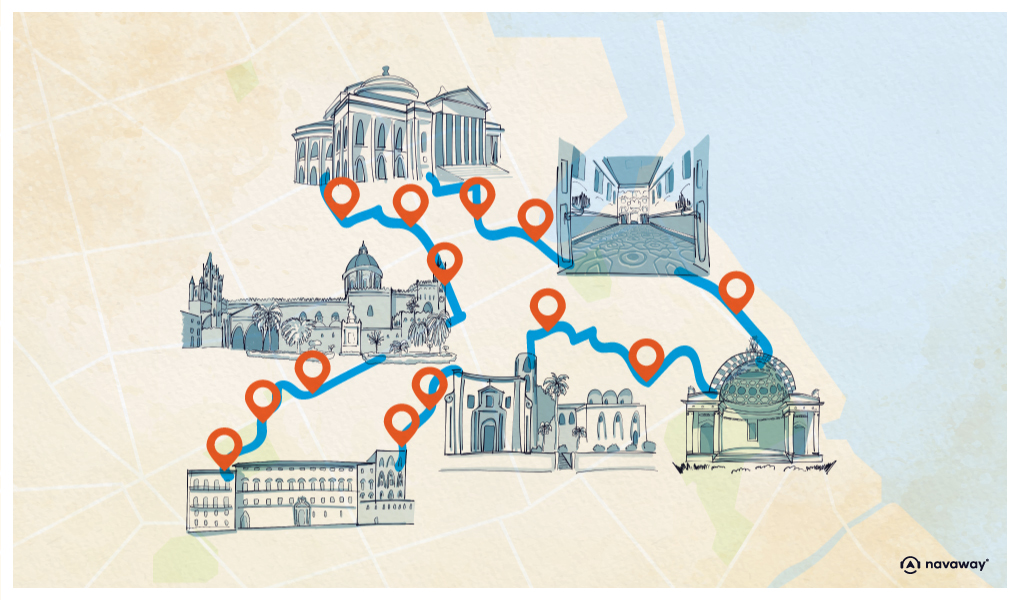
Your volcanic adventure in Sicily will be even richer if you take the time to discover Palermo, the island’s capital, before or after your excursions to Mount Etna, Stromboli and Vulcano. A crossroads of civilisations between East and West, Palermo combines centuries of Arab, Norman, Baroque and popular history in just a few square kilometres. To explore the city at your own pace, without getting lost or missing the essentials, theNavaway audioguided itinerary for Palermo is the ideal tool. With 23 commented points of interest, interactive GPS navigation and unexpected historical anecdotes, it guides you step by step through the city’s most emblematic districts and monuments. Download it before you leave to make the most of your stay in Sicily!
In conclusion, climbing Sicily’s volcanoes – Etna, Stromboli and Vulcano – is an extraordinary experience that brings the traveller face to face with the rawest forces of nature. Each volcano has its own personality: the impressive height and lunar landscapes of Etna, the incandescent magic and strict regulations of Stromboli, the accessible hiking and unusual mud baths of Vulcano. Combine these three climbs with an exploration of Palermo and its historical treasures thanks to the Navaway itinerary, and you’ll have a truly complete and unforgettable Sicilian holiday. Volcanic Sicily awaits your arrival!
FAQ: your questions about climbing Sicily’s volcanoes
Can you climb Mount Etna without a guide?
You can hike Etna without a guide up to an altitude of around 2,750 metres. Above that, the presence of an approved volcano guide is compulsory. To reach the summit craters (around 3,000 to 3,350 m), you must be accompanied. Many agencies offer guided excursions from both sides of the volcano.
When is the best time to visit Sicily’s volcanoes?
The best time to climb Sicily’s volcanoes is from May to October. Summer (July-August) is the peak season, which is very busy but ideal for the weather. Spring (May-June) and autumn (September-October) offer a better ratio of crowds to conditions, with fewer people and pleasant temperatures. In winter, it is still possible to climb Mount Etna, but snow conditions can complicate matters; ferries to the Aeolian Islands are less frequent and some services are closed.
Do I need a guide to climb Stromboli?
Yes, the presence of a certified guide is compulsory for any hike on the slopes of Stromboli, even up to the authorised limit of 400 metres. It is forbidden to climb alone, and this rule is actively enforced. Book your guide in advance with the local agencies on the island (Magmatrek, Vulcano a Piedi, etc.).
How long does it take to climb Mount Etna?
Depending on the option you choose, you should allow between 5 and 8 hours for a full excursion to Mount Etna (from the Sapienza refuge, with gondola, 4×4 bus and walk up to the summit). A 4×4 excursion around the volcano usually takes half a day (4 to 5 hours).
Can Vulcano be visited in a day from Milazzo?
Absolutely. If you leave early in the morning from Milazzo (a 50-minute ferry ride), you can visit Vulcano in one day: climb the Gran Crater (2 hours AR), bathe in the sulphurous mud, stroll along the black sand beaches and return in the late afternoon. Some visitors even include a stopover in Lipari on the same day.
Which Sicilian volcano is recommended for beginners?
Vulcano is without doubt the most accessible volcano for beginners and families. The ascent of the Gran Crater is signposted, does not exceed 400 metres in height difference, and does not require a guide. Stromboli is more physically demanding (even up to 400 metres) and requires a guide. Etna is the most complex, with various options depending on your level, but the 4×4 excursion is accessible to all.
200 audioguided tours for cities all around the world
Download