9 castles to explore in Scotland

Scotland is a land of legends, where ruined castles tell stories thousands of years old. From the wild Highlands to the windswept coastline, these majestic remains bear witness to a tumultuous past of battles, rival clans and mystery. Perched on rocky promontories, nestling on the edge of misty lochs or proudly overlooking the sea, these nine Scottish castles offer breathtaking panoramas and invite you to travel back in time. Whether you’re a history buff, a photography enthusiast or simply in search of authenticity, these remnants of castles in Scotland promise unforgettable discoveries.
200 audioguided tours for cities all around the world
DownloadAlso in the Edinburgh guide :
- What are the best things to do in Edinburgh?
- Top 10 culinary specialities in Edinburgh
- What are the best hotels to stay at in Edinburgh?
- The 10 most beautiful lochs to discover in Scotland
- The 10 best whisky distilleries in Scotland
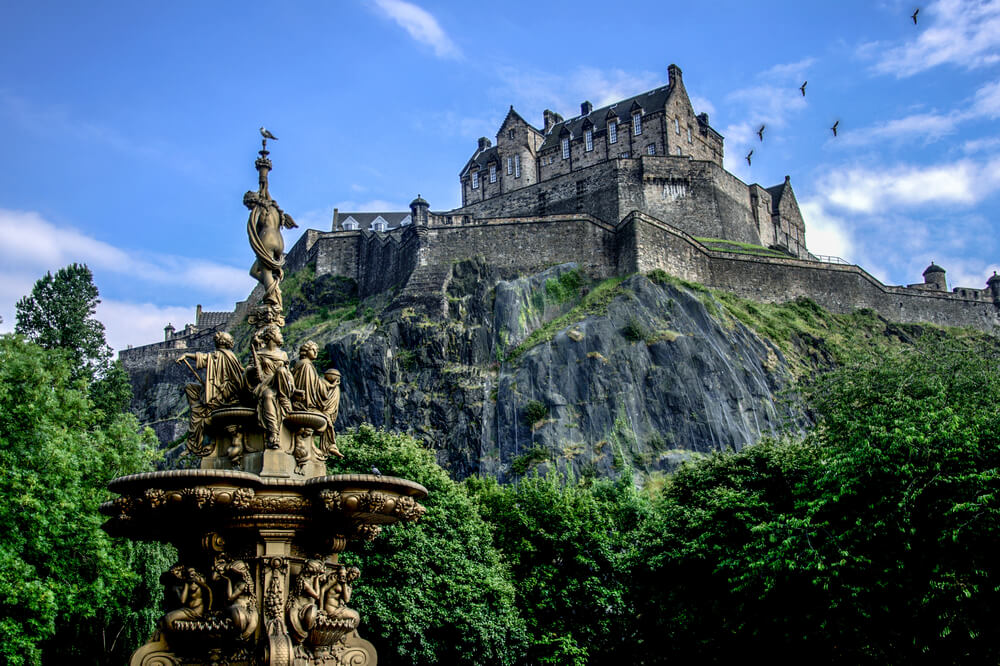
1. Edinburgh Castle, the capital’s historic fortress
It’s impossible to talk about the remains of castles in Scotland without starting with the most emblematic of them all: Edinburgh Castle. Perched on the rocky outcrop of Castle Rock, it has majestically dominated the Scottish capital for almost a thousand years. This strategic fortress, built around 1070, is surrounded on three sides by vertiginous cliffs that made it a virtually impregnable bastion. It can only be reached via the steep slope of Castlehill, which gave it a considerable defensive advantage during the many sieges it endured.
The history of Edinburgh Castle is intertwined with that of Scotland itself. Its walls have witnessed bloody battles, betrayals and reconquests. As you wander through its 12th-century corridors, you’ll discover the impact of the conflicts that have shaped the Scottish nation. The tour takes you through the various rooms, including the great hall where royal banquets were held, to the spine-chilling dungeons. Every day at precisely 1pm, except Sundays, the traditional cannon shot is fired to tell the time to sailors in the port of Leith and to the villagers of Edinburgh.
Download the audio tour to discover Edinburgh on foot and on your own
To make the most of your exploration of Scotland’s capital, Navaway’s Edinburgh Tour takes you through 24 key places of interest. This 8.3km audio tour takes you on a 3.5-hour tour of the treasures of the Old Town, from the Royal Mile to the Castle, St. Giles Cathedral and the mysterious closes. The audio commentary will give you a better understanding of the fascinating history of this city of myths and realities.
Allow several hours to explore the castle from top to bottom. As well as its impressive military architecture, you’ll discover the jewels of the Crown of Scotland, the Stone of Destiny and numerous museums recounting the country’s history. Panoramic views from the ramparts offer spectacular views of the whole of Edinburgh, with its slate roofs, Gothic spires and, in the distance, the Firth of Forth estuary.
2. Dunnottar, the spectacular jewel of the Aberdeenshire cliffs
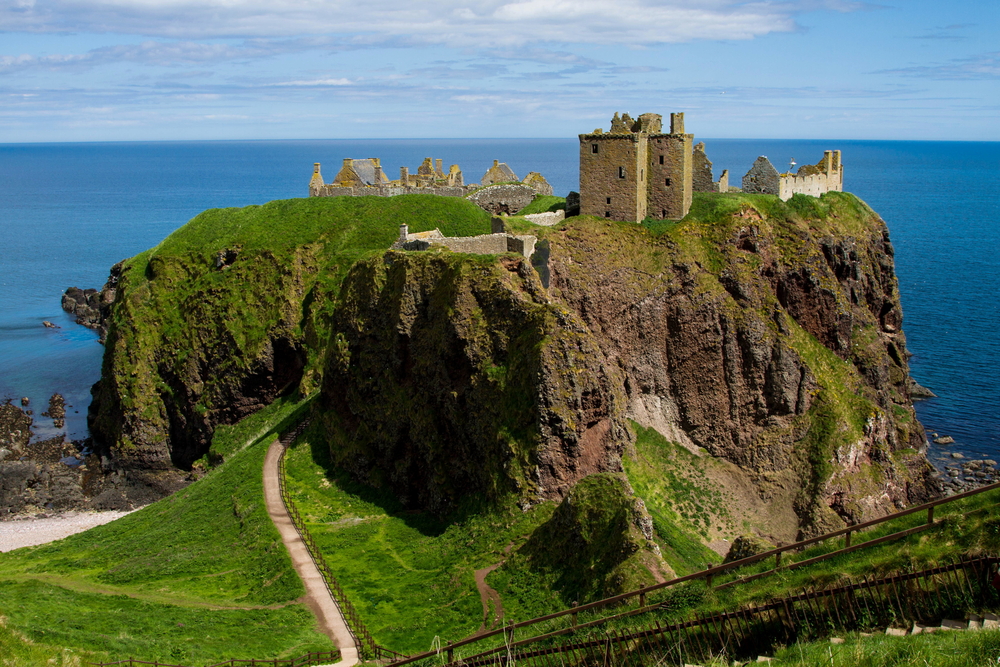
Around 30 kilometres south of Aberdeen, near the charming village of Stonehaven, stands one of the most photographed Scottish castles in the world: Dunnottar. This exceptional vestige occupies a spectacular rocky promontory, perched 50 metres above the North Sea. The strategic location of this medieval fortress enabled it to effectively control the sea lanes while offering a natural defence that was virtually impregnable. The waves crashing against the cliffs create a dramatic atmosphere that has captivated many film-makers, including those behind the Outlander series.
Dunnottar’s history dates back to Pictish times, but the ruins you can see today date mainly from the Middle Ages. The castle played a crucial role in Scotland’s wars of independence and even housed the Scottish Crown Jewels in the 17th century, protecting them from Cromwell’s army. A visit to this remarkable site requires a good level of fitness, as you have to climb more than 200 steps cut into the rock to reach the ruins. The climb can be difficult for people with reduced mobility or with pushchairs, but it is well worth the effort.
Once there, take the time to explore the various ruined buildings: the great hall, the lodgings, the chapel and the dungeons. Photography enthusiasts will be delighted by the infinite vistas offered by these remains against a backdrop of raging seas. If you’re lucky, you might even spot seals basking on the rocks below. The site is open all year round, with reduced opening times in winter. Tickets can be purchased online or on site. Dogs on leads are welcome on this walk steeped in history.
3. Ardvreck, the haunted castle on Loch Assynt
In the heart of the rugged Highlands, on a rocky promontory jutting out into the Loch Assynt, stand the romantic ruins of Ardvreck Castle. This 15th-century relic, emblem of the powerful Clan MacLeod, offers one of the most picturesque views in all of Scotland. With the majestic mountains in the background and the dark waters of the loch reflecting its ancient stones, Ardvreck perfectly embodies the mysterious atmosphere of the Highlands. Its remote and wild setting makes it a unique place, far from the traditional tourist circuits.
The keep, tower and walls were built by the McLeod clan in the 1490’s. Nearby are the ruins of Calda House, a more recent manor house dating from the 1720’s that unfortunately suffered a fire. Despite the ravages of time, much of the main tower and a defensive wall are still visible. The site can be accessed from a free car park, and a footpath leads down to the edge of the loch. Be careful, however, not to get too close to the ruins themselves, as there is a risk of the weakened stones falling.
What makes Ardvreck particularly fascinating are the many legends that surround it. A man dressed in grey, the ghost of a traitor who delivered the Marquis of Montrose to his enemies, is said to haunt the place. Another legend tells of a little girl, a daughter of the McLeod clan, who was given to the devil in exchange for his help in building the castle. These ghost stories add an extra dimension to a visit to these atmospheric remains, especially when the mist rises from the loch at dusk.
4. Stalker Castle, a fortress on an islet in Loch Laich
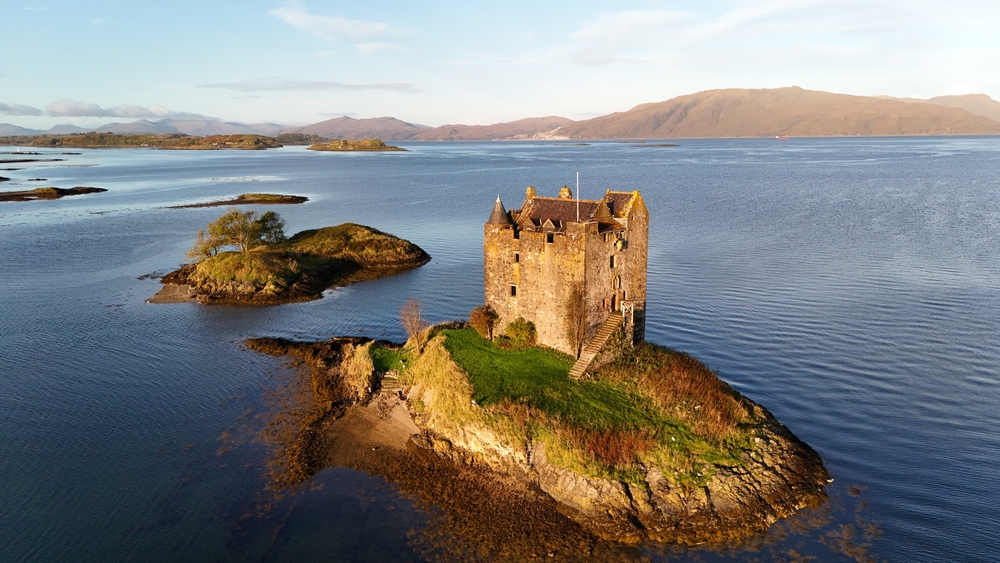
In the heart of the wild Highlands, on a tiny islet in Loch Laich, stands proudly Stalker Castle. This perfectly preserved four-storey medieval tower is one of Scotland’s most iconic landmarks. Accessible only by boat, this 15th-century relic seems to float on the calm waters of the loch, against a backdrop of majestic mountains and the changing skies typical of the region. Its unmistakable silhouette has been featured in numerous films, including Monty Python: The Holy Grail.
The history of Stalker is as tumultuous as that of Scotland itself. Built by Sir John Stewart, Lord of Lorn, the castle has been the scene of many battles and intrigues over the centuries. The builder’s descendants still live in the area and organise guided tours of the castle during the opening season. These tours, which last around two hours including boat transport, offer a unique and authentic experience, led by a member of the family who shares historical anecdotes and everyday life in this exceptional place.
To visit Stalker Castle, it is essential to book in advance, as the number of visitors is limited and access is by boat only. Unfortunately, the site is not accessible to people with reduced mobility or pushchairs due to the narrow staircases and cramped passageways. Nearby, on the Argyll coast, other historic sites are worth a visit, including McCaig’s Tower in Oban and the prehistoric cairns at Kilmartin Glen, which bear witness to the long history of human occupation in this region.
5. Doune Castle, set for cult TV series and medieval fortress
Just ten miles from Stirling, in the village of Doune, stands one of Scotland’s best-preserved medieval castles. This imposing 14th-century fortress has been given a new lease of life thanks to films and TV series. Fans of Game of Thrones, Outlander and the cult film Monty Python: Holy Grail will immediately recognise its thick walls and distinctive towers. But TV fame aside, Doune Castle is well worth a visit for its remarkable architecture and fascinating history.
Built in the late 14th century, the castle served as the royal hunting lodge for the Stewart family. In the 18th century, it was converted into a prison during the Jacobite uprising, locking up supporters of Charles Edward Stuart. On the tour, you can explore the inner courtyard, the vaulted cellars where provisions were stored, and the great hall where banquets were held. You will discover how the kitchens functioned and gain a fascinating insight into daily life in medieval times. The rooms are remarkably well preserved, making the experience particularly immersive.
After your visit to the castle, take the opportunity to wander through the surrounding forest, which offers beautiful walks along the banks of the River Teith. From the ramparts, you can enjoy breathtaking views of Ben Lomond in the distance. As the castle car park has limited capacity, we recommend you use public transport, in particular the 59 bus from Stirling. The good news is that if you arrive without a car, you will receive a 25% discount on the entrance fee. The castle is accessible to people with reduced mobility, although some passages may require assistance.
6. Kilchurn Castle, a hidden treasure on the banks of Loch Awe
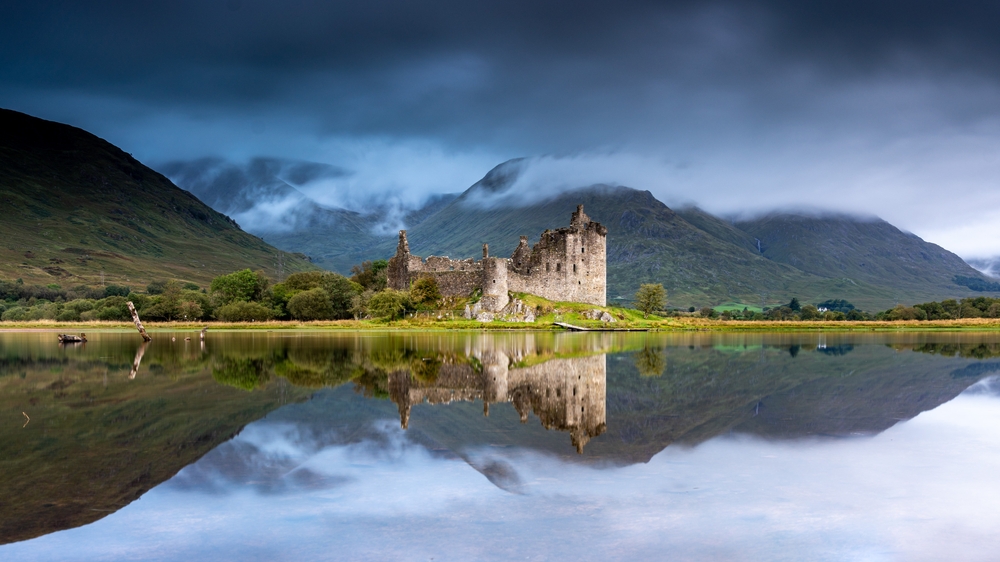
Less well known than its famous cousins, Kilchurn Castle is nonetheless one of the most photogenic remains of castles in Scotland. Situated south of Glencoe, this 15th-century gem stands on a small peninsula jutting out into the waters of Loch Awe. Built by Sir Colin Campbell, the first Lord of Glenorchy, the castle served as a strategic outpost during the Jacobite Revolution. Its silhouette reflected in the calm waters of the loch, with the mountains of the Highlands in the background, creates a picture of striking beauty, particularly at sunrise or sunset.
Kilchurn Castle was built in several phases between the 15th and 17th centuries. In the 18th century, it was severely damaged by a violent storm, leading to its abandonment. Despite three centuries of decay, many structures are still visible, including the corner towers, the surrounding walls and part of the main dwelling. By exploring the ruins, you can get an idea of the life of the Campbell lords and imagine the banquets that were held in the great hall. Admission to the site is free, but only the exterior can be visited for security reasons.
Finding Kilchurn Castle is almost a treasure hunt, as there are no signs on the A85 indicating its direction. The easiest way is to search for “Kilchurn Castle Viewpoint” on your GPS or navigation app. There is a free car park where you can park before taking the path to the ruins. Be aware that the grass around the castle can be very wet, especially in the morning with the dew, so bring good walking shoes or boots. For photographers, the site offers exceptional opportunities, especially when the morning mist rises from the loch.
7. Dirleton Castle and its enchanting gardens
Some 30 kilometres east of Edinburgh, in the picturesque village of Dirleton, lie the majestic ruins of a medieval castle that is well worth a visit. Built in 1240 by John of Vaux on the strategic coastal route between the capital and England, Dirleton Castle occupied a crucial defensive position. Its imposing tower, unique among Scottish castles, still stands proudly amid the ruins, a testament to the power of its former owners. Its proximity to Edinburgh makes it an ideal half- or full-day excursion.
The castle has had a chequered history, twice being besieged by the English during the Scottish Wars of Independence in the 14th century. Despite these attacks, many structures remain today. Visitors can explore the great hall where the lords entertained their guests, the kitchen with its imposing hearth, the bakehouse where bread was baked, the vaulted cellars, the priest’s room and the chapel of the Hallyburton estate. The remarkably well-preserved medieval architecture offers a fascinating insight into life in a Scottish fortified castle.
But what really sets Dirleton apart are the sumptuous gardens that surround the ruins. The site is home to the world’s longest herbaceous border, a horticultural masterpiece that changes colour with the seasons. Close to the ruins is also a manor house built by the Nisbet family, adding an extra dimension to the visit. The castle is open every day, but there are reduced opening times in autumn, winter and early spring (closing time 4pm until 1 April). Dogs are allowed on a lead. Remember to arrive early or late in the day, as the car park is modest in size.
8. Buchanan, the romantic ruins engulfed by vegetation
Less than an hour from Glasgow, near the village of Drymen, lie the extraordinary remains of Buchanan Castle. What makes this place so special is its poetic state of neglect: the ruins are literally engulfed by a thick layer of moss and lush vegetation. The decrepit turrets peeking through the trees create a mysterious, almost surreal atmosphere, perfectly evoking the romantic image of haunted castles. For lovers of photography and urban exploration, Buchanan Castle is a unique sight among Scotland’s castle remains.
Unlike the other castles on this list, which date back to the Middle Ages, Buchanan is relatively recent. It was built between 1852 and 1858 for the Graham clan in the Scottish baronial style. The castle served as a family residence until the Second World War, when it was converted into a military hospital. It even housed Rudolf Hess, Hitler’s aide, during brief peace negotiations. After the war, the castle never regained its former glory and was gradually abandoned, leaving nature to reclaim its rights in spectacular fashion.
Today, Buchanan Castle stands on private land in the middle of a golf course. Access to the ruins is free and can be gained by crossing the golf course (please be respectful of the players). Numerous danger signs warn visitors that it is strictly inadvisable to enter the ruins, as everything is extremely unstable and dangerous. You can, however, walk around the outside and admire these romantic remains from a safe distance. The visit can be combined with an exploration of Edinburgh, around an hour’s drive away.
9. The ruins of Sinclair Castle and Girnigoe, sentinel of the north
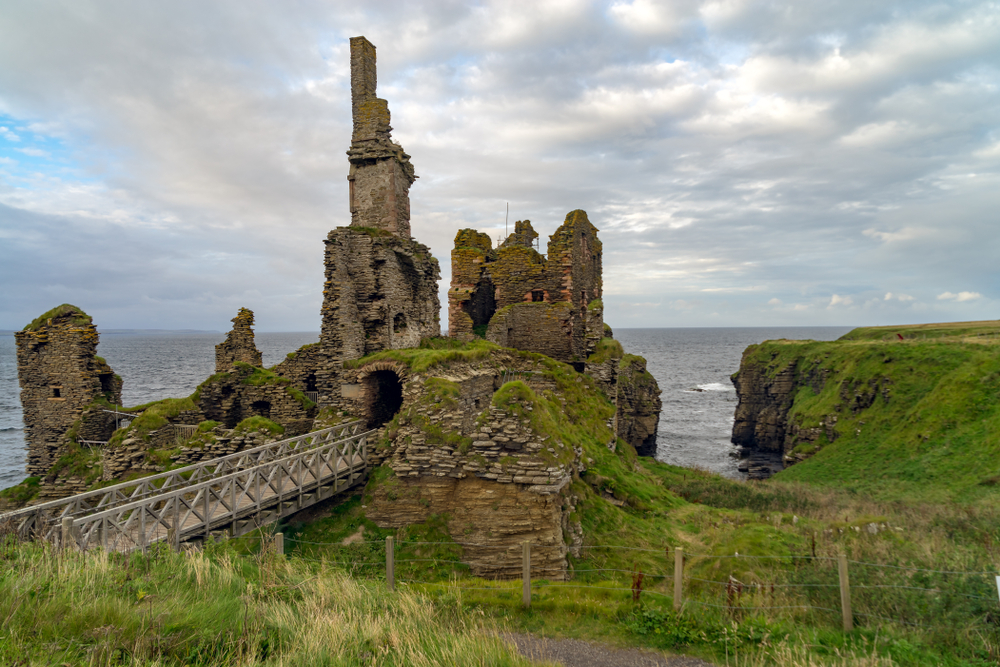
In the far north of Scotland, near the village of Wick, lie the spectacular ruins of two unique castles: Sinclair and Girnigoe. Perched on a rocky headland jutting out into the North Sea, this exceptional site is the only Scottish castle to be listed by the World Monuments Fund, testifying to its historical and architectural importance. For readers of Tintin, these ruins are an irresistible reminder of the castle on the Black Isle. The view from the cliffs over the raging ocean is breathtaking.
The history of this castle is complex, as it bears two names corresponding to two distinct construction periods. Girnigoe refers to the oldest part, whose exact date of construction is unknown, while Sinclair refers to the extension built at the end of the 15th century by the clan of the same name. For centuries, this fortress was used as a strategic lookout post to control the sea routes to the north of Scotland. The castle was abandoned after a violent conflict between two rival Scottish clans, and lay in ruins for several centuries before entering a restoration programme.
Sinclair and Girnigoe Castle is situated on the headland of Noss Head, about a thirty-minute drive from the village of John O’ Groats, the most northerly point on the Scottish mainland. The tour is free and easy to get to, making it suitable for adults and children alike. A coastal path leads to the ruins, offering spectacular views of the cliffs and sea. If you’re lucky, you may even spot seals basking on the rocks below. Bring warm, windproof clothing, as the weather can be harsh in this exposed area.
In conclusion, these nine remains of castles in Scotland are all invitations to delve into the fascinating history of this proud and battling nation. From Edinburgh Castle, the symbol of the capital, to the romantic ruins of Buchanan engulfed in vegetation, to the spectacular Dunnottar perched on its cliffs, each site tells a unique story. These medieval fortresses, witness to bloody battles, betrayals and ghostly legends, offer visitors unforgettable experiences. To help you prepare for your discovery of Scotland, don’t forget to download the Edinburgh itinerary on Navaway, which will guide you through the wonders of the Scottish capital on your own. Whether you’re a history buff, a photography enthusiast or simply looking for breathtaking scenery, Scotland’s castles promise to leave you with lasting memories.
FAQ about the remains of castles in Scotland
When is the best time to visit Scotland’s castles?
The best time to discover the remains of castles in Scotland is from May to September, when the days are longer and the weather generally milder. However, each season has its own particular charm: autumn adorns the landscape with flamboyant colours, while winter adds a mysterious atmosphere with its mists and low-lying lights. Bear in mind that some sites, such as Dirleton, have reduced opening times in winter.
Are Scottish castles accessible to people with reduced mobility?
Accessibility varies considerably from one castle to another. Doune Castle is relatively accessible, although some passages may require assistance. On the other hand, sites such as Dunnottar, with its 200 steps cut into the rock, or Stalker, accessible only by boat, are not suitable for people in wheelchairs or with mobility difficulties. We recommend that you check the specific accessibility information for each site before planning your visit.
Are castles in Scotland free to visit?
Yes, a number of castles in Scotland are open to visitors free of charge. These include Ardvreck, Kilchurn, Buchanan, Sinclair and Girnigoe. These ruined sites are not guarded and can be explored freely, although care must sometimes be taken not to enter dangerous areas. Other castles, such as Edinburgh, Dunnottar, Doune and Dirleton, charge a fee but offer guided tours and full facilities that justify the entrance fee.
How long does it take to visit a Scottish castle?
The length of your visit depends on the castle and your level of interest. For large sites such as Edinburgh Castle, allow at least 2 to 3 hours for a complete visit. Medium-sized castles such as Doune or Dirleton can be visited in 1? to 2 hours. For open-access ruins such as Ardvreck or Kilchurn, allow 30 minutes to 1 hour, depending on whether you simply want to photograph them or explore the surrounding area. Don’t forget to add time to enjoy the scenery and take photos.
Can you visit Scottish castles with children?
Most of the castle remains in Scotland are perfect for families with children. Little ones generally love exploring the towers, dungeons and imagining medieval battles. However, constant supervision is necessary, especially in ruins where there are no security barriers. Sites such as Sinclair and Girnigoe or Kilchurn are easily accessible and free, making them excellent options for families. For Dunnottar with its many steps, make sure your children are able to climb them safely.
200 audioguided tours for cities all around the world
Download