10 emblematic sites of the Mayan empire in Mexico

Mexico is home to some of the most fascinating remains of the Mayan civilisation, the thousand-year-old culture that shaped the history of Mesoamerica. From majestic pyramids emerging from dense jungle to coastal cities perched on the edge of the Caribbean Sea, the emblematic sites of theMayan empire in Mexico offer travellers an unforgettable immersion in one of the world’s richest archaeological heritages. From the Yucatán peninsula to Chiapas and the high plateaux of central Mexico, these ten must-see Mayan sites bear witness to the grandeur of a civilisation that prospered for over two thousand years before leaving behind architectural masterpieces that continue to amaze.
Whether you’re passionate about pre-Columbian archaeology or simply looking for adventure and cultural discovery, visiting Mexico’s Mayan sites is an experience in itself. Each site has its own unique atmosphere, history and architectural treasures, from temples adorned with Chac masks to stepped pyramids towering above the canopy. Before setting off to explore these treasures scattered all over the country, it might be a good idea to start your Mexican adventure in the capital: visiting Mexico City will allow you to immerse yourself in the culture and history of this fascinating country, thanks to the Navaway audio tour, which guides you in the footsteps of the Aztecs in 24 stages with commentary.
See also the Mexico guide :
- The 17 most beautiful places to visit in Mexico
- Top 10 culinary specialities in Mexico City
- Top 6 things to do in Mexico City
- Top 5 best hotels in Mexico City
- Top 6 things to do in Puebla
- What are the best hotels in Puebla?
- Visit the Tulum Pyramids in Mexico
1. Explore the ancient city of Chichen Itza, a wonder of the Mayan world
It’s impossible to talk about the emblematic sites of the Mayan empire in Mexico without starting with Chichen Itza (97751 Yucatan, Mexico, rated 4.8/5 on Google for over 135,000 reviews). Listed as one of the New Seven Wonders of the World in 2007 and a UNESCO World Heritage Site, this Mayan archaeological site is the most visited in the entire Yucatán peninsula, welcoming almost 2 million visitors every year. Founded around the 2nd century, the city reached its apogee between the 6th and 10th centuries, and was a powerful political, economic and religious centre of Mayan civilisation.
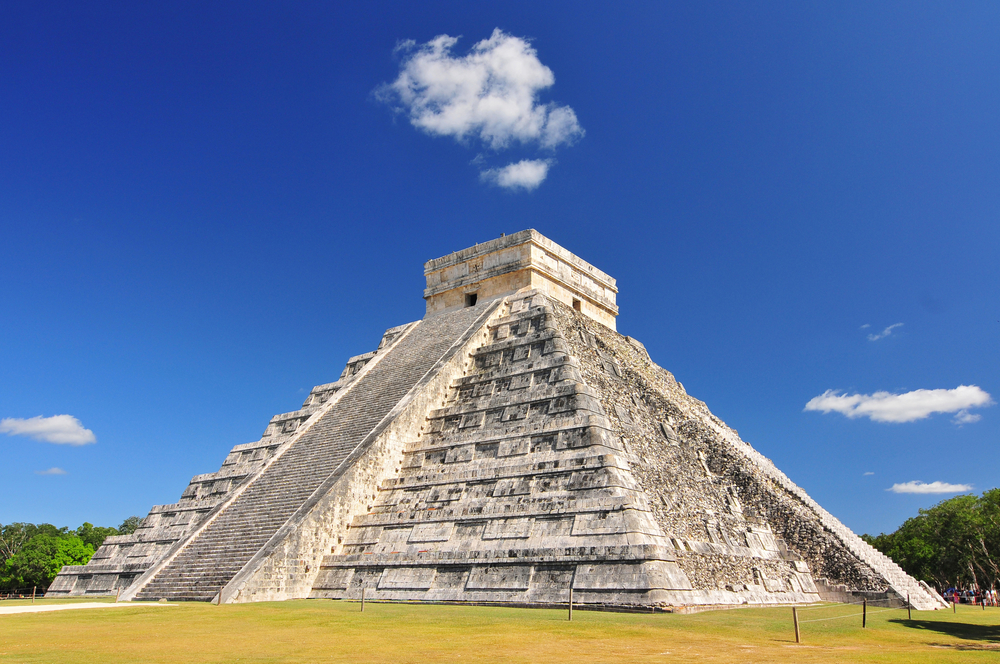
The absolute symbol of Chichen Itza is without doubt El Castillo, also known as the Temple of Kukulcán. This 30-metre-high step pyramid, with a total of 365 steps – one for each day of the year – bears witness to the extraordinary astronomical knowledge of the Maya. At each spring and autumn equinox, a phenomenon of light and shadow creates the illusion of a feathered serpent descending the sides of the pyramid, in homage to the god Kukulcán. This exceptional spectacle attracts thousands of spectators every year and is a unique illustration of Mayan architectural and astronomical genius.
In addition toEl Castillo, the site contains other gems not to be missed: the large ball court, the largest in Mesoamerica at 168 metres long, where losers – or perhaps winners, depending on interpretation – could be sacrificed; El Caracol, the circular astronomical observatory whose openings were designed to observe the stars; and the Sacred Cenote, a natural well 60 metres in diameter in which the Maya made ritual offerings. To prepare for your visit as well as possible, it’s best to arrive as soon as the museum opens (8am) to avoid the heat and crowds, which increase significantly in the middle of the day.
2. Discover the preserved town of Uxmal, a jewel of Puuc style
Located around 62 kilometres south of Mérida, in the state of Yucatán, the archaeological site of Uxmal is one of the finest examples ofMayan architecture known as the “Puuc style”. Founded around 700 AD, this ancient city had a population of up to 25,000 at its peak, between the 8th and 10th centuries. A UNESCO World Heritage Site, Uxmal is considered by many archaeologists to be one of the best-preserved Mayan cities, with its facades richly decorated with geometric motifs and masks of the rain god Chaac, whose repeated representation testifies to the crucial importance of water in this arid region.
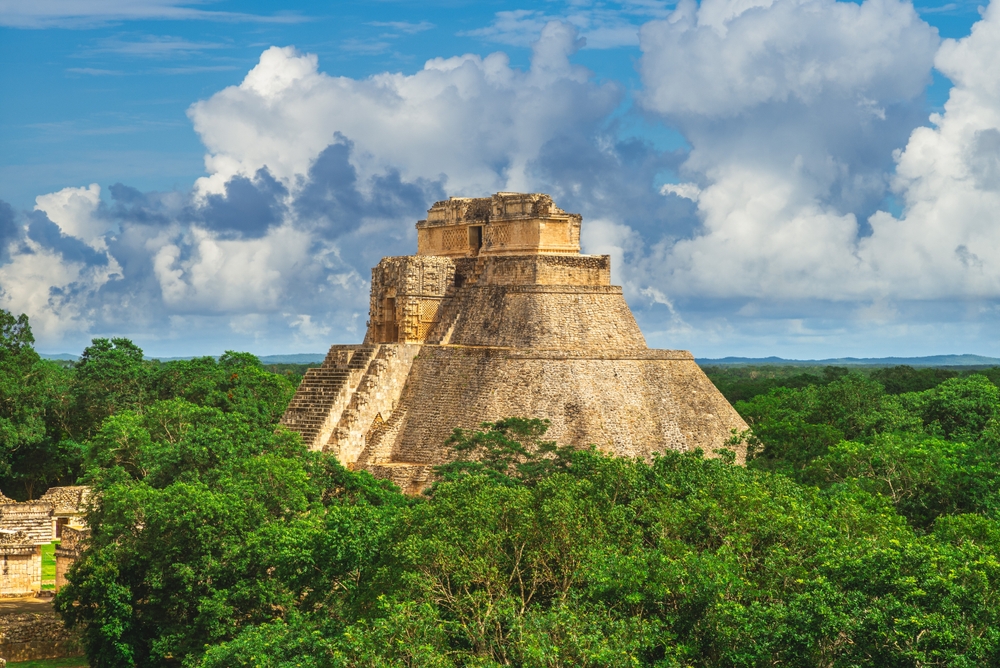
The centrepiece of the site is undoubtedly the Pyramid of the Soothsayer(Pirámide del Adivino), whose elliptical, rounded silhouette is unique in Mayan architecture. According to legend, this pyramid was built in a single night by a dwarf magician – hence its nickname “Pyramid of the Magician”. In reality, it was built in five successive phases between the 6th and 10th centuries, with each new construction enveloping the previous one. Standing 38 metres high, it dominates the entire site and offers spectacular panoramic views of the surrounding jungle from its summit.
A visit to the site would not be complete without exploring the Quadrilateral of the Nuns, a group of four buildings arranged around a central courtyard, whose upper façades are entirely covered with elaborate sculptures depicting snakes, Chaac masks and geometric motifs. The Governor’s Palace, 100 metres long and considered to be one of the most beautiful buildings in pre-Columbian Mesoamerica, completes the visit with its continuous frieze of 300 Chaac masks. Make sure you bring plenty of sun protection, as shade is rare at Uxmal: the site stretches over several hectares of arid vegetation.
3. Plunge into the heart of the jungle and admire Palenque, the city of King Pakal
Nestling in the heart of the lush jungle in the state of Chiapas, the Mayan city of Palenque is one of the most mysterious and enchanting of all the sites of the Mayan empire in Mexico. Founded around 100 BC, it enjoyed its golden age under the reign of the legendary King Pakal the Great, who ruled from 615 to 683 AD and made the city one of the most important political and cultural centres of the Classic Maya period. A UNESCO World Heritage Site, Palenque is considered one of the most beautiful archaeological sites in the whole of Latin America.
Palenque’s most emblematic monument is the Temple of the Inscriptions, a nine-storey pyramid that contains in its depths the tomb of Pakal himself, discovered in 1952 by Mexican archaeologist Alberto Ruz Lhuillier. Inside the temple, three panels covered with hieroglyphs – 617 in all – trace the city’s dynastic history over several centuries. Pakal’s jade sarcophagus, decorated with extraordinarily fine cosmic representations, is now on display at Mexico City’s National Museum of Anthropology. The Palace, with its observation tower unique in Mayan architecture and its interior courtyards adorned with bas-reliefs, is just as captivating.
The atmosphere at Palenque is decidedly different from other Mayan sites: the ruins literally emerge from the tropical vegetation, the sound of howler monkeys echoes through the canopy, and streams run through the entire site. It is estimated that only 10% of the buildings have been cleared from the jungle, which gives you an idea of the scale of what remains to be discovered. A few kilometres away, theAgua Azul and Misol-Ha waterfalls are magnificent natural stops to round off the visit. If you’re planning a trip to Mexico that includes the great Mayan sites, don’t hesitate to consult our guide to the most beautiful places to visit in Mexico to put together your itinerary.
4. Tulum, Mayan sentinel facing the Caribbean Sea
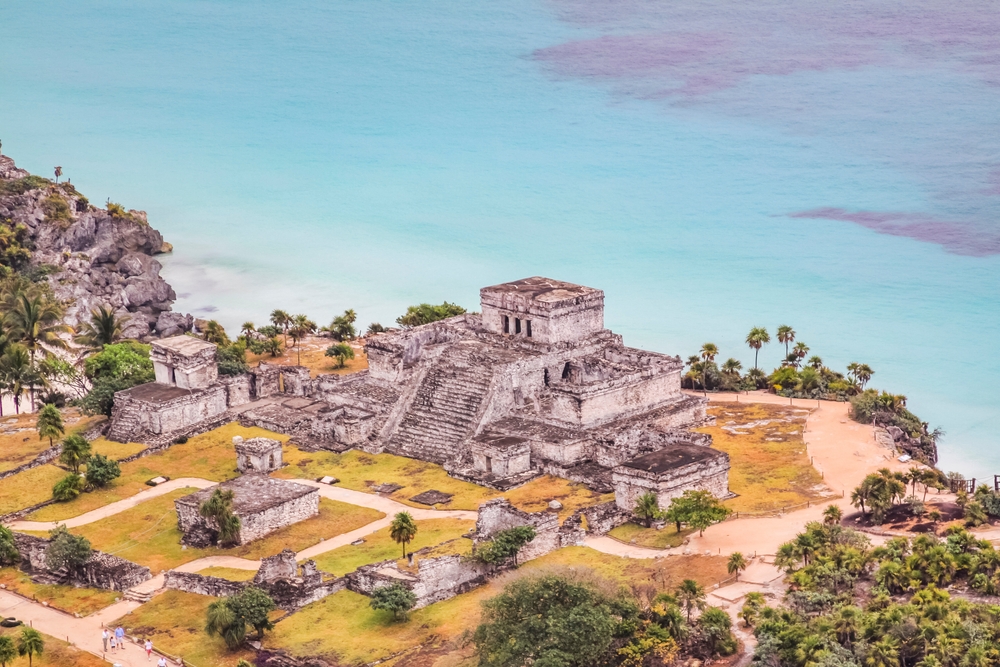
Tulum occupies a special place among the sites of the Mayan empire in Mexico: it is the only major Mayan archaeological site built directly on the seashore. Perched on a 12-metre cliff overlooking the turquoise waters of the Caribbean Sea on the Yucatán Peninsula, this ancient fortified city offers a breathtaking panorama that combines archaeological splendour with natural beauty. Founded around 564 AD, Tulum played a key strategic role as a trading port on the Mayan sea routes, exporting obsidian, jade and cocoa.
The city was surrounded by a stone wall on three sides – the fourth being delimited by the cliff and the sea – which earned it the name Tulum, meaning “enclosure” or “fortress” in Mayan. Its main monument, El Castillo (The Castle), dominates the sea from its rocky promontory, and also served as a lighthouse guiding Mayan boats along the coast. The Temples of the Descending God and of the Frescoes complete the picture, with their remarkable murals depicting the religious and daily life of the inhabitants. Tulum was one of the last great Mayan cities to survive when the Spanish conquistadors arrived in the 16th century.
Today, Tulum is one of the most popular archaeological sites in the world, combining the appeal of its ruins with the paradise-like beaches of the Riviera Maya. To make the most of your visit, we strongly recommend that you arrive as soon as it opens at 7am, before the busloads of tourists from Cancún arrive. The many cenotes in the vicinity – including Gran Cenote and Cenote Dos Ojos – are great additions to a visit to the ruins, making for an unforgettable day out in the region. Tulum is also an excellent base for exploring other Mayan sites on the peninsula, starting with Cobá, some 40 kilometres away.
5. Cobá, in the heart of the Quintana Roo jungle
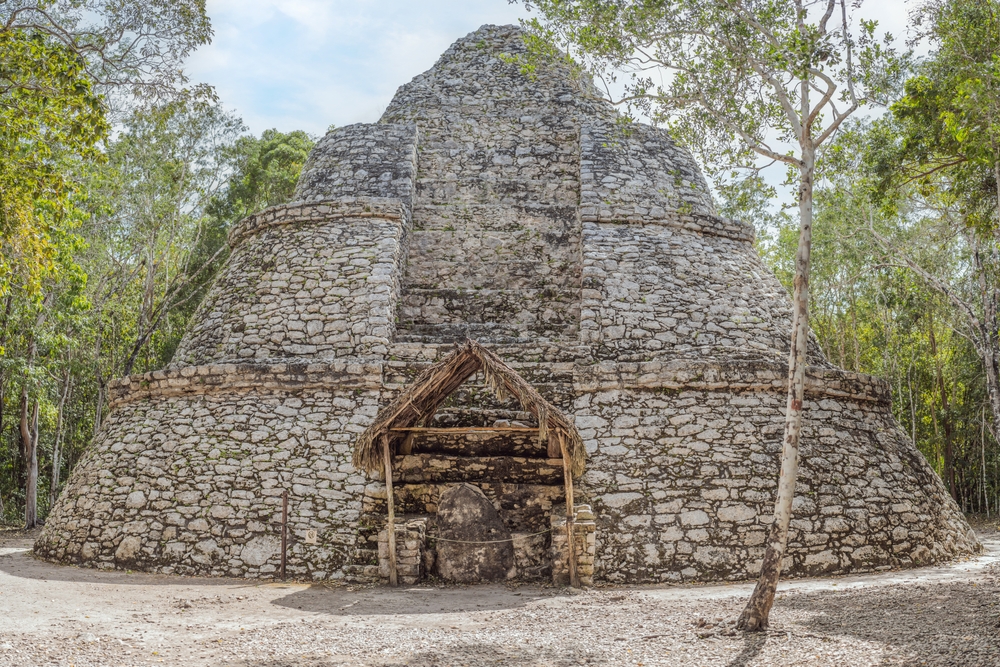
Some 42 kilometres north-west of Tulum, lost in the jungle of Quintana Roo, the archaeological site of Cobá is one of the largest and most fascinating Maya sites in Mexico. This powerful city-state, which flourished between the 8th and 10th centuries, had a population estimated at 50,000 at its peak and extended its influence over a vast region thanks to a network of paved roads called sacbés (white roads), some of which were 100 kilometres long. Gradually abandoned after the 13th century, Cobá was swallowed up by the jungle for centuries before being rediscovered in the early 20th century.
The highlight of the visit is undoubtedly the Nohoch Mul pyramid, which rises to a height of 42 metres and remains one of the highest Mayan pyramids in the entire Yucatán peninsula. Unlike Chichen Itza, where climbing was banned, it has been possible (since the end of 2025) to take the new wooden staircase to the top, rewarded by an extraordinary panoramic view over the infinite expanse of jungle. This is one of the few Mayan pyramids still accessible to climbers, making it a unique experience. The oval temple, the sacbés linking the different architectural groups and the many finely sculpted stelae complete the richness of the site.
Cobá is also unique in the way it is visited: the site extends over some 70 km² in the middle of the jungle, making it impossible to explore entirely on foot. Hiring bicycles or tricycle taxis on site is a popular and fun way to link the different groups of monuments, sometimes separated by several kilometres of forest track. The site is accessible from 8am and it is recommended that you spend at least half a day there. Wildlife enthusiasts will also be delighted: spider monkeys, toucans and brightly coloured butterflies populate the forest surrounding the ruins.
6. The listed site of Calakmul, lost in the Campeche rainforest
Located in the heart of the Calakmul Biosphere Reserve in the state of Campeche, just a few kilometres from the Guatemalan border, the Calakmul archaeological site is undoubtedly the most isolated and wildest of all the emblematic Mayan sites in Mexico. Less well known than Chichen Itza or Tulum, it is nevertheless one of the most important sites of the entire Maya civilisation: with more than 6,500 structures spread over 70 km² and a population estimated at 50,000 at its peak, Calakmul was one of the two great Maya metropolises of the Classic period – the other being Tikal, in Guatemala – and the two cities vied for supremacy for centuries.
A UNESCO World Heritage Site for both its natural and cultural heritage, Calakmul is home to two colossal pyramids. Structure II, 55 metres high, is one of the largest Mayan pyramids ever built and contains no fewer than nine richly decorated royal tombs in its bowels. Its summit offers a breathtaking view of the rainforest canopy stretching to infinity, and on a clear day you can see the pyramids of Tikal silhouetted against the Guatemalan horizon. More than 117 stelae have been identified on the site, representing rulers and their wives, the largest number of stelae discovered on a Maya site.
A visit to Calakmul is an experience in its own right, and requires careful logistical planning. The site is more than two hours by track from the main road and generally requires at least one night’s stay. But the effort is well worth it: the isolation of the site, the richness of the fauna (jaguars, tapirs, peccaries, quetzals and an infinite number of tropical birds inhabit the reserve), and above all the impression of being alone in front of colossal ruins in a virgin jungle make for an unforgettable experience. For travellers wishing to discover Mexico’s Mayan heritage at its most authentic and least touristy, Calakmul is a must.
7. The impressive Muyil temple, gateway to the Sian Ka’an reserve
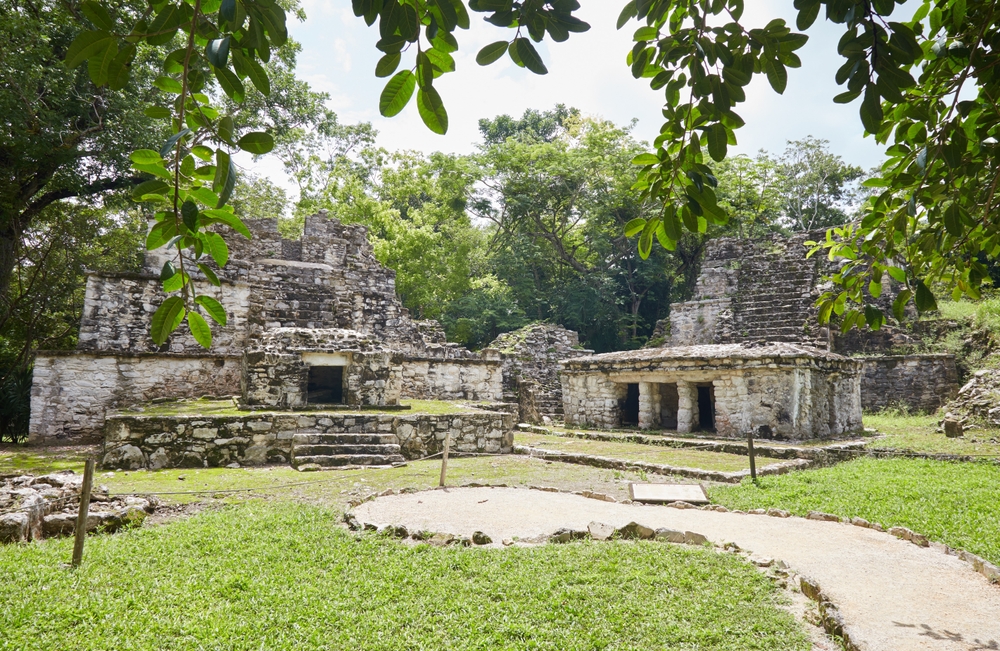
Much less well known than its neighbours Tulum or Cobá, the archaeological site of Muyil (also known as Chunyaxché) is a hidden gem on the Yucatán Peninsula, nestling within the Sian Ka’an Biosphere Reserve, a UNESCO World Heritage Site. Located just 25 kilometres south of Tulum, this is one of the oldest sites on Mexico’s Caribbean coast, with traces of human occupation dating back to the third century BC. Its strategic position on the edge of the Muyil lagoon made it a crucial crossing point on the maritime trade routes of theMayan empire.
The site’s main monument is El Castillo de Muyil, a 17-metre-high pyramid dating from the 8th century, whose summit once boasted a tower-temple unique in Mayan architecture. The frescoes and stucco still partially visible inside bear witness to the artistic talent of the ancient Maya. The site as a whole is remarkably well preserved despite the centuries, with several structures still covered in vegetation, giving them a mysterious and romantic appearance. The striking contrast between the grey stone structures and the lush tropical vegetation creates a very special atmosphere.
Beyond the ruins, Muyil offers an exceptional natural experience: from the site, a wooden path leads through the mangroves to the Muyil lagoon, where boats offer boat trips to the Sian Ka’an reserve. This aquatic journey through natural canals carved out by the Mayans, amid pink flamingos, crocodiles and extraordinary birdlife, is one of the most beautiful natural experiences in Mexico. Muyil offers a dual experience: archaeological and natural, far from the crowds that invade the region’s most famous sites.
8. Admire the Chac masks on the Ruta Puuc, the route to the forgotten cities of Yucatán
To the south of Mérida, in the gentle hills of the Yucatán, Ruta Puuc is an exceptional archaeological circuit that brings together several leading Mayan cities, including Kabah, Sayil, Xlapak and Labná. Less frequented than Chichen Itza or Uxmal – the ideal entry point for this itinerary – Ruta Puuc offers an authentic, immersive experience ofclassic Mayan architecture in the Puuc style, characterised by stone mosaic façades, round columns and geometric friezes of remarkable precision and elegance. These cities all flourished between 750 and 950 AD, before being abandoned when the Classic Maya civilisation collapsed.
The centrepiece of the Ruta Puuc is the Kabah Codz Poop, also known as the Palace of Masks, whose façade is entirely covered with more than 250 masks of the rain god Chaac, stacked one on top of the other from the ground to the top of the building. Each mask, with its characteristic long hooked nose, represents a stone prayer to obtain the rain that is essential for survival in this semi-arid region. It is one of the most spectacular and haunting examples of Mayan architecture. At Kabah, a lone triumphal arch marks the entrance to a sacbé that once led directly to Uxmal, 18 kilometres away.
At Sayil, the great three-storey Palace with its 90 rooms illustrates the scale of the Puuc cities, while at Labná, the Arch of Labná is considered one of the finest examples of Mayan ornamental architecture. These sites are generally little frequented and offer an intimate experience with the ruins, away from the crowds of the more famous sites. The Puuc Route is best explored in a day’s drive from Mérida in a hire car, combining a visit to Uxmal with several sites along the way. A word of advice: leave early in the morning to take advantage of the cooler temperatures and avoid the afternoon heat.
9. Teotihuacan, the city of the gods, at the gates of Mexico City
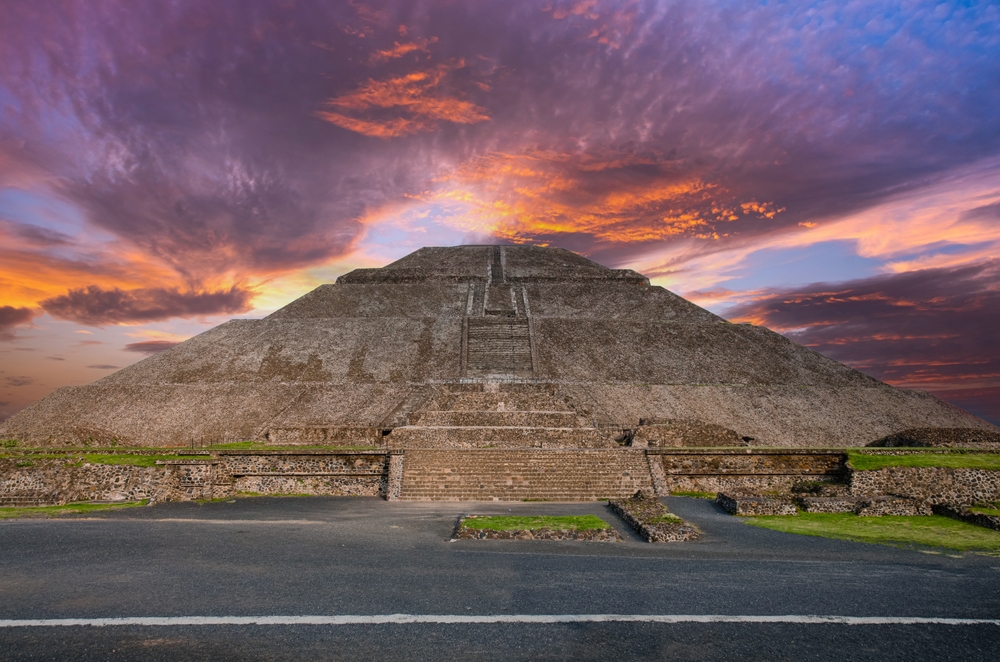
Just 50 kilometres north-east of the Mexican capital, the archaeological site of Teotihuacan is one of the most important and mysterious in Mesoamerica. Although its direct link with the Maya civilisation is open to debate – it was a multi-ethnic metropolis influenced by many cultures, including the Maya – Teotihuacan exerted a considerable influence on the entire Mesoamerican world, including the great classical Maya cities such as Copán and Tikal. At its peak, between the 4th and 6th centuries AD, the city had between 150,000 and 200,000 inhabitants, making it one of the largest metropolises in the ancient world.
The Pyramid of the Sun, the third largest pyramid in the world at 65 metres high and with a base 225 metres on each side, is the site’s star monument. Climbing its 248 steps is a physically demanding but extraordinarily rewarding experience: from the top, the view extends over the whole city and the surrounding landscape. The slightly smaller Pyramid of the Moon closes off the northern end of theAllée des Morts, the 2km-long main avenue that structured the entire city. The Temple of the Feathered Serpent(Quetzalcóatl), with its facades adorned with sculpted snake heads and alternating deities, completes this unique architectural pantheon.
Download the audio-guided tour to discover Mexico City on foot and on your own
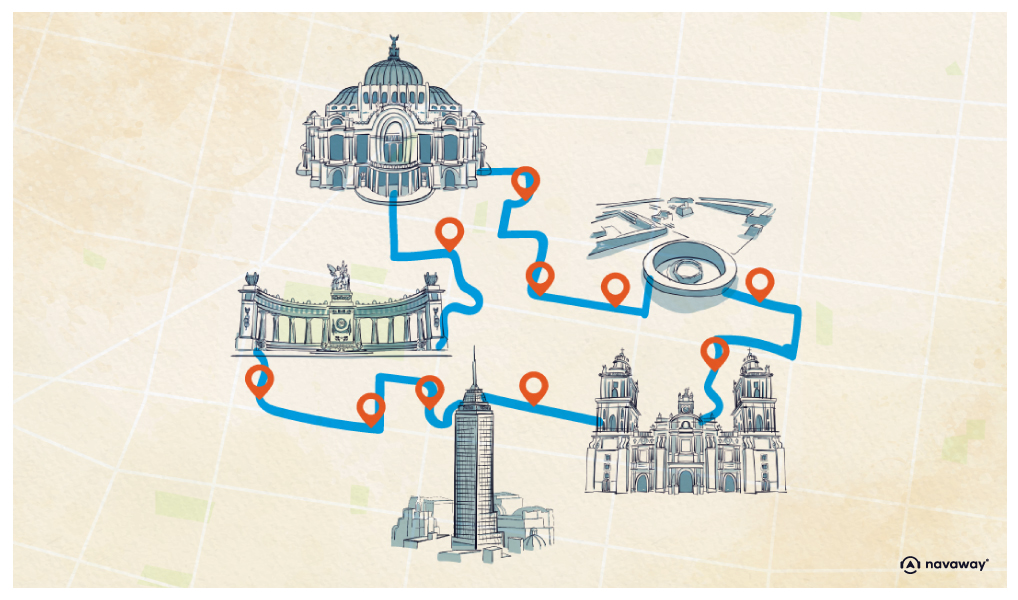
If you’re visiting Teotihuacan from Mexico City, why not take advantage of your stay in the capital to explore the historic heart of the city on the Navaway audio tour “In the footsteps of the Aztecs”? This 24-stop walking tour with commentary takes you through Mexico City’s historic districts, from the Zócalo and the Metropolitan Cathedral to the Templo Mayor, the frescoes of Diego Rivera and the colonial palaces. Thanks to interactive navigation and 24 entertaining audio guides, you can explore the Mexican capital on your own, at your own pace, guided by fascinating tales of Aztec and colonial history. An excellent complement to a visit to the surrounding archaeological sites, download before you leave to Visit Mexico City like a local.
The best time to visit Teotihuacan is when it opens at 9am, to take advantage of the cool morning air before the sun hits hard. Make sure you bring comfortable shoes, plenty of water, sun cream and a hat: the site is completely open and the distances between the monuments are considerable. Allow at least 3 to 4 hours for a complete visit. The on-site museum, the Museo de la Cultura Teotihuacana, is also well worth a visit to gain a better understanding of the history and culture of this still largely mysterious civilisation.
10. Ek-Balam, the mysterious city of the black jaguar
Just 30 kilometres north of Valladolid, the colonial city in the heart of Yucatán, the archaeological site of Ek-Balam is one of the most precious discoveries for lovers of Mayan sites in Mexico. Its name means “Black Jaguar” in Mayan, and its history is closely linked to a legendary king of the same name who is said to have founded the city in the fourth century AD. The city reached its apogee between the 8th and 10th centuries, controlling an important trading network in a region rich in natural resources. Ek-Balam is less crowded than its neighbouring sites, offering an authentic and intimate experience of the Mayan ruins.
The centrepiece of the site is theAcropolis, a 32-metre-high pyramid whose western façade houses one of the best-preserved Mayan sculptures in the world: the gaping mouth of a land monster serving as the entrance to a royal tomb, surrounded by exceptionally fine stucco figures representing Mayan angels, warriors and divinities. This sculpted façade(portada), protected for centuries under a layer of stucco, was rediscovered during excavations in the 1990s in an extraordinary state of preservation. The site is surrounded by a double stone wall, a rare feature in Mayan cities, which testifies to its strategic importance.
A visit to Ek-Balam is rounded off wonderfully by a swim in the adjoining private cenote, a shallow cenote with crystal-clear waters that provides a well-deserved break after climbing the pyramid. The Valladolid region offers other nearby nuggets, including the famous Ik Kil cenote, halfway between Valladolid and Chichen Itza, and the colonial city of Valladolid itself, with its colourful streets and authentic atmosphere. Combine Ek-Balam with Chichen Itza and Valladolid, and you have an exceptional day out at the heart of Yucatán’s Mayan and colonial heritage. If you’re passing through Mexico City before or after this tour, take the Navaway audioguide tour of the capital for a complete introduction to Mexican culture, from the Aztecs to the present day.
In conclusion, the 10 emblematic sites of the Maya Empire in Mexico presented in this article form an exceptional itinerary that spans several millennia of history and human genius. From the cosmic grandeur of Chichen Itza to the still-buried secrets of Calakmul, from the lakeside majesty of Muyil to the sculptural finesse of Ek-Balam, each site offers a unique gateway to Mayan civilisation and its priceless heritage. To help you prepare for your trip, take a look at our guide to the most beautiful places to visit in Mexico, and if your itinerary takes in the capital, explore Mexico City in depth with the Navaway audio tour, which offers 24 guided stages to visit Mexico City on your own and rediscover the pre-Hispanic roots of this fascinating country. Enjoy your trip to the land of the Mayas!
FAQ – Frequently asked questions about Mayan sites in Mexico
When is the best time to visit Mayan sites in Mexico?
The best time to visit Mayan sites in Mexico is from November to April, during the dry season. Temperatures are pleasant (25 to 30°C), rainfall rare and vegetation less dense. Avoid the rainy season from May to October, especially in July and August, when torrential rains can make some paths impassable. For sites on the Yucatán peninsula (Chichen Itza, Tulum, Uxmal, Cobá, Ek-Balam), the heat is bearable from November to March. For Palenque in Chiapas, expect higher humidity all year round.
Do I need a guide to visit Mayan archaeological sites?
A guide is not compulsory, but highly recommended, especially for complex sites such as Chichen Itza, Palenque and Calakmul, whose rich history and symbolism merit in-depth explanations. Certified guides offer their services at the entrance to most of the major sites. Audioguides are available at some sites. For visiting Mexico City and discovering its Aztec treasures, the Navaway audioguide tour is an excellent independent and fun alternative to a traditional guide.
How long does it take to visit the 10 Mayan sites in Mexico?
To visit the 10 emblematic sites of the Mayan empire in Mexico in the best possible conditions, you should allow at least 2 to 3 weeks. The Yucatán sites (Chichen Itza, Uxmal, Tulum, Cobá, Ek-Balam, Muyil, Ruta Puuc) can be grouped together in 7 to 10 days, with Mérida or Valladolid as bases. Calakmul requires 2 or 3 specific days, and Palenque at least 2 days in Chiapas. Teotihuacan can be visited in a day from Mexico City. Add several days in Mexico City to explore the capital with the Navaway tour.
Is it still possible to climb the Mayan pyramids in Mexico?
Most of the Mayan pyramids in Mexico are now off-limits to climbers for conservation and safety reasons. This applies toEl Castillo in Chichen Itza (banned since 2006), the Pyramid of the Soothsayer in Uxmal and the Temple of the Inscriptions in Palenque. On the other hand, the Nohoch Mul pyramid in Cobá reopened to climbers at the end of 2025 with a new wooden access system. At Teotihuacan, it is still possible to climb the Pyramid of the Sun and Moon. The situation may change, so it is advisable to check access conditions before your visit.
Which Mayan sites in Mexico are UNESCO World Heritage Sites?
Several of the 10 sites presented in this article are listed as UNESCO World Heritage Sites: Chichen Itza (1988), Palenque (1987), Uxmal (1996), Calakmul (2002 for natural heritage, 2014 for cultural heritage) and Teotihuacan (1987). This international recognition testifies to the exceptional universal value of these sites, which are the most eloquent testimony to the greatness of Mexico’s pre-Hispanic civilisations. To find out more about Mexico’s heritage, take a look at our complete selection of the most beautiful places to visit in Mexico.
200 audioguided tours for cities all around the world
Download